Russia's Arctic shadow war: How Moscow’s most-probed front fuels its Ukraine invasion
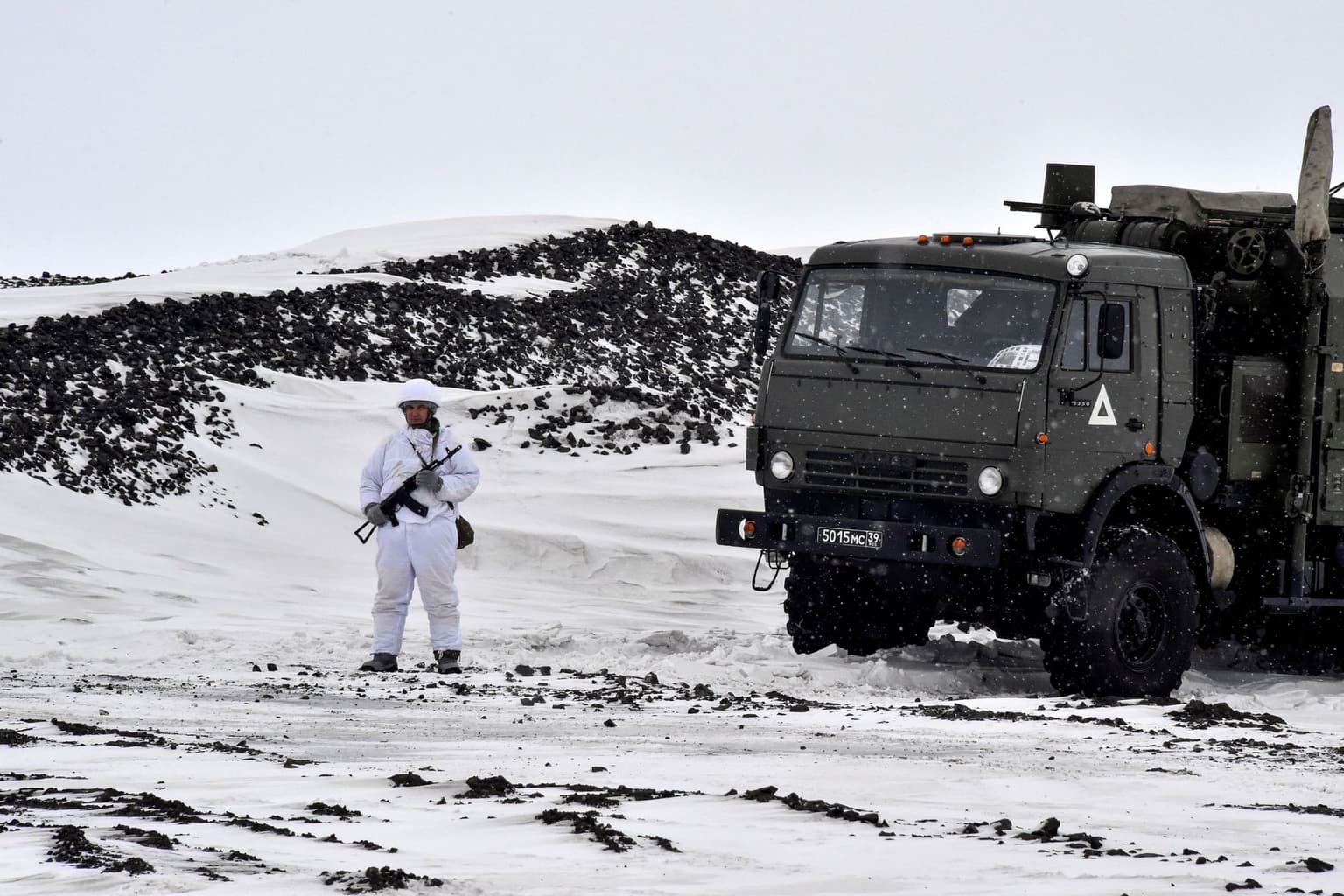
A Russian serviceman stands guard by a military truck on the island of Alexandra Land, part of the Franz Josef Land archipelago, in Russia, on May 17, 2021. (Maxime Popov / AFP via Getty Images)
 on Google
Norway’s Svalbard fiber optic cables — a pair carrying vital Arctic satellite data from SvalSat, the world’s largest commercial ground station — thread through waters dangerously close to Russia’s reach.
The Kremlin's Nagurskoye air base on Franz Josef Land is just 260 kilometers (161 miles) from Svalbard’s shores.
These cables transmit satellite signals and sensitive data that European governments, research institutions, and militaries rely on, including infrastructure bolstering Ukraine’s defense via allied satellite networks.
As U.S. seizures of Russian shadow fleet vessels in the Caribbean and North Atlantic grab headlines, experts warn that Moscow’s ability to sabotage cables and jam navigation systems in the Arctic is growing, threatening European stability.
Russian-traced incidents
According to recent maritime data, over 20 subsea cables in the Baltic and Arctic regions were damaged between late 2024 and early 2026 — a sharp increase in incidents compared to previous years.
The latest incident took place on New Year's Eve when Finnish police detained a vessel sailing from Russia, suspected of damaging an undersea telecom cable running from Helsinki to Estonia.
On Jan. 12, Finland released the vessel and all but one crew member (with others reportedly from Russia, Georgia, Azerbaijan and Kazakhstan) but didn't label it Russian sabotage, leaving attribution unspoken despite the red flags.

"The way in which Moscow has manifested these incidents is to try to ensure that it was just an accident or make it very difficult to attribute even if it seems like it was intentional," Benjamin L. Schmitt, senior fellow at the University of Pennsylvania's Kleinman Center for Energy Policy and Perry World House, told the Kyiv Independent.
"That's why you've seen in the growing number of subsea cable cuts, whether they be telecommunications cables, electricity interconnectors, or gas pipelines in the Baltic Sea, there still hasn't been an official attribution in any of these cases to a state that was behind these incidents," Schmitt said.
Russia also often pairs these sabotage acts with disinformation campaigns, deflecting blame in multiple directions to bewilder the public, he added.
"I think that Russia… tries to make the narrative much more complex than what it is, which is in many of these cases pretty clear — you have Russian-connected (ships) with Russian-connected crews that are doing something that is outside of the norm of normal commercial maritime operations to sabotage subsea infrastructure."
State operators
Much of the public conversation still treats these incidents as the work of careless crews or rogue commercial actors, even though the pattern and ship links point otherwise.
But Sergey Sukhankin, a Russia expert and senior fellow with the Jamestown Foundation, explains that unlike in Ukraine or Syria, Russia does not rely on what he describes as "shadowy mercenaries" in these types of operations.

"It is Russia’s regular security apparatus — the Defense Ministry and the (Russian Federal Security Service) FSB — that is driving subsea sabotage and electronic warfare in the Arctic," Sukhankin told the Kyiv Independent.
Sukhankin warns that Russia may mask defense or intelligence personnel as scientists or civilian specialists if it sees an opportunity, particularly against European NATO members rather than the United States.
Washington has shown now in its global pursuit of Russia’s shadow fleet that it is prepared to respond forcefully, Sukhankin argues, while European governments have often struggled to find legal or political grounds for decisive action.
This, in turn, offers more clues as to how and where Moscow may choose to provoke in the Arctic.
Three theatres
To understand this critical front — and why it matters to Ukraine — one should think of the Arctic as three overlapping theaters:
The Russian Arctic, is a resource‑rich region where Moscow turns to Chinese and BRICS partners for capital and technology, using Arctic oil, gas, and the Northern Sea Route to sustain its war economy. Sukhankin notes that Moscow is actively recruiting non-Western partners to bypass the Arctic Council, the primary international body (consisting of the eight nations with Arctic territory) that has sidelined Russia since the full-scale invasion of Ukraine.

However, within the BRICS, China is the only member with the capital and strategic ambition in the Arctic which Russia welcomes economically but eyes warily as a military partner.
The North American Arctic, is a vulnerable flank where the U.S. and Canada struggle to modernize defenses and match Russian and Chinese dual‑use infrastructure and shipping investments. North Americans “understand the gravity of threats pretty well,” Sukhankin says, and are actively planning responses.
Lastly, the European Arctic — northern territories of Denmark (including Greenland and Faroes Islands), Iceland, and Norway — is currently Russia's most-probed front.
"If there is to be escalation, it will take place in the European Arctic as the North American Arctic is quite far from Russia and hasn't experienced the same degree of hybrid threats," Gabriella Gricius, research fellow at the North American and Arctic Defense and Security Network told the Kyiv Independent.
"We are seeing increasing hybrid attacks — critical infrastructure sabotage, disinformation, operation of the shadow fleet, espionage attempts, cyber attacks — in differing areas across the European Arctic," Gricius says.

"It does not serve Russian interests to escalate (beyond hybrid attacks) in the Arctic as it sees the region as key to its national security vis-a-vis oil and gas extraction and shipping," Gricius continues.
"This is exactly why hybrid attacks are a good strategy for Russia right now as they allow it to cause trouble in the Nordics without taking the blame."
Indigenous cost
Russia’s Arctic strategy carries another darker layer — environmental lawlessness. Moscow suspended Arctic Council funding in 2024 and fully withdrew from the Barents Euro-Arctic Council in 2023 after activities stalled post-Ukraine invasion, paralyzing joint environmental monitoring, oil spill response, and indigenous protections across 40% of Arctic coastline under Russian control.
Sukhankin warns that Moscow treats the ecosystem as a bargaining chip, flouting nuclear safety and indigenous rights to rush resource extraction or to support its war effort.
“We have facts showing Russia deliberately decimating its indigenous peoples... even ethnic Russians are not that valuable to Russians, but ethnically non-Russian peoples are even less valuable,” Sukhankin says. Russian independent media outlet The New Tab reported in 2025 that despite legal deferrals, more Arctic indigenous men have gone to fight in Ukraine than the Russian average.
Experts note that while Arctic security focus intensifies — with U.S. officials increasingly naming China, and its alignment with Russia, as key threats — the administration's fixation on Greenland overlooks graver risks like Sino-Russian icebreaker exercises in the North Pacific challenging U.S. dominance.
read also
 Olena Goncharova
 Martin Fornusek
 Tim Zadorozhnyy