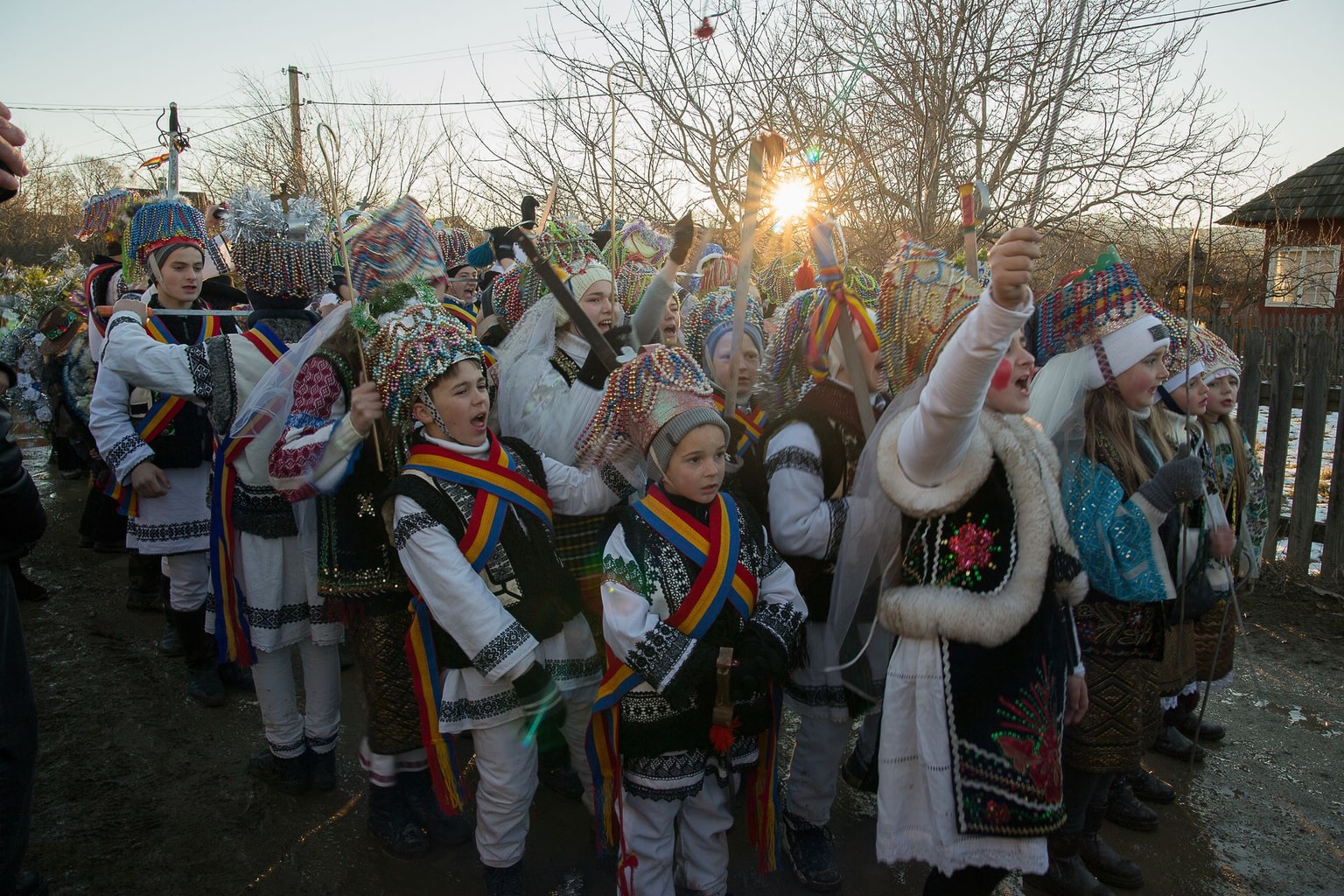
Children take part in Malanka celebrations in Krasnoilsk, Chernivtsi Oblast, Ukraine, on Jan. 14, 2022. (Zuzana Gogova / Getty Images)

Each winter in southwestern Ukraine, villages are transformed by a riot of color, noise, and a kind of organized chaos. Costumed performers that are sometimes human, sometimes animal, sometimes entirely otherworldly wander from house to house, dancing, singing, playing instruments, cracking whips, and offering shots of alcoholic drinks.
Their mission is simple but profound: to sweep away misfortune, summon laughter, and ensure abundance in the year ahead.
This lively tradition is known as Malanka, an ancient pre-Christian ritual marking the eve of the Old New Year under the old Julian calendar. Once observed from Jan. 13–14, Malanka now begins on Dec. 31 following Ukraine's recent calendar reforms, which aligned religious and folk holidays with the new Julian calendar.
"If we speak about its ritual meaning, Malanka is a way to prevent evil in the coming year. According to tradition, figures representing death, devils, or evil spirits enter a house during Malanka, they will not return again (for the rest of the year)," Tsiia Sviderska, a popularizer of folk traditions in Chernivtsi Oblast, told the Kyiv Independent.
"There is an element of trickery and deception of evil in this. That is why Malanka must be loud — noise, music, and shouting perform a protective function, driving away everything impure."
The tradition has survived everything from Soviet censorship to Covid-19 pandemic lockdowns, with locals vowing to celebrate no matter the cost. In Krasnoilsk, in Chernivtsi Oblast, residents explained to Suspilne media in 2022 that it was more than just a celebration — it was a tradition "in their blood."


Malanka includes a lively cast of characters, the prominence of their roles shifting from village to village. Traditionally, men have donned both male and female costumes, including Malanka herself — a woman dressed in an embroidered shirt, wrap skirt, headscarf, and red sash — prancing alongside Vasyl, her male counterpart in a traditional highlander Hutsul-style outfit. In some villages, children and teenagers are welcomed into the performance, while adult women rarely take on costumed roles.
Other figures add to the humor, mischief, and theatrical flair: the Roma, clad in tattered rags and soot-smudged faces, cracks his whip to drive the animals; the mischievous Goat, in a sheepskin coat with a stuffed head perched like a hat, attempts to disrupt the proceedings; and the troupe’s Jewish merchant carries a bag of coins to collect the night's bounty.
Additional characters might include an old man and woman, a soldier, a doctor, a bear, or even the devil. In more contemporary-oriented celebrations, performers sometimes don masks of politicians or celebrities, turning the celebration into a rejection of authority and an embrace of communal revelry and laughter.
The costumes are far from store-bought or improvised. In many villages, preparations begin weeks in advance, with performers painstakingly crafting each outfit by hand, stitching, painting, decorating, and shaping every detail to bring their characters vividly to life.
With a cheerful knock and a hearty shout, the revelers visit locals' houses, launching into carols, banter, and spirited antics. Their performances are meant to drive any evil out of people’s houses that has accumulated over the past year. Laughter fills the home, and people reward the performers for their visit before they spill back into the streets, carrying the joy and chaos of Malanka through the rest of the village.
Some village celebrations, like those in Krasnoilsk, draw large numbers of tourists each year. Locals set up "checkpoints" along the road to "welcome" the tourists, with the villagers minding the checkpoints dressed up as border patrol officers or members of Ukraine’s Security Service (SBU), demanding a small fee to pass. The proceeds collected at the checkpoints typically go toward funding a large celebration for the whole village afterward.
Not to be confused with Vertep — Ukraine’s Christmas tradition — Malanka is a New Year's folk celebration featuring costumed processions, skits, and communal satire rooted in seasonal renewal, whereas Vertep storytelling centers more on the Nativity and related biblical themes with moral and cultural motifs.
Fortune-telling also plays an important role for some people during Malanka. As a 1945 article in the Ukrainian magazine Holos recounts, young girls eager to glimpse their futures retrieve a cherry branch previously cut and set in water on Saint Katerina’s Day on Nov. 25. Blossoms promise love and happiness; a withered branch foreshadows future disappointment.

Other methods are even more theatrical: a girl might shake spoons on the threshold of her home, listening for distant dog barks to divine the direction of her future spouse.
Even the head of the household turns to more mystical methods for guidance. On the first night of Malanka, the eldest man can place twelve onion skins along the windowsill — one for each month — sprinkling salt atop them. By morning, the moisture in the salt predicts rain or sunshine for each month.
The following morning, also known as St. Vasyl's Day, sowers — traditionally male — carry grain seeds with them, visiting friends’ and family members’ homes, scattering the grain toward the religious icons while reciting blessings for health, prosperity, and abundance:
I sow, I scatter, I plant,
I greet you with the New Year,
For happiness, for health, and for the New Year,
May it grow as well as last year,
Rye, wheat, and all kinds of grain,
Hemp up to the ceiling for a great harvest.
Be healthy, with the New Year and with Vasyl!
God grant it!
This period is also a time of purifying one’s home and welcoming positive emotions for the New Year. Homes are swept "in two halves," according to the article in Holos. Sweepings from the doorway are discarded to carry away lingering negativity, while those from the inner house, leading toward the sacred icon corner found in traditional Ukrainian homes, are saved. On New Year’s morning, these remnants are carried outside and set aflame, ensuring that all harm from the past year burns away.
"For me, Malanka is important as a tradition because it is a space of collective psychotherapy. Essentially, we live through and rethink everything that happened to us over the year and bring it into a public game on the night of transition into the New Year," Sviderska said.
"Malanka always speaks about the 'here and now' and gives people an opportunity to release tension, fears, and experiences through play."