Trump's NATO doubts are a 'gift' for the Kremlin
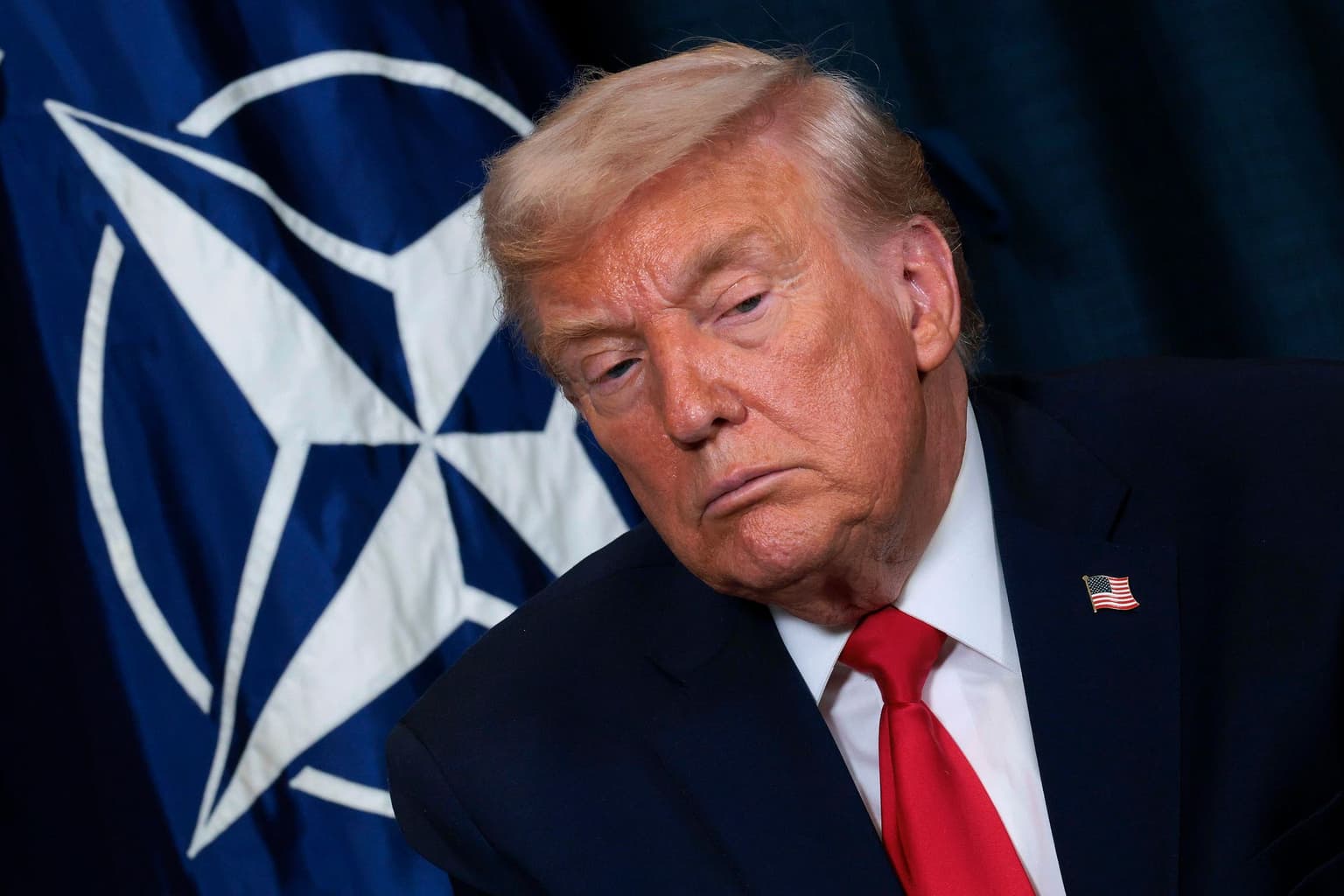
U.S. President Donald Trump meets with NATO Secretary General Mark Rutte in Davos, Switzerland, on Jan. 21, 2026. (Chip Somodevilla / Getty Images)
 on Google
Failing to strong-arm NATO member states into joining his country's war against Iran, U.S. President Donald Trump has once again questioned the need for the alliance's existence.
"We would have always been there for them, but now, based on their actions, I guess we don't have to be, do we?" Trump said at an investment forum in Miami last week.
His chief diplomat, Marco Rubio, doubled down on March 30, saying Washington "will have to reexamine" its relationship with NATO countries after the war.
The words seem to articulate most clearly what many partners feared since Trump's re-election — that Washington is laying the groundwork to renege on its role as the guarantor of Europe's security.
"Article 5 is now in very great danger," Francois Heisbourg, a security expert at the Paris-based Foundation for Strategic Research, told the Kyiv Independent. "It's really bad."
With Russia continuing its war against Ukraine and fears about an open clash with NATO growing, the timing could not be worse.

"President Trump's comments are deeply disappointing," Michael McFaul, the former U.S. ambassador to Russia, told the Kyiv Independent.
"They are yet another gift to (Russian President Vladimir) Putin."
Transactional NATO
The U.S.-Israeli war with Iran, which recently entered its fifth week, has driven worldwide inflation and energy prices.
An end to hostilities is nowhere in sight, as the Iranian regime blocks the Strait of Hormuz and continues its strikes across the Middle East, allegedly receiving intelligence support from Russia.
If Trump loses, "he will be looking for revenge against those who, in his eyes, will have caused his defeat," Heisbourg says.
Trump has urged European allies — who were not consulted about the operation beforehand and are not bound to join offensive wars under NATO obligations — to provide material assistance, including warships, to reopen the strait.
After more than a year of Trump's mockery and a deterioration of relations over Greenland and Ukraine, Europe has been reluctant to unconditionally join the U.S.-Israeli campaign.
Some even closed their airspace to U.S. aircraft involved in the operation.
European leaders stressed that the war in Iran is "not Europe's war." In response, Rubio drew a parallel with Ukraine.
"Well, Ukraine is not America's war, and yet we've contributed more to that fight than any other country in the world," Rubio said on March 27.

Jamie Shea, a security expert and a retired NATO official, says that the "Iran war has shown yet again that Trump and Marco Rubio see NATO purely in transactional terms."
"NATO has never been about the European allies automatically supporting every U.S. foreign policy adventure, but this is what it is becoming under Trump," he told the Kyiv Independent.
Trump's revenge, Heisbourg warns, could hit Ukraine first, for example, by diverting weapons that European NATO allies purchased for Kyiv.
While the Trump administration ceased nearly all new aid allocations to Ukraine, it still provides crucial intelligence support and sells hard-to-replace equipment, such as Patriot interceptors.
"Trump is escalating an old pattern that other NATO leaders should be familiar with by now," Jörn Fleck, senior director with the Europe Center at the Atlantic Council, told the Kyiv Independent.
According to the expert, "European leaders would be well advised to avoid getting drawn in by provocations or insinuations over NATO and Article 5."
Message to Russia
Trump's relationship with NATO has long been a strained one.
On his campaign trail in 2024, he said he would let Russia do "whatever the hell they want" to NATO allies who did not meet their defense spending commitments.
The alliance has heeded Trump's call. All NATO members hit the 2% of GDP defense spending goal last year, and the allies agreed to raise that benchmark to 5%.
Despite these efforts, transatlantic relations took another dive after Trump aggressively pushed for the annexation of Greenland, a territory of a NATO ally.
The U.S. is now reportedly floating a "pay to play" model under which allies that do not meet the 5% benchmark would have restricted voting rights. Trump is also reportedly again considering withdrawing U.S. troops from Germany.
The Kyiv Independent has reached out to the White House for comment on the reports.
While frustration with Trump's attitude grows, McFaul argues that the situation can change again quickly.
"Trump says many things that lack staying power. He quickly changes his mind," the former ambassador said.
"And Europeans should remember that Trump is deeply unpopular in the United States right now and will not be president forever."
But Shea warns that even though Trump's "changes his messages frequently, they send the wrong signals to Russia and encourage the Kremlin in its attempts to undermine and challenge NATO."
read also
Note from the author:
Hi, this is Martin Fornusek.
I hope you enjoyed this article. In our team, we believe fact-based and truthful reporting should be available to all — that's why we don't use any paywall.
If you'd like to help us provide you with more in-depth coverage of Ukraine's struggle against Russian aggression, global politics, and other topics, please consider joining the Kyiv Independent community.