In Germany, Ukrainian veteran's role in Nord Stream attack tests wartime law
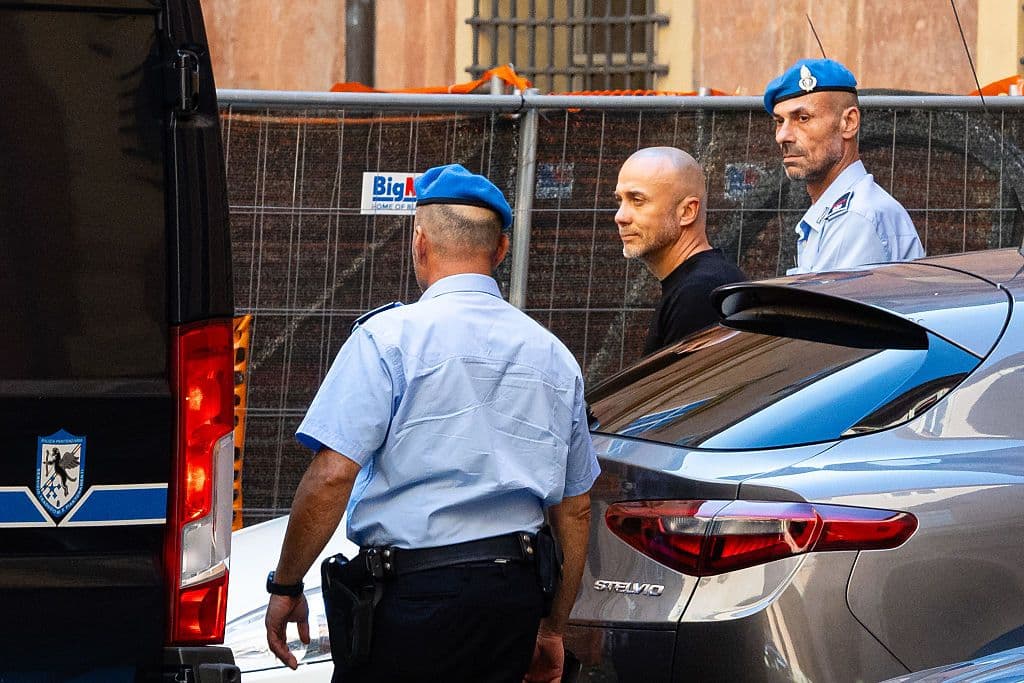
Serhii Kuznietsov, (C) is loaded onto a Prison Police van to be taken back to jail, after appearing before the Bologna Court of Appeal, which confirmed his arrest on Aug. 22, 2025, in Bologna, Italy. (Massimiliano Donati/Getty Images)
 on Google
A former Ukrainian officer, Serhii Kuznietsov, spends his days in near-total isolation at Hamburg's detention center. He is accused by Germany of destroying Russia's Nord Stream gas pipelines months after the start of the all-out war.
Arrested in August while on vacation with his family in Italy due to a European arrest warrant issued by Berlin, Kuznietsov was extradited to Germany in late November.
According to the prosecution, Kuznietsov coordinated a group of six who allegedly planted explosives on the Nord Stream pipelines in the fall of 2022, triggering a series of underwater explosions that ruptured three of the four pipelines running from Russia to Germany.
Kuznietsov's contact with his Ukrainian lawyers after his extradition to Germany was limited to a few brief meetings, also attended by an interpreter who was translating the conversation meant to be private to two local security service officers present at all times.
Ombudsman Dmytro Lubinets and Ukrainian lawyers have raised concerns over the conditions Kuznietsov is facing: restrictions on mobile calls, neglect of his vegan dietary needs, limited outdoor exercise, and lack of winter footwear.
"Such conditions could potentially be seen as a form of torture, which is unacceptable according to international human rights standards," Lubinets said.
The Nord Stream project was controversial from the very start. Backed by the German government, the four pipelines of Nord Stream 1 and Nord Stream 2 were set to further cement Europe's dependency on Russian gas.
The Nord Stream 2 pipelines never opened, with the project halted days before the start of the all-out war. The Nord Stream 1 pipelines, meanwhile, transported nearly 60 billion cubic metres in 2021.
Germany is the only country still investigating the explosions. Neighboring Denmark and Sweden dropped their probes in 2024 without holding anyone to account.
"I believe this is a political case, and there is no direct evidence of Serhii's involvement in these events, nor can there be," Kuznietsov's lawyer Mykola Katerynchuk told the Kyiv Independent.
"It is a big misunderstanding, which I hope will be clarified during an objective investigation and judicial review."
Evidence and legal strains
Kuznietsov's lawyers describe the current evidence against him as slim, yet the German investigators say they are still collecting more.
The investigation is set to last six months. By then, the court should receive enough material to decide whether Kuznietsov should remain in custody. The trial could start in April or May, with the first hearings expected by late summer.
German prosecution cites current evidence to be a DNA test, a photograph of a person crossing the EU border who resembled Kuznietsov but had a different name, and testimony from a driver who allegedly transported the suspect by bus.
Katerynchuk questions the origin of the photos and document copies, as well as the witness testimony. He also said that the German prosecutor requested permission to collect another DNA sample, but the court denied the request.
Katerynchuk says the defense has a limited understanding of why and where the initial DNA test was collected.
"When Serhii was brought to court, the prosecutor's office, for some reason, asked for permission to obtain DNA samples from Serhii, but the court refused. The court directly stated: if in the application for an arrest warrant and extradition you already indicated that you have DNA and it matches Serhii's DNA, then this was the basis for his detention. Why then demand DNA samples again is unclear," the lawyer said.
Kuznietsov's other lawyer, Ilya Novikov, says the German side expected him to cooperate with the investigation, which they believe could help confirm that Ukraine's leadership ordered the destruction of the Nord Stream pipeline.
Kuznietsov has consistently denied his involvement.

As media reports surfaced about Ukraine's alleged involvement in the Nord Stream explosions, Kyiv took a cautious approach, denying any role in the incident.
"We have nothing to do with this," President Volodymyr Zelensky said in 2023. "(The reports) only play into the hands of the Russian Federation."
Kuznietsov's defense has taken a different stance. While his German lawyers seek to argue that Kuznietsov's involvement remains unproven, the Ukrainian lawyers aim to defend the legitimacy of the damage to the Nord Stream pipelines, regardless of who carried it out.
A watershed moment came with Poland's decision on Ukrainian diving instructor Volodymyr Zhuravliov, another suspect in the case.

In October, a Polish court refused to extradite him to Germany. Zhuravliov, who had been detained under a European arrest warrant in Warsaw last fall, was immediately released from custody following the court's decision.
The Polish judge Dariusz Lubowski said that whoever was behind the pipeline explosions did not commit a crime if the action was taken in defense of Ukraine and targeted Russia's critical infrastructure. He called the actions "justified and fair," saying that they should be viewed in the context of Moscow's "genocidal war."
As the judge pointed out, the explosion occurred in international waters, not in Germany, and the pipeline is not a German organization. He said that Germany doesn't have the authority to prosecute anyone for the blasts, nor did it have grounds to issue a European arrest warrant.
Germany's highest criminal court countered by asserting its jurisdiction, saying the attack's result — the disabled pipelines — occurred on German territory, where they end.
In January, the court kept Kuznietsov in custody, rejecting his appeal and detailing its version of how the Nord Stream pipelines could have been blown up. It said the pipelines were "civilian assets" and did not directly support Russia's war effort against Ukraine.
The court called Nord Stream 1 "critical" to Germany's energy supply and said the blasts "affected the country's security," even if unintentionally. The apparent aim, the ruling said, was political — to halt Russian gas flows.
According to the court, the incident was highly likely initiated and directed by a foreign state.
"Assuming the sabotage was initiated and directed by Ukrainian authorities, it wouldn't be justified under international law as a lawful act by Ukraine in the international armed conflict with Russia, according to the investigation so far," the court said.
Ukrainian authorities confirmed that Kuznietsov was a Ukrainian soldier. After joining the army at the start of the full-scale war, he served in Ukraine's Special Operations Forces and left the military in 2023.
As a serving member of the Armed Forces at the time of the explosions, Kuznietsov should be covered by functional immunity, which shields military personnel from foreign prosecution for acts carried out on behalf of their state.
The German court has dismissed Kuznietsov's claim to immunity, saying it hadn't recognized the pipeline as a legitimate military target. It also ruled that the Ukrainian suspect couldn't claim combatant immunity since it doesn't apply to covert operations where soldiers can't be distinguished from civilians.
"In our opinion, this should also serve as a signal to Ukrainian state institutions that a passive stance is no longer effective," Novikov said.
He warns that Ukraine could face a verdict in the Kuznietsov case where only the German prosecutor's position is heard, as Ukraine has not made its own statement. According to him, the lawyers are defending him personally, not Ukraine or its interests.
Political implications
Fueled by Russia-friendly politicians, the Nord Stream case may become a domestic policy issue in Germany.
The leader of the far-right Alternative for Germany (AfD) party, Alice Weidel, said that if they win the elections, they will demand Kyiv pay for the damage to the Nord Stream pipelines and reimburse the funds allocated for Ukraine's aid.
"The court's verdict in the Kuznietsov case could become a key argument for German society," Novikov noted.

Ukraine's Ombudsman said he is working to gain physical access to Kuznietsov. In early February, he handed a package of documents concerning the violations of his rights to a delegation of German lawmakers during their visit to Ukraine.
"I urged them to intervene in this situation immediately," Lubinets told the Kyiv Independent.
Before being extradited to Germany, Kuznietsov wrote in a letter that he was treated like "criminal number one."
His Italian lawyer, he said, was frustrated that he "couldn't find any support from Ukraine," while Kuznietsov understands that the government "has more pressing concerns at the moment, finding ways to end the war."
"I love Ukraine very much, and I am proud to have the honor of serving as an officer in its Armed Forces," he wrote.
Kuznietsov's Ukrainian lawyers don't rule out that if convicted, Russia could leverage it to seek compensation for the Nord Stream damage, possibly tapping into the $300 billion in frozen Russian assets.
"The stakes are really high; it's not just about Serhii and his family," Novikov said. "This is not only a humanitarian issue. This case will continue to affect our relations with European countries for a long time, and it can't be treated lightly."
Note from the author:
Hello there! This is Kateryna Denisova, the author of this piece.
The Kyiv Independent doesn't have a wealthy owner or a paywall. Instead, we rely on readers like you to keep our journalism funded. If you liked this article, please consider joining our community today.
Thank you.