How Russia blackmails the desperate families of Ukrainian POWs
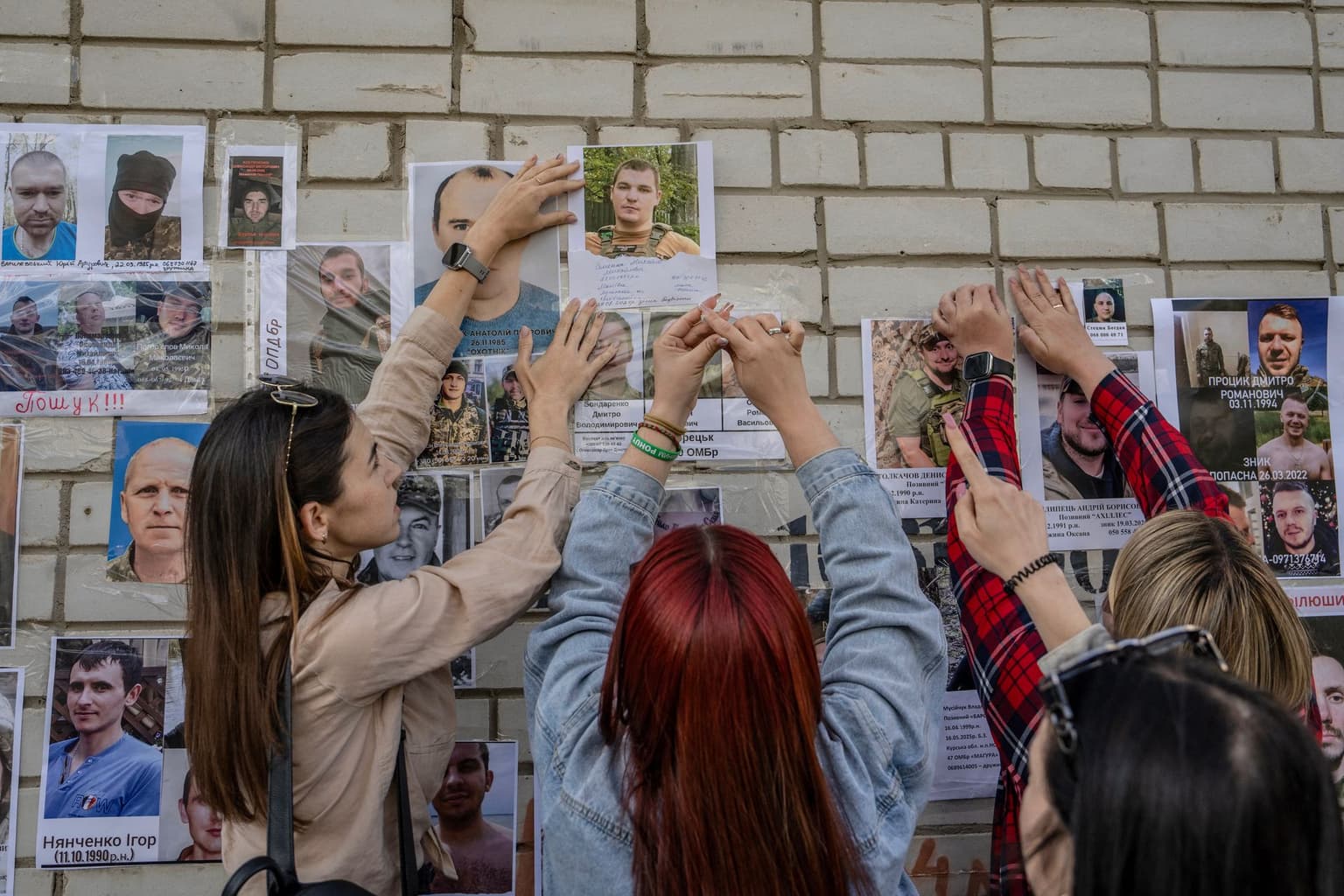
People put up portraits of missing or captured relatives and friends in Chernihiv Oblast, Ukraine, on June 10, 2025. (Andrew Kravchenko / AFP via Getty Images)
 on Google
Karina Remez knew her husband — 33-year-old Dmytro Remez — had been captured in 2022 while defending Mariupol. For years, there was no confirmed information about where he was being held. Then, in early February 2025, a man contacted her claiming he had shared a cell with Dmytro and had personal information to pass on.
The initial questions soon escalated into direct blackmail. They demanded that she blow up a communications tower and provide Ukrainian military locations.
To pressure her, they forced Dmytro to speak to her on the phone. During later calls, they spoke to her themselves with sounds of torture in the background.
"I could hear screams. But I don’t know. Maybe it wasn’t him," Remez told the Kyiv Independent.
"I asked them to show me proof that it was really him. They didn’t like that I was asking questions. They would just cut the call."
She refused to cooperate. As of Feb. 25, Dmytro has still not been released, just like nearly 7,000 other Ukrainian POWs still held in Russian captivity, with no certainty about when, or if, they will return home.
Deliberate campaign
Petro Yatsenko, spokesperson for Ukraine’s Coordination Headquarters for the Treatment of Prisoners of War, says this is a deliberate Russian strategy aimed at destabilizing Ukraine that has only escalated and become increasingly cruel during four years of full-scale war.
In 2022 and 2023, Russia aimed at turning families against the Ukrainian authorities.
"They were saying that Ukraine was doing nothing to free the prisoners, that Russia was ready to release Ukrainians but the government was inactive. They urged families to go out into the streets," Yatsenko said.
"If a family cooperates, Russia has no incentive to exchange that prisoner. Why would they lose that leverage?"
But the demands soon became much more targeted and far more violent.
"Families are pressured to burn military vehicles, provide the locations of air defense systems, carry out acts of sabotage, or, most recently, register Starlink terminals for Russian use," Yatsenko said.
After the Ukrainian government in partnership with SpaceX effectively cut off Starlink access for Russian troops earlier this month, Moscow's forces have sought ways to circumvent the measure, including threatening the families of POWs
Such was the seriousness of the threat, Ukraine's Security Service (SBU) issued a text message alert warning of the practice.
The system and its limits
Russia's coercion and blackmail often find easy targets among relatives desperate for information about missing loved ones.
When a Ukrainian soldier is captured, their personal details should be recorded by Russia. That information is then transmitted through the International Committee of the Red Cross (ICRC) to Ukraine. If it matches a missing person report, the family is notified.
But the process entirely depends on Russia providing that information.
"Under the Geneva Conventions, the country holding prisoners must register them, ensure humane treatment, and inform the other side of their status," Oksana Kokhan, spokesperson for the ICRC in Ukraine, told the Kyiv Independent.
According to the ICRC, confirmation can take three to four months. Errors in names, incomplete data, or the absence of official notification can delay the process further.
In the absence of official information, relatives often pursue other avenues, further opening them up for targeting.
How the contact begins
Since 2022, relatives of captured or missing Ukrainian soldiers have created online communities to help each other. They post names, photos, and phone numbers, hoping someone has seen their loved one.
"In 2022, Facebook groups started appearing where families left their contacts. Later, Russians began creating Telegram channels where they also published photos of prisoners, and families searched there," Yatsenko explained.

One of the most visible Russian channels presents itself as helping families pass letters to prisoners and establish contact.
Hanna Naumenko, co-founder of the Association of Azovstal Defenders’ Families, said that despite the risks, this Russian channel has become one of the most used platforms operating in this space.
"They post on Telegram that they are looking for relatives of a specific prisoner. Of course families monitor these channels. At first, it’s just about passing a letter. Writing a reply. Once contact is established, the pressure begins," Naumenko told the Kyiv Independent.
Coercion
Ukrainian officials and investigative journalists say the blackmail of POWs’ relatives is part of a coordinated campaign involving Russia’s security services, including the Federal Security Service (FSB). They work through intermediary channels to identify and target new families.
"The tasks seem simple at first, like sharing personal information or checking a location. But once a person agrees, they get drawn in. It may turn into something like carrying a bag to a building — and that bag contains explosives. There have been cases where devices were detonated remotely," Yatsenko explained.
A 2026 investigation by "Schemes," the investigative unit of Radio Free Europe/Radio Liberty, uncovered private messages from Russian Major General Roman Demurchiyev detailing his cooperation with an FSB officer in handling Ukrainian POWs.
In one exchange, the FSB officer, using a call sign "Greek," says they need "fresh prisoners" in order to exploit their families. In another, Demurchiyev asks whether detained Ukrainian soldiers are needed or should be killed.
Yatsenko said that cooperation with Russians also puts the prisoner at risk.
"If a family cooperates, Russia has no incentive to exchange that prisoner. Why would they lose that leverage?" Yatsenko said.
Karina Remez refused to cooperate and reported the contact to Ukrainian intelligence. Dmytro was later sentenced to 18 years in a strict-regime penal colony in Kemerovo, Siberia.
"We send parcels and money. Whether it reaches him, we don’t know. In his letters, he says it does," she said.