Europe's green transition is now a matter of energy security
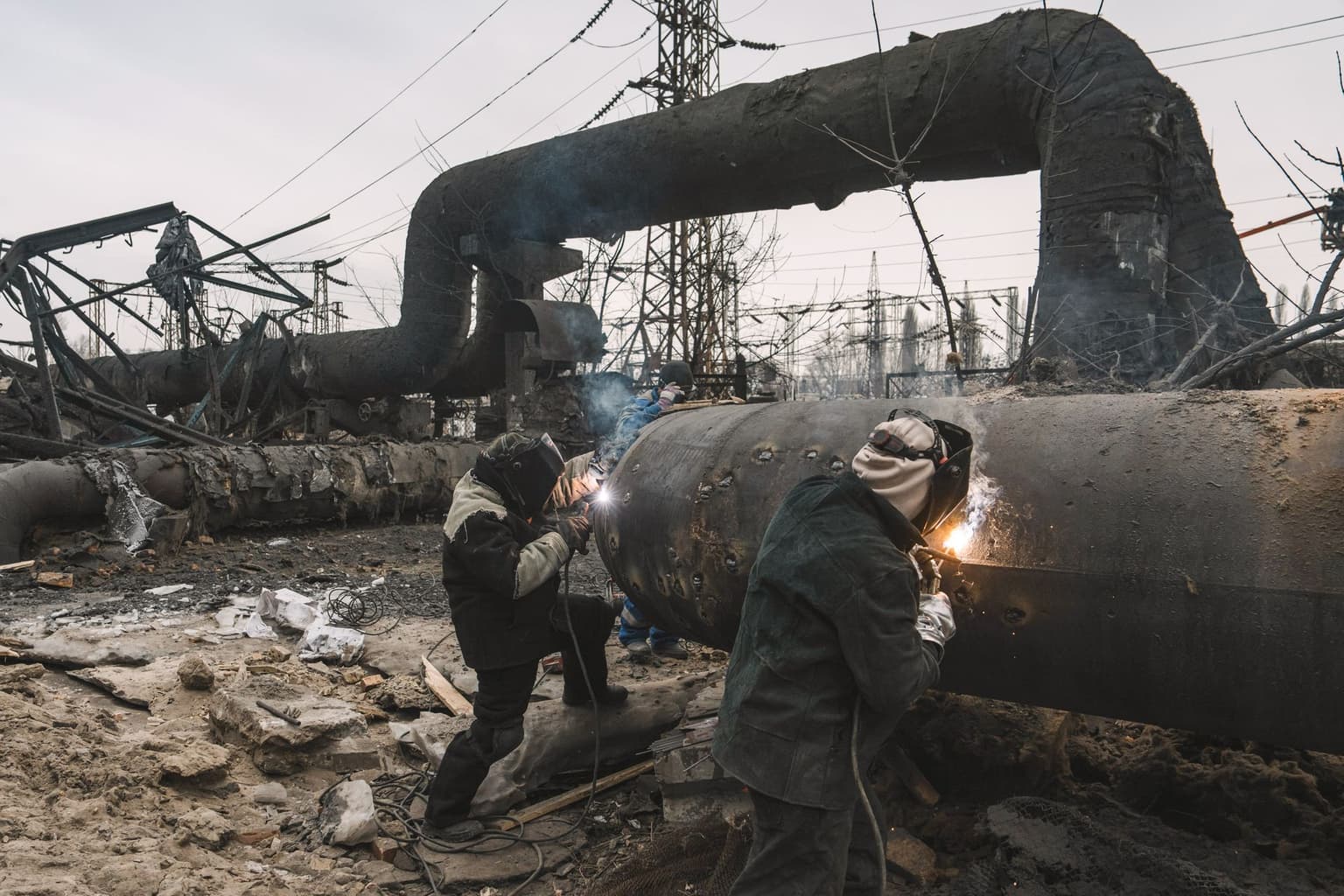
Workers cut damaged pipework near electrical power lines at the Darnytsia Thermal Power Plant following Russian air strikes in Kyiv, Ukraine, on Feb. 4, 2026. (Andrew Kravchenko / Bloomberg via Getty Images)
 on Google
Erika Tserkasina
Climate Systems and Energy Policy unit expert at Stockholm Environment Institute Tallinn Centre
Europe's approach to energy security long rested on a simple idea: scale equals safety. That assumption is now being tested in Ukraine — and increasingly proven wrong.
For decades, coal-fired power plants have been the backbone of Europe's energy system, underpinning industrial growth, modern living standards, and what was long assumed to be a secure and resilient energy supply.
Today, Ukraine's costly experience shows that to build resilience, European energy systems must embed local renewables — a shift that requires timely and strategic investment.
On Feb. 3, Russian missiles struck Ukraine's Darnytsia thermal power plant, leaving Kyiv without electricity during one of the coldest winters in recent years. According to Ukraine's Energy Minister, four years into Russia's full-scale war against Ukraine, "there is not a single power plant in Ukraine that has not been hit," illustrating how Russia's systematic attacks have turned centralized civilian energy infrastructure into a weapon of war.
Ukraine's experience exposes a vulnerability that is not unique to Ukraine but is inherent to Europe's highly centralized energy system architecture, too.
In an era of escalating geopolitical risk, Europe can no longer treat centralized energy infrastructure as a guarantee of security. Ukraine's experience, acquired at immense human and economic cost, offers both a warning and a lesson. The question is whether the EU is prepared to learn that lesson and take early action by investing now in local renewable energy installations to support its larger systems.
Working with a Ukrainian municipal water station that serves more than 400,000 people, Stockholm Environment Institute Tallinn Centre explored how critical infrastructure can become more resilient by generating and managing its own clean, reliable energy — even when the central grid is under attack.
Our analysis of different renewable energy generation options showed that solar and wind systems paired with battery storage can provide reliable and affordable power for municipalities that can no longer depend solely on the centralized electricity grid.
The study showed that an area slightly larger than a football pitch can accommodate a battery-equipped wind energy system that generates 58.5 GWh annually — an amount of electricity comparable to the annual consumption of about 17,000 households.
In practice, this means installing wind turbines in the direct vicinity of the water station — either at ground level or on suitable structures.
The system's total lifetime cost is estimated at 46.2 million euros ($54.8 million), including 30.2 million euros ($35.9 million) in upfront investment. Spread over its 25-year lifetime, this translates into a levelized cost of electricity of 0.131 euros ($0,16) per kWh. While this figure does not include taxes or network charges, it remains below recent EU average household electricity prices of around 0.19 euros ($0,23) per kWh.

Across the EU, decentralized renewables and energy communities have long been deployed for climate mitigation, affordability, and citizen participation. Ukraine's experience adds another dimension: these systems are also instruments of security and resilience.
Installing renewables at critical infrastructure sites, strengthening municipal capacity to plan, generate, and manage local green energy systems, and enabling excess electricity to flow back into the grid now form part of Europe's security architecture as well as its climate action.
Needless to say, 46.2 million euros ($58.4 million) is a significant amount for a municipality in Ukraine — or anywhere in Europe.
This is where international financial institutions come into play. Numerous bodies, including but not limited to the European Bank for Reconstruction and Development, the European Investment Bank, the Nordic Green Bank, and the World Bank, provide repayable and non-repayable financial assistance, often through programs specifically targeting municipalities, to support the resilience and decarbonization of local energy systems.
As Europe's priorities shift towards security investments to build resilience amid the climate crisis, EU member states and candidate countries like Ukraine should see investment in local renewable energy systems as a practical response to today's overlapping challenges.
Safeguarding essential infrastructure and advancing decarbonization, such systems address security and climate objectives simultaneously.
Ukraine's costly lesson is clear: scale alone does not guarantee safety. Energy systems built around centralized assets are vulnerable when targeted. Resilience depends on dispersing risk through decentralized generation, hybrid renewable configurations, and storage that can sustain essential services during disruption.
Crucially, sustainability and security need not be competing agendas. Europe now has the opportunity to align its climate investments with a new security reality, building an energy system designed not only to decarbonize, but to endure.
Editor's note: The opinions expressed in the op-ed section are those of the authors and do not purport to reflect the views of the Kyiv Independent.
read also
 Martin Fornusek
 Alessandra Hay
 Dominic Culverwell