Editorial: What happens when oligarchs own media
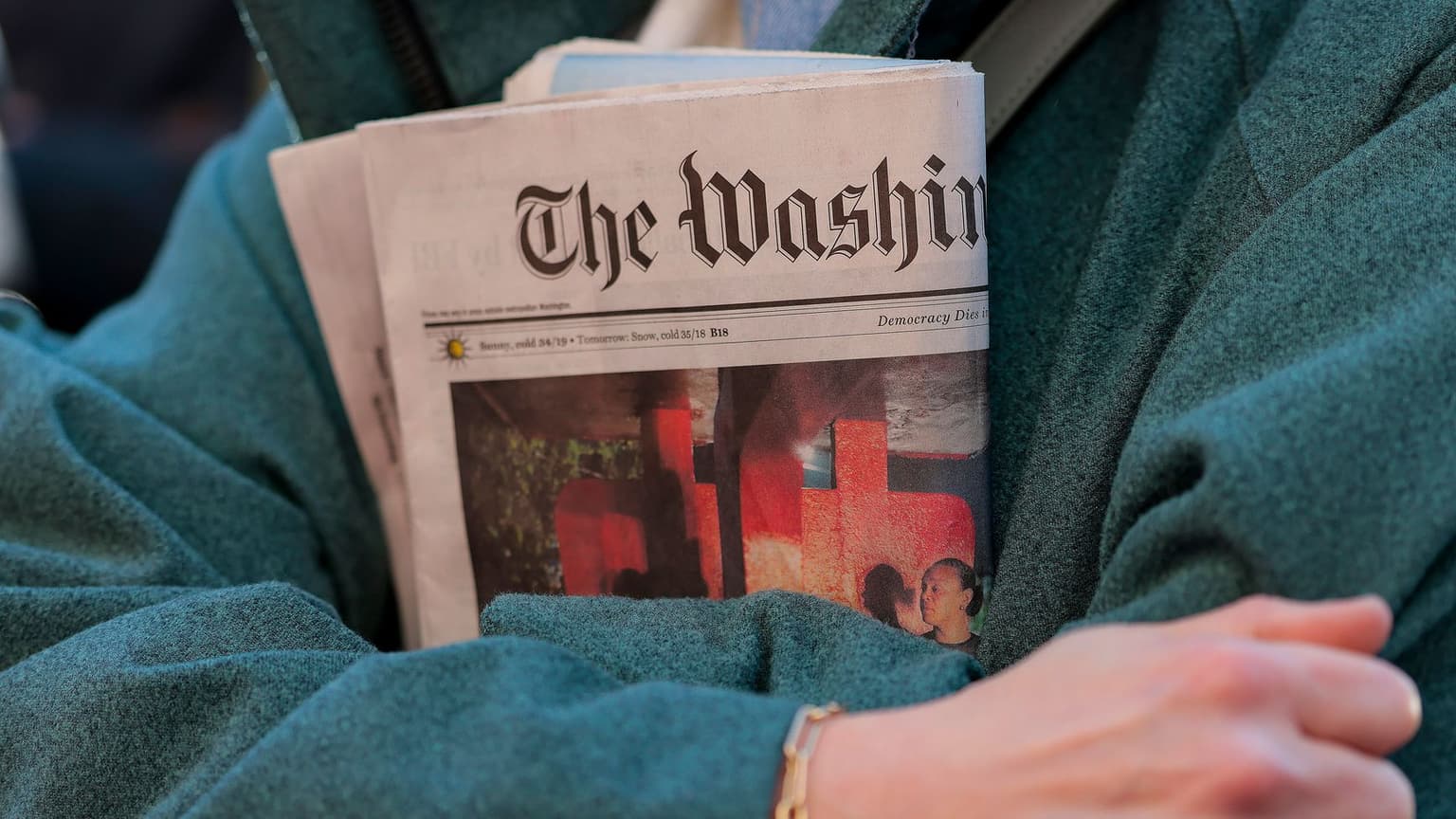
A local Washington resident who reads The Washington Post joins guild members protesting during a rally outside the newspaper’s office building in Washington, D.C., U.S. on Feb. 5, 2026. (Heather Diehl / Getty Images)
 on Google
The Kyiv Independent
When Jeff Bezos gutted the Washington Post, carrying out mass layoffs that included foreign bureaus, we watched it from Ukraine with dismay — and recognition of a pattern we know too well.
As a Ukrainian newspaper publishing in English, we understand how essential it is to keep the world informed about Ukraine and Russia’s war. That is why we were alarmed to see one of the world’s most influential newspapers pulling back from exactly that mission.
That retreat plays directly into the hands of those who benefit when Ukraine is pushed out of the global conversation — authoritarian regimes, disinformation networks, and a Kremlin that has long relied on silence, war fatigue, and shrinking scrutiny to advance its war.
The war in Ukraine is far from slowing — quite the opposite. Last year was the deadliest one for Ukrainian civilians since the invasion began. This battle remains to be where the fate of the free world is being decided, whether the free world is tired of watching it or not.
This is a mistake and a disservice to readers who rely on the Washington Post to understand the world.
This is precisely where strong journalism is needed most.
There is one actor that fully understands journalism's role in this war: Russia. Russia has killed journalists on the front lines, targeted them with cyber attacks, and tortured them to death in captivity — all because the Kremlin understands that journalists are the enemy, as is the truth itself. The Kremlin wants no independent witnesses of this war — it would much prefer the world to see it only through the images and narratives of propaganda.
Those who choose to slash institutions that inform the public — especially at moments like this — render direct assistance to authoritarian regimes. Does Jeff Bezos understand that by decimating the Post he serves the interests of America’s and free world’s natural enemies?

As an English-language newspaper, we compete with the outlets like the Washington Post. It is a competition we respect and value. The Post’s Kyiv bureau did outstanding work, serving the readers well by informing them about the war that affects their lives, no matter how far away it may seem.
Today, we stand in solidarity with our colleagues from the Washington Post’s Kyiv bureau and condemn the decision to effectively dismantle its operations. This is a mistake and a disservice to readers who rely on the Washington Post to understand the world.
This situation is also painfully familiar to us.
Four years ago, a different wealthy businessman fired the whole staff of a different Post — the Kyiv Post. The owner wanted a softer editorial stance and a controlled newsroom. The journalists refused — they wanted to serve the public interest, not act as the owner’s lapdog.
That story had a hopeful ending. The fired journalists went on to found the publication you’re reading now — the Kyiv Independent.
That was our lesson at what happens when the media depend on the whims of the ultra-wealthy. This is why the majority of the Kyiv Independent is owned by its own newsroom and funded by its readers. Thanks to them, we are able to grow while many publications shrink or divert resources away from Ukraine.
But this is also why the fate of the Washington Post matters so deeply.
The Post inspired generations of reporters through its courage and its belief that journalism can hold power to account — from the Pentagon Papers and Watergate to its choice of the bold motto, “Democracy Dies in Darkness.” Undermining such an institution weakens the entire ecosystem of free media — and strengthens those who benefit from silence.
Journalism thrives when those who own it understand that ownership is a responsibility, not a privilege. When they do not, the damage reaches far beyond a single newsroom.