As Russians and Belarusians compete at Olympics, Ukraine pushed to the margins
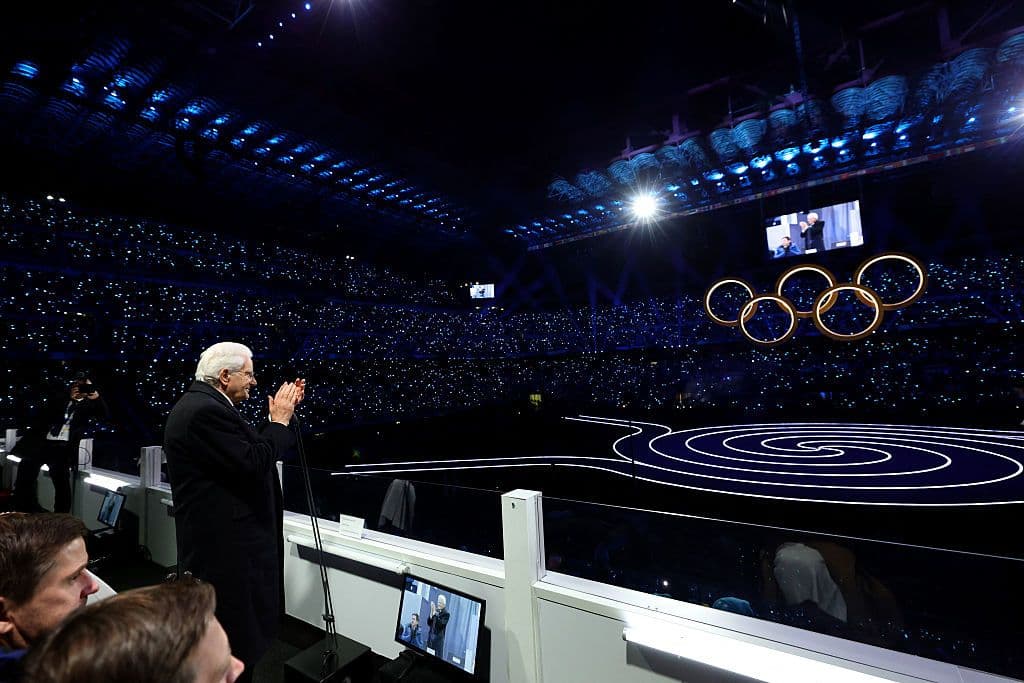
Sergio Mattarella, President of Italy, gives a speech during the opening ceremony of the Milano Cortina 2026 Winter Olympics at San Siro Stadium on February 06, 2026 in Milan, Italy. (Andreas Rentz / POOL / AFP via Getty Images)
 on Google
One of the most talked-about moments at the Olympics came from Ukrainian skeleton racer Vladyslav Heraskevych. After his race in Beijing in 2022, just days before Russia launched its full-scale invasion, he held up a sign reading "No war in Ukraine."
But his appeal went largely unheard.
Four years later, Heraskevych is preparing to represent Ukraine at the Olympic Games again — at a time when the war continues to escalate, while restrictions on athletes from Russia and Belarus are gradually being relaxed.
"There is still a feeling that this is all unreal," Heraskevych told the Kyiv Independent. "It is like we are in a movie that will end soon, and life will be normal again. But, unfortunately, the reality is different."
Thirteen Russian and seven Belarusian athletes will compete in the XXV Winter Olympic Games as "neutral," meaning they will not be allowed to participate under their national flags or use national symbols.

While this is the smallest Winter Olympics delegation in the history of both countries, a troubling trend is emerging: despite the ongoing war, restrictions from international sports organizations are loosening, and mentions of Ukraine are being increasingly avoided.
"Morally and ethically, it is surprising that sport does not uphold its human rights commitments, especially in the Olympic world," Jens Sejer Andersen, founder of the Play the Game initiative, told the Kyiv Independent.
"But from a more realistic, pragmatic perspective, this was to be expected for many reasons."
Russian, Belarusian creeping return to international sports
When Russia launched its full-scale invasion of Ukraine in 2022, the International Olympic Committee (IOC) acted quickly, recommending that international sports federations suspend Russian and Belarusian athletes from competing entirely. At the time, it seemed the sporting world was taking a clear stand — but that position would soon begin to shift.
Next year, the IOC had softened its approach, recommending that Russian and Belarusian athletes be allowed to return to individual competitions, provided they participated under a neutral flag. In 2024, that policy extended to the Paris Summer Olympics, allowing athletes from Russia and Belarus to rejoin the global stage, albeit without national symbols.
Speaking to the Kyiv Independent, Andersen, founder of the Play the Game initiative, said that, unlike athletes, Russian and Belarusian sports officials were never fully suspended, allowing them to quietly influence international sports organizations.
For example, Shamil Tarpishchev, president of the Russian Tennis Federation and a supporter of Russia's invasion of Ukraine, remains a member of the IOC. Meanwhile, oligarch Alisher Usmanov, a close ally of Russian President Vladimir Putin, was re-elected president of the International Fencing Federation (FIE) in 2024 despite international sanctions, though he later resigned.

Russia is also seeking allies among member states to advance its agenda within international sports federations. Ukrainian Youth and Sports Minister Matvii Bidnyi highlighted the International Ice Hockey Federation (IIHF), which has so far maintained a ban on Russian and Belarusian participation, as an example.
"(The Russians) are trying to bring in countries from the global south to the IIHF, where there has never been any hockey at all. But one country, one vote — and it is clear they end up shouldering all the costs on these issues," Bidnyi said on national television.
Most international sports federations followed the IOC's guidance in 2023, easing restrictions on Russian and Belarusian athletes. Only a few — like the International Biathlon Union (IBU) — have held firm, refusing to allow these nations back into their respective sports.
But even for these organizations, maintaining a firm stance is difficult. Russian and Belarusian athletes are also challenging the bans through legal channels, turning to the Court of Arbitration for Sport (CAS) to secure their return to international competition.
One of the largest federations in winter sports, the International Ski and Snowboard Federation (FIS), announced on Oct. 21, 2025, that Russian and Belarusian athletes would be barred from the 2026 Olympic qualifying competitions. But Russia challenged the decision at the CAS, which ultimately overturned the ban, labeling it "discriminatory."
Similarly, in October, the International Bobsleigh and Skeleton Federation (IBSF) Appeals Tribunal ruled that the exclusion of Russian and Belarusian athletes was illegal, allowing them to compete — but too late to qualify for the 2026 Olympics.


Ukrainian skeleton racer Heraskevych said that if the Russian side had pursued legal action earlier, it likely would have secured a place in Italy. He added that, while the IBSF Congress remains opposed to admitting Russian and Belarusian athletes, the federation's leadership appears "friendly" toward Moscow and Minsk.
When asked why restrictions on Russian and Belarusian athletes are gradually easing, Andersen explained that the leaders who shape federation policies are not necessarily driven by geopolitics. Instead, their focus is often on developing and promoting their sport.
"And the absence of Russian athletes is inconvenient for business," Andersen said.
According to Andersen, many sports officials also genuinely believe in the ideals of sport — that it can unite people and promote peace. At the same time, he called these beliefs "naive" and said that they are being "oversold."
"No country will sacrifice its strategic political interests just for the sake of two weeks of sporting celebrations," he added.
Can Ukraine turn the tide?
Prior to the 2026 Olympic Games, Ukrainian athletes issued an open letter to the IOC, urging the committee not to allow Russian and Belarusian competitors to take part.
In September 2025, President Volodymyr Zelensky also spoke with IOC President Kirsty Coventry, emphasizing the need to keep a clear separation between "the sports movement and Russian evil."
Despite these efforts, the IOC's position remained unchanged: Russian and Belarusian athletes are set to compete in seven sports at the Olympics in Italy.

The IOC is tasked with verifying athletes' neutrality — checking whether they serve in the military or security forces of Russia or Belarus, or whether they have publicly supported the war or participated in pro-war events. Yet some athletes have already been found to have violated these rules.
Russian figure skater Petr Gumennik performed a military-themed routine in an ice show in 2024, wearing a Russian soldier's uniform. Another Russian figure skater, Adelia Petrosyan, participated in the Summer in Moscow festival that year, during which the event collected aid for Russian soldiers fighting in Ukraine.
Ukrainian athletes, meanwhile, are being urged to show restraint. Because statements opposing Russia's war in Ukraine may be interpreted as political and thus violate IOC rules, Ukrainian athletes risk punishment, including suspension from competition.
Heraskevych said that after Ukraine's national team protested the admission of Russian and Belarusian athletes in early January, he was approached through a third party and asked not to organize any actions related to Russia's war against Ukraine. According to the athlete, the request may have come from the IOC.

Similar guidance has come from Ukraine's own officials. Vadym Guttsait, president of the National Olympic Committee of Ukraine, urged athletes to "control themselves" and respond calmly to any potential provocations from the Russian side.
"You already know how to behave when you meet these athletes. I understand what you feel in your heart, I understand how you will feel," Guttsait said.
"But you still need to control yourself so there are no provocations — because those provocations would then be used against you, against Ukraine, to claim that we are the ones provoking."
When asked how Ukrainian athletes should speak about what is happening in their country, Andersen said that this responsibility should instead fall to political leaders, including the president and other high-ranking officials.
At the same time, Global Athlete (GA) Director General Rob Koehler noted that sponsors of major competitions such as the Olympic Games also have the power to influence decisions made by sports organizations.
"How can those sponsors justify continuing to support the IOC when they withdrew their business from Russia because of the invasion, yet still back an organization that supports Russia?" Koehler told the Kyiv Independent.
"Russia continues to undermine the Olympic movement. It is mind-boggling, but for some reason, they still want them back," he added, referring to the numerous doping violations involving Russian teams.
Heraskevych, now at a crossroads over how to represent Ukraine — in sport and in keeping global attention on the war.
He called for Ukraine to impose more sanctions on Russian and Belarusian athletes, sending a signal to other states.
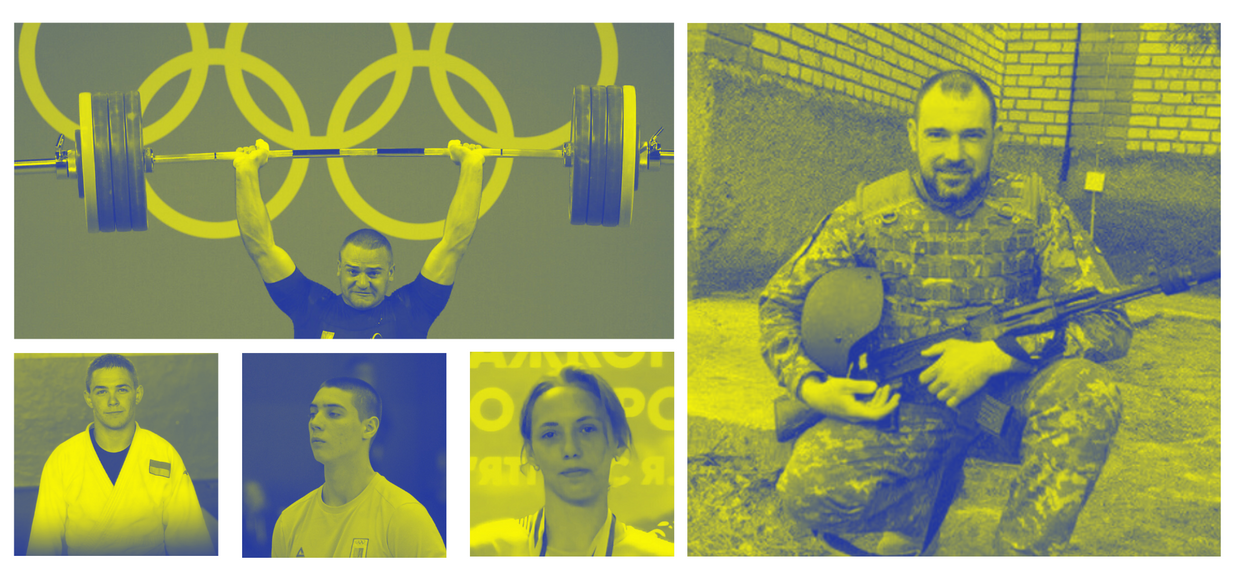
"We need to talk about Ukraine and draw attention to the victims of the war," Heraskevych said. "More than 500 athletes have already died in this war, and that figure is truly scary."
read also
 Andrea Januta
 Kateryna Hodunova