Are dollars replacing diplomacy in US-Russia talks?
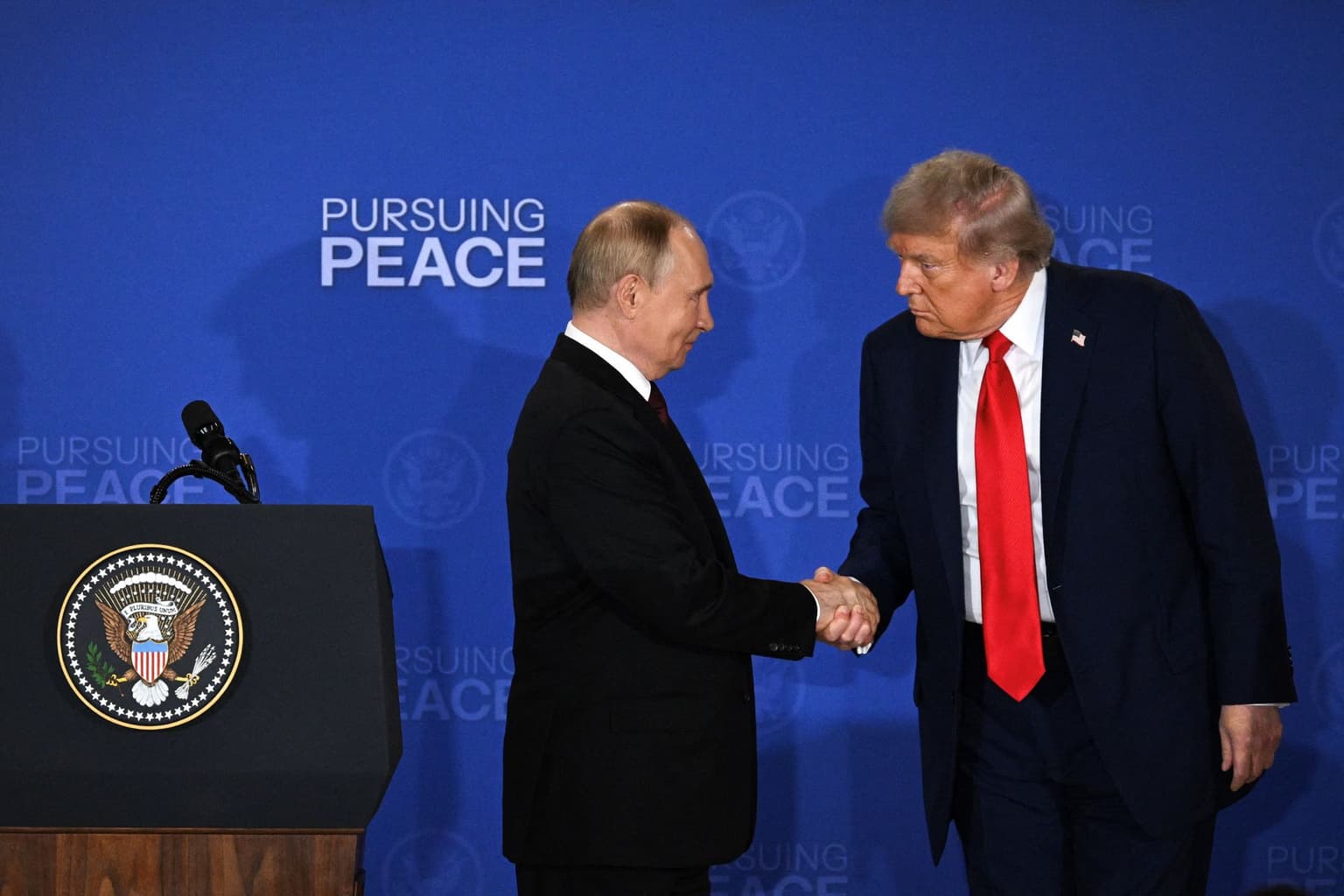
U.S. President Donald Trump (R) and Russian President Vladimir Putin (L) shake hands at the end of a U.S.-Russia summit on Ukraine at Joint Base Elmendorf-Richardson in Anchorage, Alaska, U.S. on Aug. 15, 2025. (Drew Angerer / AFP via Getty Images)
 on Google
Charles Hecker
Associate Fellow at the Royal United Services Institute
Anyone hoping for a geopolitically robust and sustainable resolution to Russia's war on Ukraine should quickly re-examine their optimism or at least check their assumptions.
Commercial interests, rather than military or political concerns, are driving the United States' talks with Russia.
This mercantile approach carries two critical risks. First, Russia's aggression against Ukraine does not stem from an economic rivalry. Talking business with Russia misses the point entirely. Second, the suggestion that business relationships pave the way to better politics is deeply flawed. It hasn't worked between the West and Russia over the past thirty years and is even less likely to work today.
In the earliest days of his second presidency, Donald Trump made it clear that U.S. foreign policy toward Russia would seek normalization. Trump and Russian President Vladimir Putin began speaking on the phone; the U.S. and Russia's top diplomats held meetings in Riyadh, Saudi Arabia.
Talks in Riyadh also featured Kirill Dmitriev, head of Russia's sovereign wealth fund and Putin's envoy to the U.S. business community. During the talks, Dmitriev reminded his American counterparts that U.S. companies left billions of dollars on the table when they exited Russia following the full-scale invasion of Ukraine.
The message was clear and landed firmly: These riches remain available to anyone willing to come back.
The hint in 2025 of a rapprochement between Russia and the U.S. lit a fire under the American business community. The possibility of sanctions relief — and a potential return to Russia — sent lawyers, bankers, PR agencies, and a cross-section of executives looking for their suitcases.
Even so, commercial opportunities still seemed secondary to political and military concerns. The talks, after all, were being led by the U.S. and Russia's secretary of state and foreign minister, neither of whom is a business executive. These talks ultimately failed, but the notion stuck: peace could bring a commercial bonanza.
The August Trump-Putin summit in Alaska in 2025 also failed to produce results; a lavish lunch set for the two presidents went untouched. But the Anchorage talks featured a commercial side-dish.
In the run-up to the summit, Russia was reportedly laying the legal groundwork for ExxonMobil to return to the Sakhalin-1 oil and gas project. Exxon later denied that it had plans to return to Russia.

More recent developments have completely inverted the character of talks between the U.S. and Russia. Rubio and Lavrov are nowhere to be seen. Ubiquitous negotiator Steve Witkoff, a property developer, is now joined in his Russia work by Jared Kushner, a private equity executive and Trump's son-in-law.
The suits have replaced the diplomats; commercial matters have overtaken geopolitical and military concerns.
Dmitriev, too, remains a prominent presence. Following their periodic meetings, some in the Kushner-adjacent suburbs of Miami, Dmitriev trumpets business opportunities, rather than progress toward peace. In October 2025, Dmitriev publicly suggested that the two sides build a tunnel under the Bering Strait.
The current composition and contents of talks between the U.S. and Russia do not bode well for creating sustainable peace.
Putin's drivers for pursuing the war are territorial, political, and military, not to mention nationalistic, hegemonic, and chauvinistic. Building tunnels or striking energy deals does not replace the thirst for territory, particularly for Putin, who holds private property and private wealth in deep contempt.
On the other side, the opposite is true. Private property and private wealth, for Trump or for his entourage, are the main items on the menu. Ukraine and the Ukrainians are further down the list.
No matter how much money may be at stake, returning to Russia will require a bottomless appetite for risk. Russia's war on Ukraine has gone on far longer than anyone, including the combatants, ever expected. Russia's business environment is undergoing a significant transformation, very little of which favours market re-entry for Westerners.
Most international businesses are likely aware of these changes; if they're not, they should be.
Assumptions about the role of money may be more important than the money itself. Talks between the U.S. and Russia appear to rest on the notion that re-attaching the countries' economies will foster a new political understanding.
This is unsettlingly close to the flawed hypothesis the West held about Russia in the 1990s and the early 2000s. Give Russia enough time and money, the theory went, and it will become a stable political and business partner. Painfully, we now know that wandel does not come durch handel.
Speaking of wandel durch handel, one may wonder, where is Europe in its approach to Russia? As the U.S. moves haltingly toward normalization, the UK and the EU remain firmly in punishment mode.
For now, that means the U.S. would be in the lead position to resume commercial activity with Russia, ahead of its European counterparts and competitors. Given the chance, at least some European businesses would go back to Russia. But normalization seems even further away through the European lens.
Editor’s note: The opinions expressed in the op-ed section are those of the authors and do not purport to reflect the views of the Kyiv Independent.