How to keep an elephant and a gorilla warm during Kyiv's coldest winter of the full-scale war
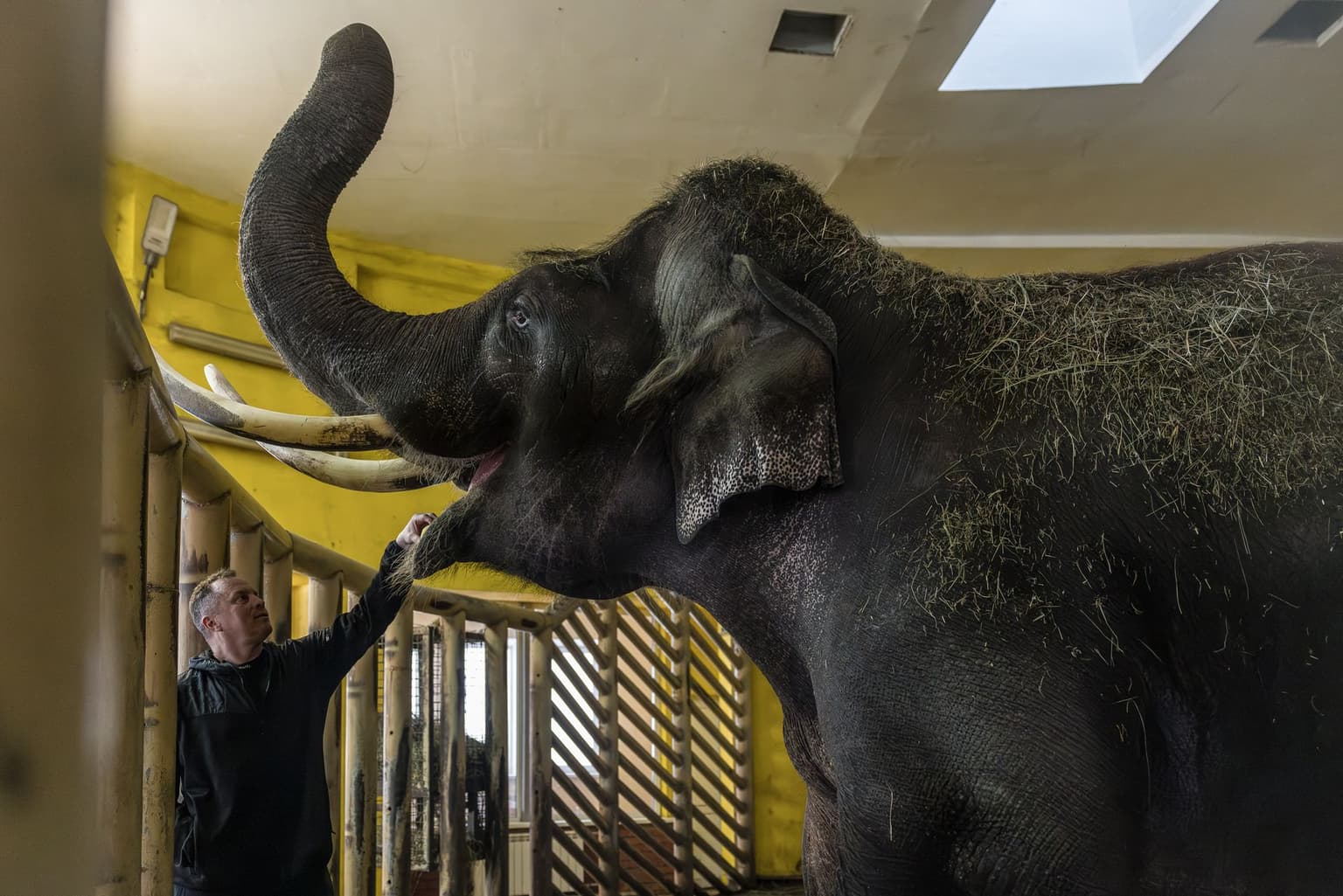
Kyiv Zoo chief Kyrylo Trantin feeds 20-year-old elephant Horace at the Kyiv Zoo in Kyiv, Ukraine, on Jan. 27, 2026. (Oksana Parafeniuk / The Kyiv Independent)
 on Google
Life in Kyiv right now is difficult for any 51-year-old, but when you are also a western lowland gorilla more suited to the warmth of central Africa, the ongoing energy crisis is particularly tough.
This is the current plight of Tony, one of the oldest residents of Kyiv Zoo, a popular attraction in the capital that is somehow managing to stay functioning even as Russia continues its relentless campaign to freeze Ukraine into submission.
Zoo technician Anastasiia Larionova is one of the team of people making sure this happens, and as the temperatures in Kyiv plunge below -20°C (-4°F), she still starts her morning the same way — checking on each of Kyiv Zoo's animals and making sure none go hungry.


This winter, that familiar routine has become a test of endurance not just for people, but for the animals who depend entirely on her care.
Feeding apples to Hutsul horses originally from the Carpathian Mountains, one of the few species at the zoo that can tolerate the bitter cold sweeping across Ukraine, Larionova said she finds solace in her work, even though it is far from easy.
"This marathon began in 2022 and continues to this day," Larionova told the Kyiv Independent.
As winter brought sub-freazing temperatures across Ukraine, Russia stepped up targeted strikes on energy infrastructure. The strikes have left thousands without heating, electricity, or running water, and pushed businesses to the brink.
Kyiv became one of the epicenters of the energy crisis after strikes throughout January left hundreds of homes without heat for nearly three weeks — and with no certainty when it will be restored.
For people, there are ways to survive the harshest winter of this war, even under these conditions, but animals cannot endure the bitter cold on their own.

The Kyiv Zoo is home to more than 2,000 animals across 321 species, many of them exotic. Among them are the Indian elephant, hippopotamus, crocodiles, dozens of brightly colored, heat-loving birds, and a variety of primates.
Caring for such a diverse collection requires significant resources — a challenge the zoo's management began preparing for well before the beginning of 2026.
Making matters even harder, the zoo is located in Kyiv's Shevchenkivskyi district, one of the areas most frequently hit by Russian attacks, according to estimates from the Ukrainian media outlet Texty.org.ua. As a result, drones and missiles flying over the animal enclosures, and loud explosions nearby are not uncommon.
"As a CEO, I needed to know about the experiences of other zoos during wartime," Kyrylo Trantin, the Kyiv Zoo CEO, said. "Most of the information is about how things were during World War II. But now everything is different."
The first generators and stoves appeared at Kyiv Zoo back in 2022, when the country faced its first blackouts due to Russian strikes on the energy sector. But their impact is nothing compared to the strain on the energy system nearly four years later.
This winter, stoves and generators have become indispensable. Power outages can last for several days at a stretch, and after attacks, heating often vanishes entirely.


Yet in some enclosures, temperatures must be maintained at a steady 19–20°C (66–68°F), including Tony the gorilla's.
Tony, Ukraine's only gorilla, lives in an enclosure with electric heated flooring and exotic trees painted on the sunny yellow walls — a vivid reminder of his natural habitat.
During blackouts, a log-burning stove, fenced off from visitors, helps maintain a cozy temperature, standing directly in front of his enclosure.
"My dream is to have a small nuclear reactor for the zoo," Trantin said.
According to the CEO, staff are now on duty around the clock, tending the stoves. Wood must be added at least five times a day, and during particularly harsh frosts, every 3 to 4 hours throughout the night.
The zoo also acquired 12 generators, 15 stoves, and three solar stations during the full-scale invasion. Keeping operations running consumes about 200 liters of gasoline a day, according to Trantin.
Yet finding specialists to service generators is currently difficult, as most of them are fighting on the front line in the army, Trantin said.
"We must take care of both people and animals. But animals come first."

Kyiv Zoo chief Kyrylo Trantin poses for a portrait near the elephant enclosure at the Kyiv Zoo in Kyiv, Ukraine, on Jan. 27, 2026. (Oksana Parafeniuk / The Kyiv Independent)
These sources of heat and light not only keep the enclosures at the right temperature but also preserve food and keep the animals fed. The generators even allow the zoo to pump water from its own well, despite supplies sometimes being cut off after Russian attacks.
"As always, we must take care of both people and animals. But animals come first," Trantin told the Kyiv Independent.
Each day, zoo staff prepare meals, provide constant access to water, monitor the animals' health and behavior, keep enclosures clean and well-maintained, and ensure the animals are happy.
According to Trantin, none of the animals have died from Russian strikes during the all-out war. At the same time, the Kyiv Zoo has managed to shelter 600 animals evacuated from areas affected by Russian aggression — and continues to add new species to its collection.

In November 2025, Hutsul horses, named after the region in western Ukraine, arrived at the zoo, accompanied by a special exhibition highlighting their origin and history. Trantin said he brought them because they are a distinctly Ukrainian breed, and preserving the heritage is important.
"Ukraine has been holding on for four years now. It's hard for us, but we must unite. Otherwise, we will cease to exist," he said.
"And while our girls and boys are defending us (on the front line), we are protecting the animals here."