A million-dollar parking fee: Canada's high-stakes battle over a stranded Russian plane
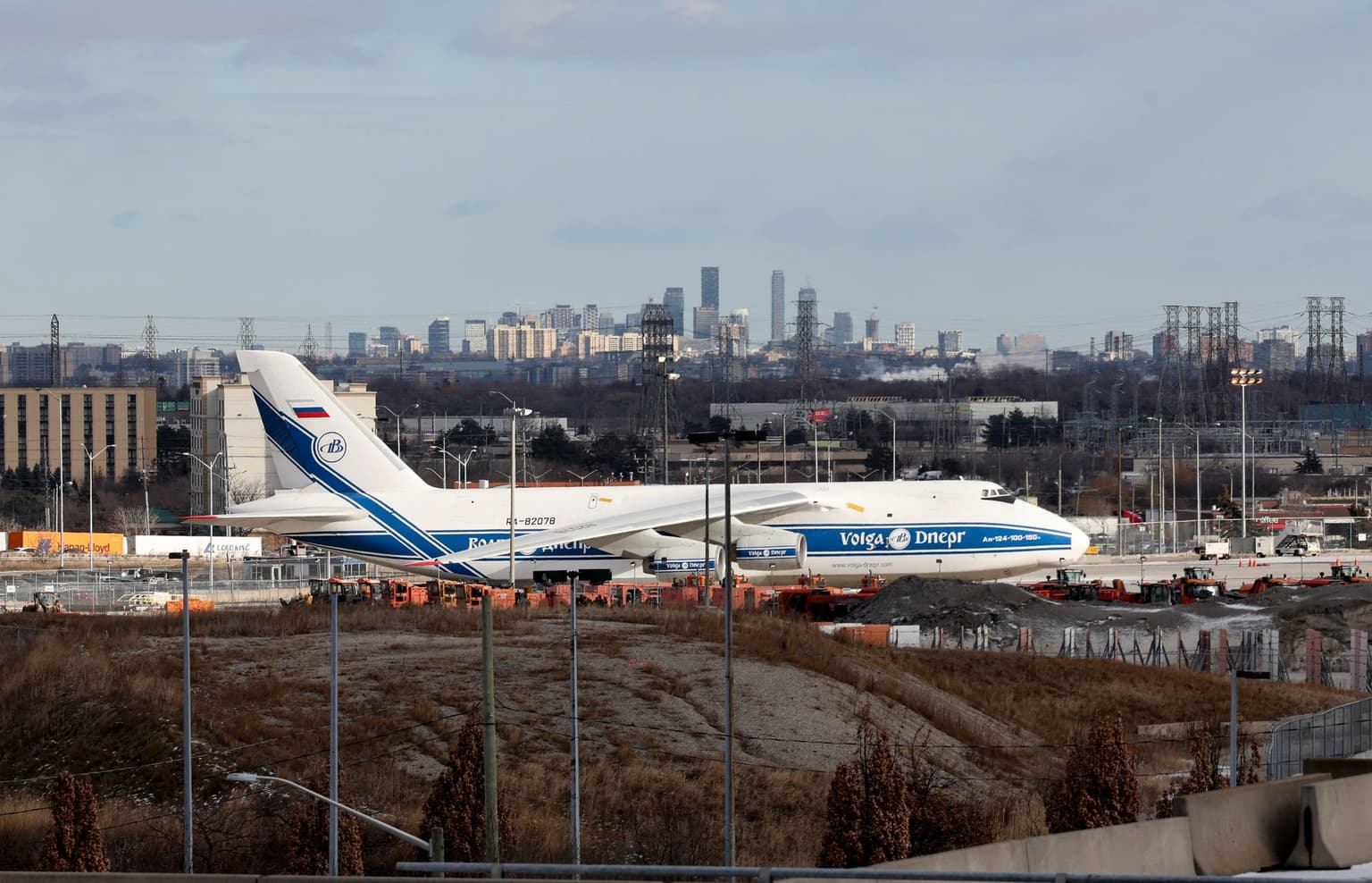
A Russian-owned Antonov An-124 cargo aircraft is seen at Pearson International Airport in Toronto, Ontario, Canada, on Jan. 8, 2025. (Richard Lautens / Toronto Star via Getty Images)
 on Google
In what is potentially the world's most expensive parking ticket, a Russian-registered Antonov An-124 has remained locked in a frozen embrace with the tarmac at Toronto Pearson Airport.
Stranded for almost four years, the aircraft has racked up over $1.5 million Canadian dollars ($1.1 million) in parking fees. Parked so long, in fact, that it has found its way onto the infrequently updated satellite views of the airport in both Apple Maps and Google Maps.
But for an international community that just watched the European Union retreat from a plan to use frozen Russian reserves as loan collateral, this Kyiv-designed aircraft is more than just an interesting anecdote in the history of long-term parking. It represents a crucial inflection point in Western resolve.
As Canada enters the legal endgame to forfeit the aircraft, the question to be answered is whether a Western democracy can move beyond “freezing” Russian property and reallocate it to benefit Ukraine.
True forfeiture cases are rare. There have been a handful of success stories: the $300-million superyacht Amadea was sold at an auction in San Diego after a two-year legal battle, with the U.S. government successfully piercing the “straw ownership” of Russian oligarchs.

But “frozen” is usually a state of decay. Most seized assets, like the yachts languishing in European ports or the $210 billion in Russian Central Bank reserves locked in Belgium, remain in a legal coma. The An-124 in Toronto is Canada’s attempt to follow the Amadea’s lead, but the path has been anything but swift.
It began on June 8, 2023, when Canada officially took control of the aircraft, just over a year and three months after landing and being refused permission to depart. But as the government dug into the plane’s paperwork, they found a familiar obstacle: a maze of ownership.
To ensure the seizure would hold up in court, Canada issued a new order in mid-February. The initiative aimed to dig through a complex corporate veil, focusing on a network of subsidiaries and individuals from Ireland to the Netherlands, all of whom held a significant controlling interest in the hull.
read also
 Kateryna Hodunova
 Alisa Yurchenko
 Lucy Pakhnyuk
On March 18, the Attorney General felt confident enough to take the next step, filing a formal application with the Superior Court of Ontario for forfeiture. Russia’s Volga-Dnepr Group, the plane's operator, has since fired back with a $100-million lawsuit against the Canadian government, while calling Ottawa’s move “pirate hijacking.”
Despite the accusations, legal experts view Canada’s move as a calculated first step in a new era of asset forfeiture.
“Volga-Dneper can call it whatever they want, but the freezing and seizure of assets belonging to sanctioned individuals is a common foreign policy move,” Robert Currie, a professor of transnational criminal law at Dalhousie University, told the Kyiv Independent.
“What is new in this is that the aim of the government of Canada is to confiscate and repurpose the asset, in order to assist Ukraine against Russian aggression,” he said, adding that the Special Economic Measures Act (SEMA) was “amended to allow exactly this.”
Under the 2022 amendments to the Special Economic Measures Act (SEMA), Canada became the first G7 nation to move beyond simply “freezing” assets. The new powers allow the government to seize property, seek its permanent forfeiture in court, and repurpose the proceeds towards rebuilding the war-torn country, restoring international peace, or compensating victims of the conflict.
read also
Martin Fornusek Nathalie Timtchenko
“It is a safer bet for forfeiture than the monies belonging to the Russian Central Bank, insofar as those monies are (as a starting point) immune from seizure by foreign states. Of course, there is a very solid legal argument in favor of the seizure (countermeasures), and all that is preventing it is lack of political will in the EU. But that being so, property of sanctioned private individuals should, in principle, be easier to work with,” according to Currie.
As the forfeiture case unfolds, speed is often traded for certainty. However, the legal slow-walk could potentially be a matter of strategy, not just paperwork. At a news conference on Oct. 31, Foreign Affairs Minister Anita Anand defended the years of delay, explaining that the government has been forced to “disentangle” a complex web of Russian shell companies to ensure the seizure is final.
Currie also believes that Canada is serious about transferring the plane to Ukraine, “or at least has gotten more serious about it in recent months.”

“The delay in part reflects a prosaic reality in the Canadian legal system — our legal processes often move too slowly, and it can be hard even to get a courtroom for the number of days you need one,” Currie told the Kyiv Independent.
For Anand, the goal isn't just to punish a sanctioned airline, but to perform a symbolic act of restoration: “This is a legal process, but it’s also in the context of: ‘How else can we help Ukraine in its time of need?'... Russia completely obliterated some of Ukraine’s Antonov aircraft that were in Ukraine at the beginning of the war. And so this is, in a sense, replenishing the Antonov fleet.”
However, replenishing a fleet requires a plane that can actually fly. After enduring three harsh Canadian winters on the tarmac, the aircraft’s airworthiness is a growing concern. While it was briefly seen moving across the airport’s tarmac for “routine checks” this September, it is unclear if the plane is still mechanically sound.
Public Services and Procurement Canada did not respond to the Kyiv Independent’s questions regarding whether the million-dollar parking fees have ever been paid or if the plane currently has any dedicated security.
Similarly, Global Affairs Canada remains silent on whether the government is exploring the possibility of bringing in Ukrainian technicians from the Antonov Company to service the plane on-site if the forfeiture is successful. Currently, the Russian plane presents a $100-million opportunity, poised for a court decision that could turn it into a valuable support asset for cash-strapped Ukraine.
Note from the author:
Hi, this is Oleksiy Sorokin, deputy chief editor of the Kyiv Independent.
At the Kyiv Independent, we believe quality journalism should be accessible to everyone — which is why we don’t have a paywall. Our work is made possible by readers who choose to support us.
If you found this article valuable, consider joining our community today and helping us keep independent journalism free and accessible to all.