‘A cult of death’ — Former Soviet dissident on Russia and authoritarianism's global rise
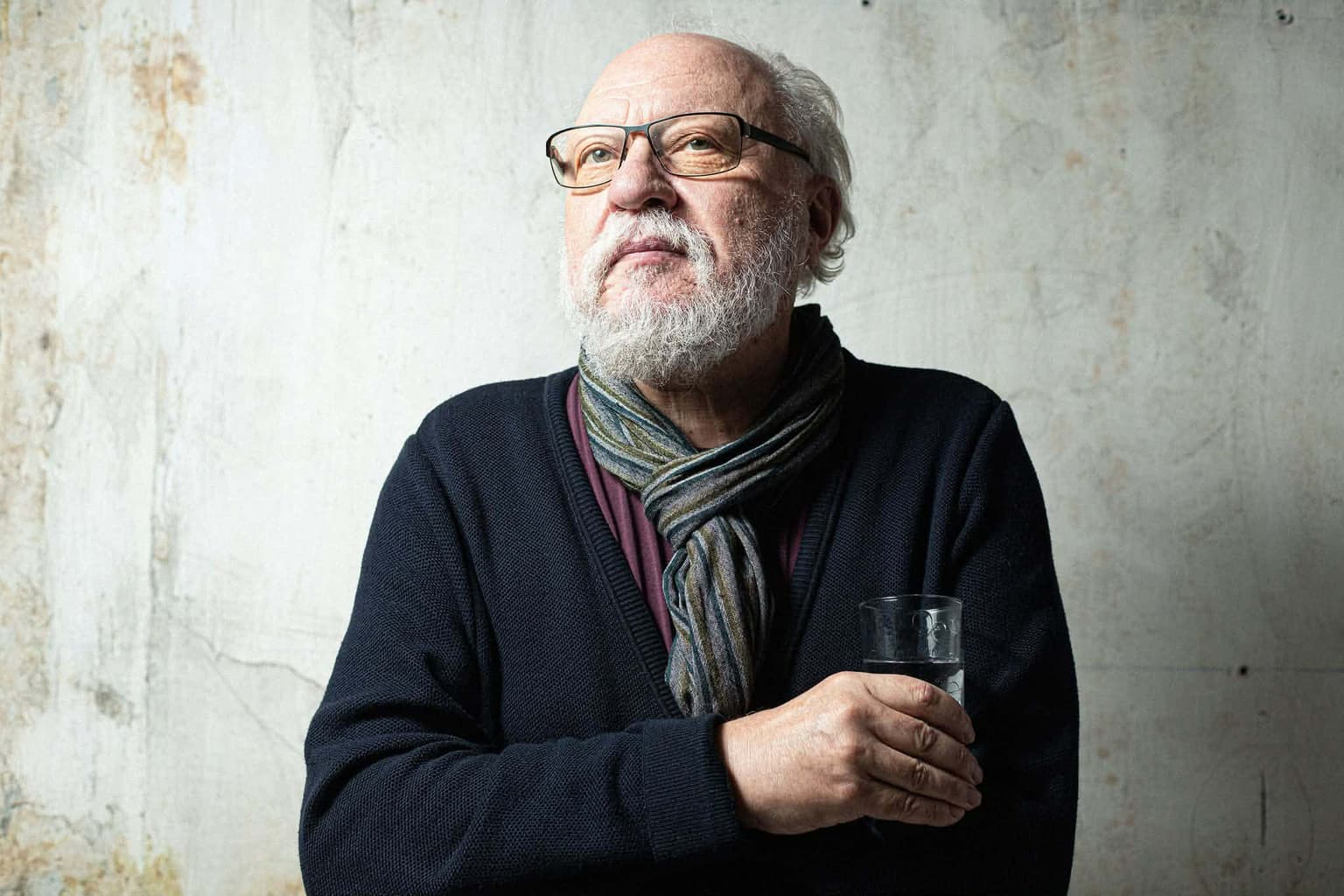
Igor Pomerantsev, a veteran radio broadcaster, poet, and former Soviet dissident, during Meridian Czernowitz 2021 in Chernivtsi, Ukraine, in September 2021. (Julia Weber)
 on Google
In an authoritarian society, it’s free thinkers who are targeted by those in power. A book, a social media post, a private conversation — anything can be used against those who refuse to conform in a country ruled by intimidation, lies, and outright violence. This is why, in a world where authoritarianism appears to be on the rise, a free press is more important than ever.
Few understand this reality better than Igor Pomerantsev, a veteran radio broadcaster, poet, and former Soviet dissident. Having spent decades working for Radio Free Europe/Radio Liberty (RFE/RL) and the BBC after being exiled from the Soviet Union, he has witnessed firsthand how authoritarian regimes attempt to control narratives and silence dissent.
In an interview with the Kyiv Independent, Pomerantsev discussed the vital role of institutions like RFE/RL in upholding press freedom — and what its loss at the hands of the U.S. could mean for regions starved of independent journalism. He reflected on his own path to dissent in the Soviet era, why he describes the Russian state as a “cult of death,” and the lessons today’s dissidents must learn as authoritarianism gains ground worldwide.
This interview has been edited for length and clarity.
The Kyiv Independent: You’ve worked with RFE/RL for many years, and so I had to start off by asking you for your thoughts on the U.S.’s funding cuts, which essentially put the future of the organization in serious question.
Igor Pomerantsev: Without RFE/RL, it feels as if we are being deprived of a fundamental element of our environment — freedom of information is one of the most essential aspects of human life.
I work for the Russian language service, and Russian is a lingua franca. Of course, there are other sources of information for Russian-speakers, but the real tragedy is the fate of the Central Asian services. It is truly a tragedy. They are losing their only source of free and independent information about their own countries.
It has been a long process of trying to put an end to the work of RFE/RL. I remember back in Munich, during the administration of (former U.S. President Bill) Clinton, our budget was drastically cut. We were essentially like refugees, forced to leave Munich for Prague — where (then Czech) President (Vaclav) Havel generously offered us a building (to continue working in), practically for free, for just one crown. In a way, the Czech Republic took us in as financial refugees.
The next attempt to suffocate us came under (former U.S.) President (Barack) Obama in 2016, when we were cut off from shortwave broadcasting. For decades, people across the former Soviet Union had relied on us through shortwave radio. It was as if millions of people were suddenly deprived of their only source of alternative information. Without shortwave, we had to adapt, shifting to modern forms of broadcasting — podcasts, for instance. There was a silver lining to this transition, but ideally, we should have been able to maintain shortwave while also expanding into new formats.
And so, you see, this depriving us of oxygen has been happening for a long time. Now, however, we are simply being shut down outright. I’ve worked for RFE/RL for 30 years, and I’m not here to boast — that would be pointless. But among our listeners were many decision-makers.
Some have criticized us for not reaching a “broad enough” audience, but we were never meant to be a pop music station. Our listeners were people who could engage with complex ideas, who could understand nuanced discussions. Yes, mass audiences often prefer simpler content, but that was never our mission.

The Kyiv Independent: You began working with institutions like the BBC and RFE/RL after being exiled from the Soviet Union. You were labeled by the Soviet authorities as a “dissident.” For those of our audience who are unaware of your background, could you just talk about how that came to be?
Igor Pomerantsev: I think I first became a dissident when, during an interrogation by the KGB, they told me: “You are a dissident.” Before that, it had never occurred to me to think of myself that way. In a normal situation, you don’t wake up one day and declare, “I am a splinter” — you simply live in your country as one among millions.
My initial reaction was, of course, completely negative. I didn’t want to be a splinter, an outcast. But that’s how they viewed my life, my fiction, my nonfiction, my poetry. To call yourself a dissident requires a certain state of mind. Take, for example, the great Ukrainian literary critic and poet Ivan Svitlychny. After his arrest and sentencing, he wrote a cycle of poems titled “I Am a Dissident.” But that was already a different kind of self-awareness — a deliberate declaration.
Poems like his can seem almost iconoclastic, but in their depth, they were political as well. In my case, I didn’t choose it. I was labeled, stamped as a dissident. And only later did I begin to reflect on why — and what drove me.
People sometimes refer to the “dissident movement,” but in reality, it was not a movement at all. It was a collection of isolated individuals, each expressing a deeply personal protest. For me, living in the Soviet Union was a daily source of shame for many reasons. First, I couldn’t accept the existence of political prisoners in my own country. Most people in the Soviet Union didn’t care — they were too focused on their own lives. But for me, it was unbearable. I knew that two camps, in Mordovia and the Perm region, were filled with political prisoners.
Second, the lies. You’d turn on the television, and it was nothing but lies — a personal insult, really. Sure, you could switch off the TV, but the lies were everywhere. In school, history was distorted. At university, you were forced to sit through absurd lectures on “The History of the Communist Party of the Soviet Union.” Most people ignored it, but some were more sensitive to it. Some couldn’t just let it wash over them.
At that time, in the 70s, Ukraine had about 3.5 million Communist Party members — mostly adult men. Some were active, some were passive, but the fact remained: if you were a party member, you couldn’t just dismiss it as a passive act. These people had families, children. Their conformity wasn’t just personal — it shaped the entire society.

From childhood, people were already being brainwashed through school, universities, propaganda, media — everything. It surrounded you, flooded over you. Instinctively, we all needed to survive — not just physically, but existentially, intellectually, spiritually.
I was a young writer, just starting out, and for me, reading all kinds of literature was essential. That was my first step toward becoming a dissident. I started reading Samizdat and Tamizdat — and from there, the path was clear: repression, surveillance, detention. My detention wasn’t long, but still — I was arrested over books. And for me, as a writer, books were my life. Literature was life. But the authorities saw it differently. They tried to suffocate my existence by accusing me of reading and spreading so-called anti-Soviet literature.
Ironically, literature was what saved me. It kept me intellectually and mentally intact. I owe my integrity to books.
There were different kinds of dissidents — nationalist, patriotic, democratic. I would describe myself, and a small circle of my friends, as something else entirely. We were like characters from Albert Camus, the French philosopher who championed responsible individualism.
Dissidents, by definition, must be different. That’s the whole point — to stand apart. In my own circles, there were also the so-called “bourgeois nationalists” — a ridiculous term in the Soviet Union, where there was no actual bourgeoisie. And through Samizdat, I learned that in Leningrad, there were even Russian fascists who considered themselves dissidents.
But for me, it was about something else. Later, I wrote an essay called “The Right to Read” that was published in the Partisan Review. As a young writer, what mattered most was having access to books — whether I loved them or hated them. The choice had to be mine, not dictated by men with pistols.

That’s how my real conflict in Kyiv began. Though, in fact, the first one happened earlier, at Chernivtsi University, where I was a student. I was lucky enough to get my hands on a policy document from the Czechoslovak Communist Party — at the time, a surprisingly liberal text. Not only that, but it had been published in Ukrainian, since Rusyns in Slovakia read Ukrainian. So, of course, I read it aloud — everywhere, at every corner of the university. That’s what led to my first interrogation. Every Soviet university had a so-called “special department” staffed with two or three KGB agents. That’s how I got to know them personally.
The Kyiv Independent: Given everything Russia is doing now, can we say it is following in the authoritarian footsteps of its predecessors, the Russian Empire and the Soviet Union?
Igor Pomerantsev: As a writer, I'll speak about literature, not politics, because that's where my expertise lies. The relationship between the Russian state and its writers has always been aggressively intrusive, dating back to the 18th century. Even then, writers were among the first victims of Russian censorship. Take, for instance, the journalist and satirist (Nikolai) Novikov — he was arrested and tried for his magazine. This pattern continued, escalating over time.
Many of Russia's most important literary figures, even the classics, found themselves in some way victimized by their confrontation with the state. Why? Because literature offers hope. It promises life. When you write, you're engaging with living people, and you, too, are a living person. But the state, built on death and fear, instinctively rejects literature's free spirit.
Take (Fyodor) Dostoevsky, for example. While some might see him as problematic today, he was sentenced to death. Even (Ivan) Turgenev, a respected figure who preferred to live in France and Germany, faced repercussions. His speech in memory of (Ukrainian author Mykola) Gogol led to his being sent to Schlisselburg prison and later placed under house arrest in his village.

I could name many more writers, but the point remains: If you weren’t a complete conformist — if you were creative and free — you were in some way discriminated against or repressed. I'm speaking about literature here, while political scientists would focus on history. But when I think about the Russian state, I see that it is grounded in a cult of death.
Some cultures are built around death, even if not exclusively. For example, the Aztecs had a culture of sacrifice, with blood flowing daily through their empire. This wasn't simply a primitive thirst for death; it had its rituals, heroes, and monuments. Sometimes it can even look beautiful. It's not a simple concept; it's a part of life, and in some cultures, it can dominate.
The Kyiv Independent: It seems we live in a world where authoritarianism is once again on the rise. What advice do you have for the future dissidents of the world?
Igor Pomerantsev: There was a classic Samizdat pamphlet in the Soviet Union that gave specific instructions on how to behave during an interrogation. It wasn’t a thick book, just a concise guide with very concrete advice. For example, it taught you how to handle questions from interrogators that were outside the official law or codex.
Some of the details were quite valuable. For instance, if the interrogators started threatening you, you needed to remain calm and respond first. One key piece of advice was that if you were taken to the KGB, you had to always ask why you were there. Are you being accused or are you a witness? If they said you were a witness, ask which case they mean. And if they mentioned someone like Ivanov so-and-so, you could respond by asking, "I know many Ivanovs, could you show me a photo of him?" There were all sorts of little tricks to help navigate the situation.
I read this pamphlet in my younger years, so theoretically, I was prepared. But there’s also a certain kind of "prison wisdom." It boils down to three things: Don’t trust, don’t be afraid, and don’t ask.
So, when you ask me what kind of lessons I can share from my dissident past, they are very practical ones. Any individual of a certain integrity must simply keep reading, be curious about the world, and think for themselves — it is that simple.