'Embarrassing' — We asked 3 experts why Venezuela's Russian-supplied air defenses were AWOL
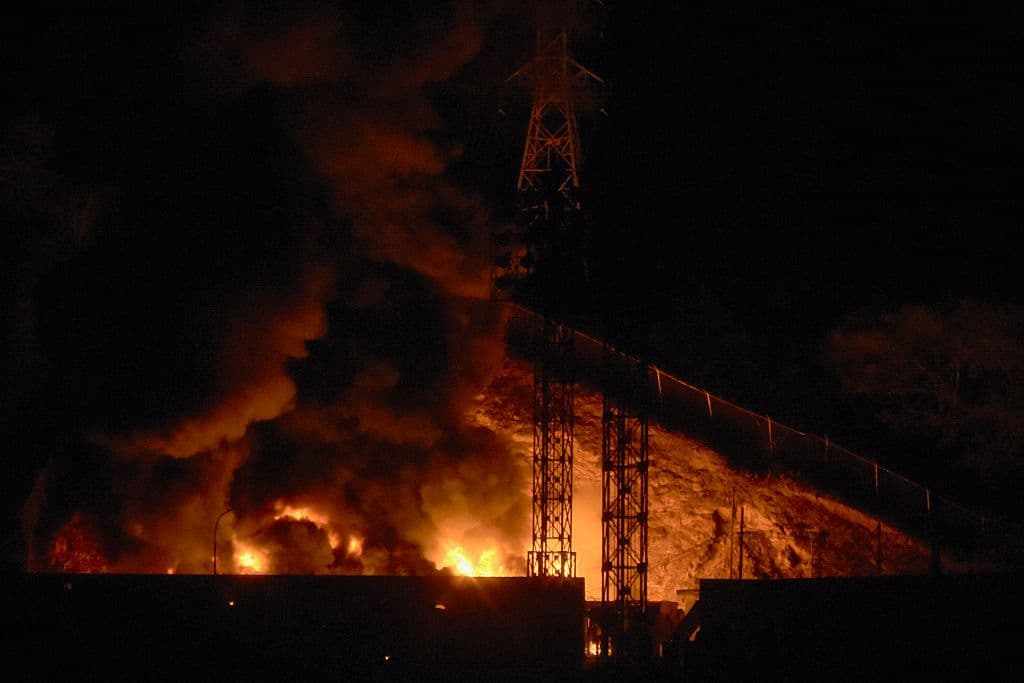
A fire burns at Fuerte Tiuna, Venezuela’s largest military complex, after a series of explosions in Caracas, Venezuela, on Jan. 3, 2026. (Luis Jaimes / AFP via Getty Images)
 on Google
Of all the images that emerged from the U.S. military operation to capture Venezuelan leader Nicolas Maduro on Jan. 3, one of the most surreal was the sight of a fleet of American helicopters flying unchallenged over the skies of Caracas.
Video from Caracas, Venezuela shows U.S. military helicopters, including CH-47 Chinook and V-22 Osprey aircraft, operating over Caracas alongside multiple explosions. The cause and context of the blasts remain unconfirmed. pic.twitter.com/owOx9X7DPP
— George Allison (@geoallison) January 3, 2026
"Seems those Russian air defenses didn't quite work so well, did they?" U.S. War Secretary Pete Hegseth said at an event on Jan. 5, referring to the fact that most of Venezuela's air defenses are Russian-made systems provided by its longtime ally.
Venezuela's military is known to possess a significant number of Russian air defense systems including Buk-M2s and S-300VMs.
The S-300 is a long-range surface-to-air missile system that intercepts aircraft, cruise and ballistic missiles. Developed by the Soviet Union, it remains a key component of Russia's air defense and, depending on the variant, can engage multiple targets at ranges of up to 150 kilometers (93 miles).
But on Jan.3, as U.S. forces swept into the country's capital and left with its leader, these Russian-made systems were nowhere to be seen.
The Kyiv Independent asked three defense experts how they thought this could happen.

Thomas Newdick
Writer and editor at The War Zone
A popular take already is that Russian air defense systems are junk. But that's not an accurate reading of what happened, because it's the command-control element, it's the leadership decisions, it's the training as well. And the readiness — my feeling is that the readiness levels were really low for whatever reason.
There are so many questions about how the U.S. military was able to do this so quickly and apparently so effectively. I would imagine it was a real cocktail of different inputs and capabilities from the U.S. military that ensured that even if the command was given, or even if the Venezuelan military leadership gave the command or tried to give the command, then the actual operators were essentially blinded to what was going on.
If you have an operation of this kind in which there seems to have been very little air defense activity, then you have to look at the possibility of whether that order was even given at all, or whether potentially an order specifically was given not to engage. That's also a possibility.
On the other hand, if any military in the world is going to be able to literally remove an air defense capability, even if it's just for a short window of time, then that's what the U.S. military is trained to do.
Venezula also has an entire air force — fighter jets as well, which didn't seem to do anything at all.

So you've got, to some degree, a multi-layered air defense system with manned fighter jets, with long range surface-to-air missiles, medium range surface-to-air missiles, short range surface-to-air missiles, manned portable air defense systems, and then also artillery, cannons, machine guns, all of that.
And if you look at that on paper, that's a comprehensive air defense umbrella.
But the actual technology, the equipment, is only one part of it. You have to have the doctrine to be able to use it. You have to know how you're going to use it. And you have to have the command and control element, which is probably the most important bit.
So however advanced the surface-to-air missile is, and however well trained the operator, if you don't have the chain of command that works efficiently, then it's not going to be able to do anything.
But it doesn't look good in terms of PR when it comes to Russian air defense systems — if you look at the combat performance of certain Russian air defense systems in Syria, in Libya, in Ukraine, in Iran, and now in Venezuela, then you put that all together, it doesn't look good.
John Polga-Hecimovich
associate professor at U.S. Naval Academy, and War on the Rocks contributor
The failure of Russia-made weapons to stop U.S. airstrikes is an embarrassment for Russia.
I think there are two major reasons (for this failure) — first, although there aren't many details as of yet, the U.S. disclosed that U.S. Cyber Command conducted cyber operations to suppress Venezuelan defenses during the strike on Caracas.
Non-kinetic cyber effects from U.S. Cyber Command were deployed before kinetic strikes began, playing a major role in neutralizing air defense systems.
The New York Times reported that “the effort began with a cyber operation that cut power to large swaths of Caracas, shrouding the city in darkness to allow the planes, drones and helicopters to approach undetected."

Moreover, President Donald Trump said at his press conference on Jan. 3 that lights in Caracas went dark during the operation "due to a certain experience that we have," which alludes to this same thing.
The second reason is simply that the equipment was in worse condition than anyone knew.
It suggests Russia had limited capacity and interest in coming to Venezuela's aid at the current moment, given the war in Ukraine, and that Russia's defense cooperation with Venezuela — from training to weapons sales — is much more a thing of the past than a thing of the present.
Sascha Bruchmann
military analyst at the London-based International Institute for Strategic Studies
Venezuelan-operated Russian air defenses appeared completely incapable of constraining U.S. forces’ freedom of operation in Caracas during the U.S. raid — and the vulnerability would have been noted by all countries operating Russian systems.
U.S. air strikes successfully targeted Russia’s aerial defense assets when U.S. helicopters should have been extremely vulnerable. Instead, they were seen operating with impunity over Caracas.
To me, it looks like U.S. forces suppressed Venezuelan air defenses through cyber and electronic warfare (EW) capabilities, including the F-22s and F-18 Growlers that (Chairman of the Joint Chiefs of Staff) General Dan Caine mentioned before striking them.
I am not aware of any assets Russia could immediately deploy that would overcome this vulnerability — even if they had them available. And they don’t.
Russia has lost too much in Ukraine. Venezuela is too far away. Moscow has nothing that could alter the military balance and is unable to project power to counter the U.S. fleet in the Caribbean.