What's on at the Venice Biennale? Russian soft power
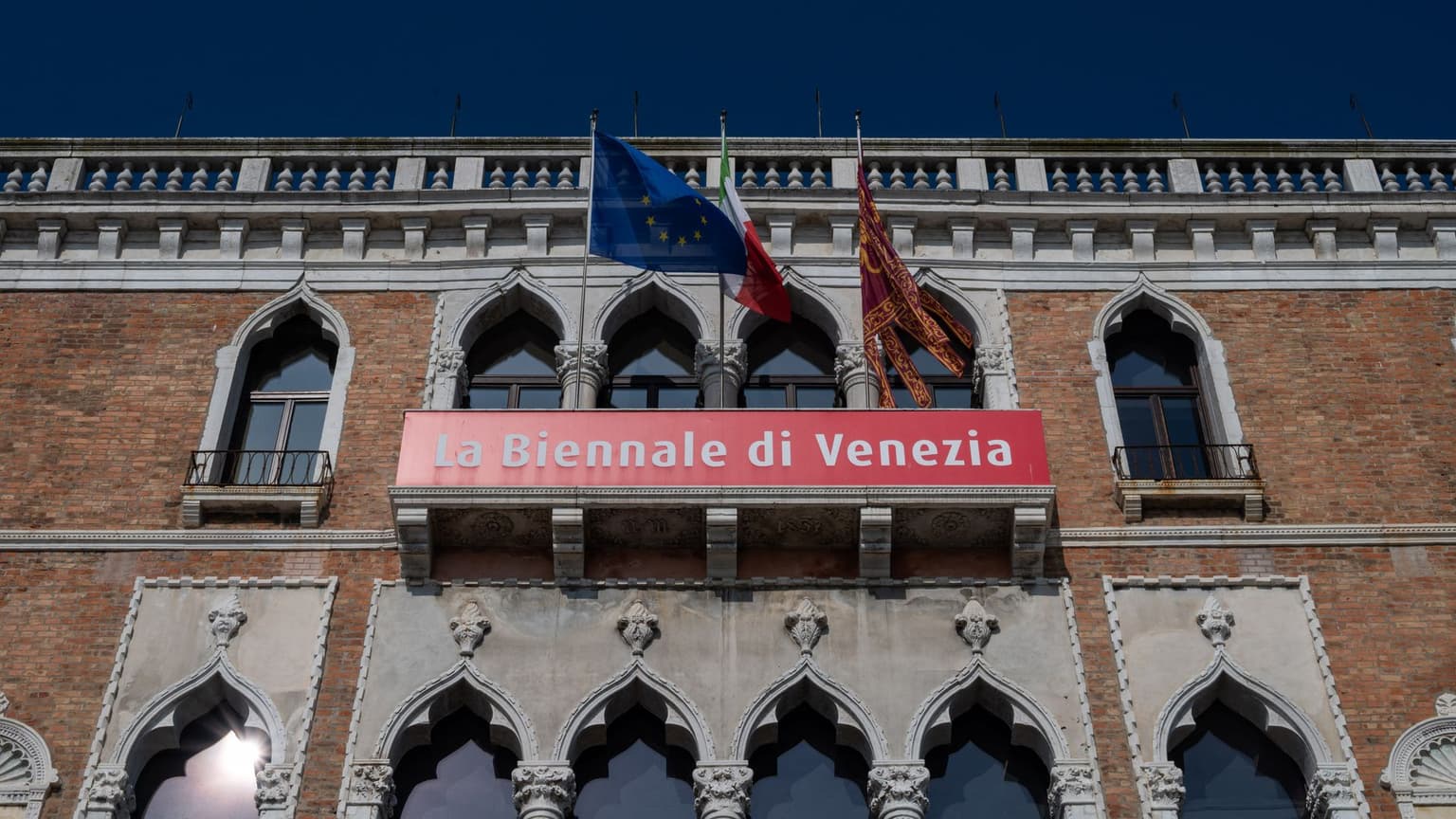
A Venetian Gothic facade adorned with banners for the 2026 Venice Biennale, with European, Italian, and Venetian flags displayed above in Venice, Italy, on Feb. 25, 2026. (Riccardo Milani / Hans Lucas / AFP via Getty Images)
 on Google
In the fifth year of Russia’s full-scale war against Ukraine, the Russian pavilion is set to return to the Venice Art Biennale with a “musical festival come to life” that serves as “a space for dialogue and exchange.”
The pavilion was effectively canceled in 2022 after the artists and curator chosen to represent Russia withdrew in protest of the invasion. At the time, the organizers of the Biennale released a statement praising the decision and condemning “all those who use violence to prevent dialogue and peace.”
While many international cultural institutions initially supported a boycott of Russian culture in solidarity with Ukraine, the consensus appears to be shifting — extending even to cultural initiatives associated with the Russian government.
Kirill Savchenkov, one of the artists who dropped out of the Russian pavilion in 2022, told the Kyiv Independent that he saw its reopening as “part of an ongoing culture war and some sort of active measures to cause political division in Europe.”
The Venice Biennale’s press office claimed that “Biennale has always complied with its regulations both for Russia and for those countries engaged in military actions.” They did not respond to the Kyiv Independent’s additional requests for comment.
The Russian government’s role in the pavilion poses a direct challenge to the idea that Russian culture can be considered wholly separate from Russian politics.
Mikhail Shvydkoy, Russia’s delegate for international cultural exchanges and former culture minister, boasted to ARTNews on March 3 that the Russian pavilion’s return to the Biennale showed that Russian culture was not “isolated” and that the West had “failed to cancel” it.
Anastasia Karneeva, who serves as the commissioner of the Russian pavilion, was given the title by Russia’s Culture Ministry in 2021 for an eight-year term.

“We are extremely interested in the more active participation of our cultural figures in shaping an international artistic agenda,” Russian Culture Minister Olga Lyubimova said at the time of her appointment.
Karneeva’s ties to the Russian state go beyond her appointment as commissioner of the Russian pavilion, though.
Smart Art — an art consultancy company co-founded by Karneeva in 2016 — has also been involved for a number of years in the work of the Russian pavilion.
Karneeva’s business partner at Smart Art is Ekaterina Vinokurova, the daughter of Russian Foreign Minister Sergey Lavrov. Vinokurova has been sanctioned since 2022 by the U.S, Canada, the U.K., Australia, and Japan — but not the EU.


Karneeva herself is the daughter of Nikolai Volobuev, the deputy CEO of Rostec, Russia’s largest state-owned defense company. Volobuev has been sanctioned by the U.S., the U.K., and Canada.
Her business dealings, according to reports, are not limited to the art world. In 2020, the Russian online business magazine Ko reported that Karneeva had become a co-owner of Carbonix, a Rostec-affiliated company that has described itself as “the only manufacturer in the world” of carbon implants for bone replacement.
The Kyiv Independent reached out to Karneeva to try to clarify the extent of the Russian government’s involvement in this year’s program and if the artists involved were allowed to declare an anti-war position.
As of publication, she has yet to reply.
The number of musicians chosen by Karneeva and her team for this year’s Russian pavilion has puzzled some observers, given that the Venice Biennale maintains a separate program dedicated to music.
Ekaterina Antonenko — artistic director and chief conductor of the A.V. Sveshnikov State Academic Russian Choir, which has received recognition from Russian President Vladimir Putin — is listed among the attendees.
The lineup for this year’s Russian pavilion also includes members of the Toloka ensemble, a nationalistic folk ensemble of young people who have performed in support of Russian soldiers fighting in Ukraine.
“Perhaps the most cynical part of the story (relating to invited musicians) is that they are bringing in a DJ from Mali — a country that has effectively become a Russian client state since 2021, following waves of documented crimes against humanity committed by the Wagner mercenary group,” Ukrainian art curator and journalist Konstantin Akinsha told the Kyiv Independent.
Some of the Russian democratic opposition in exile have been speaking out against the return of the Russian pavilion, with Pussy Riot co-founder Nadya Tolokonnikova warning them to “expect resistance."

“Obviously, this culture war moment is less pressing than defending the skies above Kyiv, or the lives and territories near the front line,” Tolokonnikova told the Kyiv Independent, “but I hope I can rally some artists to meet and push back this attempted normalization of a terrorist regime.”
In a March 5 post on X, formerly known as Twitter, Tolokonnikova wrote about how Italy had the power to prevent the return of the Russian pavilion — if they actually wanted to.
The Russian pavilion is located on the grounds of the Giardini, an area of parkland in Venice, which is the property of the Italian state. Given that the pavilion is not an embassy and does not exist on sovereign Russian territory, the Russian government does not have any official claim to it.
After the controversy surrounding the return of the Russian pavilion gained momentum, the Italian Culture Ministry publicly claimed that it had nothing to do with the Venice Biennale’s decision.

Pietrangelo Buttafuoco, who was appointed by the Italian Culture Ministry as the head of the Venice Biennale in 2023, is a journalist with known right-wing views. He previously declared in 2018 that Putin was "the only true right-wing statesman" in the world and questioned why Russia was considered by the West as "a rogue state."
“This is not culture outside politics, but politics disguised as culture,” Tolokonnikova said, adding that the Russian state’s participation in this year’s Biennale was “a serious blow to Europe’s security.”
“The Kremlin has long used culture as a continuation of foreign policy — and as a way to legitimize the regime abroad. It is the cultural expansion of imperial Russia into the heart of Europe.”
read also
 Kate Tsurkan
 Kate Tsurkan