Russia steps up attacks with Kh-32 missiles — here's what we know
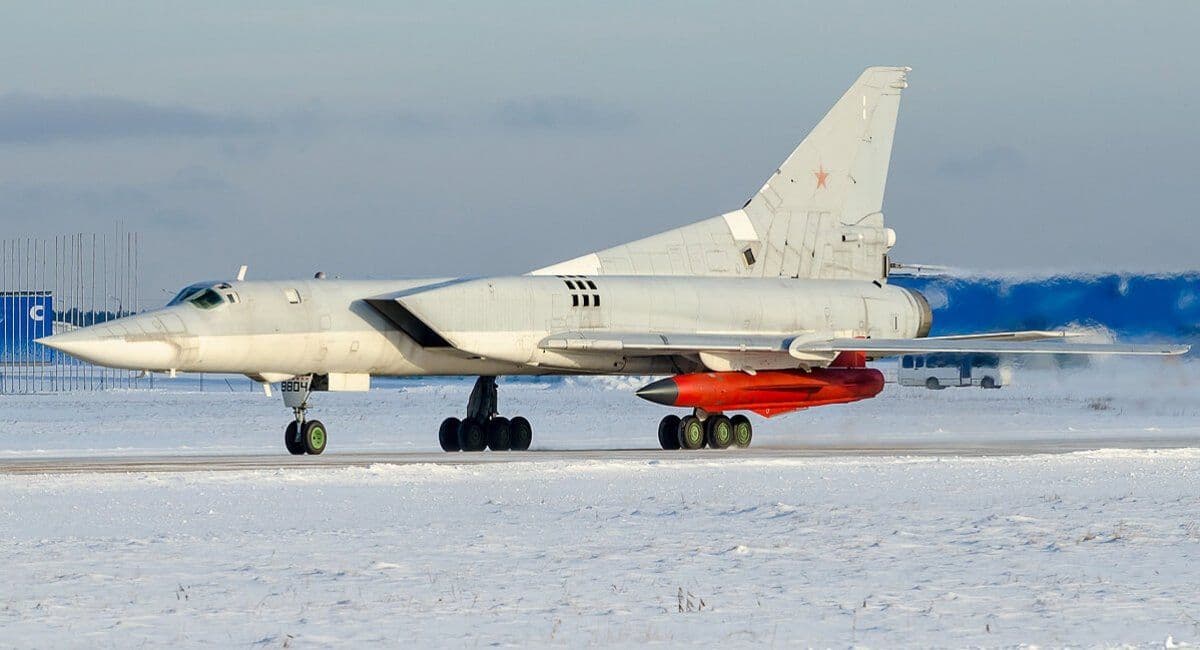
Tu-22M3 with a Kh-32 missile in an undated photo. (militarnyi.com)
 on Google
On Jan. 24, Ukraine's Air Force reported intercepting nine Kh-32 missiles, drawing renewed attention to a weapon that Russia has until now used sparingly in attacks on Ukraine, but often with devastating consequences.
Known for its high speed and steep flight profile, the missile has long posed a serious challenge for Ukraine’s air defenses, with advanced systems such as the U.S.-supplied Patriot among the few capable of countering it.
The missile is extremely difficult to intercept, due to its combination of speed, high-altitude flight, and sharp terminal dive. Its use during the full-scale invasion has been linked to some of the deadliest attacks on civilians.
These include the June 2022 strike on the Kremenchuk shopping mall, which killed at least 21 people.
What is the Kh-32 Missile?
The Kh-32 is a modernized version of the Soviet-era Kh-22 air-to-surface cruise missile, originally designed to strike large naval and ground targets.
The development of Kh-32 began in the late 1980s at the Raduga design bureau, but the project was repeatedly halted following the collapse of the Soviet Union due to funding constraints.
Work on the missile resumed in the mid-1990s, with early testing conducted in 1998, before stalling again because Russia lacked resources to modernize its carrier aircraft. Testing resumed only in 2008, after a Tu-22M3 strategic bomber was modified specifically for the program.
The Kh-32 was first publicly presented in 2016, the same year Russia formally declared it operational.


The missile is air-launched and designed for long-range, hypersonic flight, with a reported range of up to 1,000 kilometers, enabled by enlarged fuel tanks. Defence Express, a Ukrainian military outlet, estimates its speed at Mach 4 to Mach 5, depending on flight profile.
The Kh-32 uses a combination of inertial navigation and an active radar seeker, a guidance system optimized for engaging large, high-contrast targets rather than precision strikes. Its warhead is believed to be smaller than that of the Kh-22, though Russian authorities have not disclosed its exact weight.
Russian media has portrayed the Kh-32 as a next-generation "highly effective" weapon, capable of "striking both surface and small ground targets."
In practice, however, the Kh-32 remains large, heavy, and logistically demanding, requiring liquid fuel, which complicates storage, handling and pre-launch operations. It can only be launched from the Tu-22M3, limiting the number of missiles Russia can deploy simultaneously and constraining their operational use.
"Despite the upgrades, this is not a fundamentally new weapon," says Andrii Kharuk, a Ukrainian historian and weapons expert. "It is an attempt to modernize an old Soviet design, not to turn it into a precision missile."
What are the dangers of KH-32?
The threat posed by the Kh-32 lies less in technological novelty than in the combination of speed, altitude, and flight profile, which together make it a challenging target for air defenses.
"It is a difficult missile to intercept," said Douglas Barrie, senior fellow for military aerospace at the International Institute for Strategic Studies (IISS). "After launch, it climbs to a very high altitude, and in the terminal phase it comes in at a steep angle and at high speed. From a defender’s perspective, that makes it a particularly challenging target."
Barrie noted that this flight profile, while complicating interception, also carries a trade-off for the attacker.
"That kind of approach doesn’t help the missile’s accuracy," he said. "Coming in at high speed and at a steep angle increases the risk that it may not hit the intended target."
"Patriot, and potentially the SAMP-T system using missiles from the Aster family, are really the only systems available to Ukraine that would have a reasonable chance of engaging the Kh-32."
The Kh-32’s design reflects its origins as a weapon intended to strike large-area targets, such as aircraft carriers or major industrial facilities, rather than conduct precision strikes. When used against cities, its limited accuracy combined with a large explosive payload significantly increases the risk to civilians.
For much of the war, Ukrainian officials have warned that intercepting the Kh-32 was beyond the reach of most air defense systems available to Ukraine. According to Barrie, only a very limited number of systems currently offer a realistic chance of interception.

"Patriot, and potentially the SAMP-T system using missiles from the Aster family, are really the only systems available to Ukraine that would have a reasonable chance of engaging the Kh-32," he said.
France has announced plans to supply Ukraine with the newer SAMP-T NG variant, which Ukrainian officials say could further strengthen air defense coverage against high-speed, high-altitude threats. However, as with Patriot, such systems remain scarce, limiting the areas that can be fully protected.
At the same time, the Kh-32’s operational use is constrained by practical factors. Because of its size and the characteristics of its carrier aircraft, launches cannot be conducted on a large scale.
"A Tu-22M3 can carry only one or two of these missiles," Kharuk said. "This limits how widely Russia can use them."
Even with these constraints, the Kh-32 remains a serious threat, particularly in regions without advanced air defense coverage – underscoring both the significance of recent interceptions and Ukraine’s continued calls for additional modern air defense systems.