The war's hidden explosions: The mental health toll inside Ukraine's homes
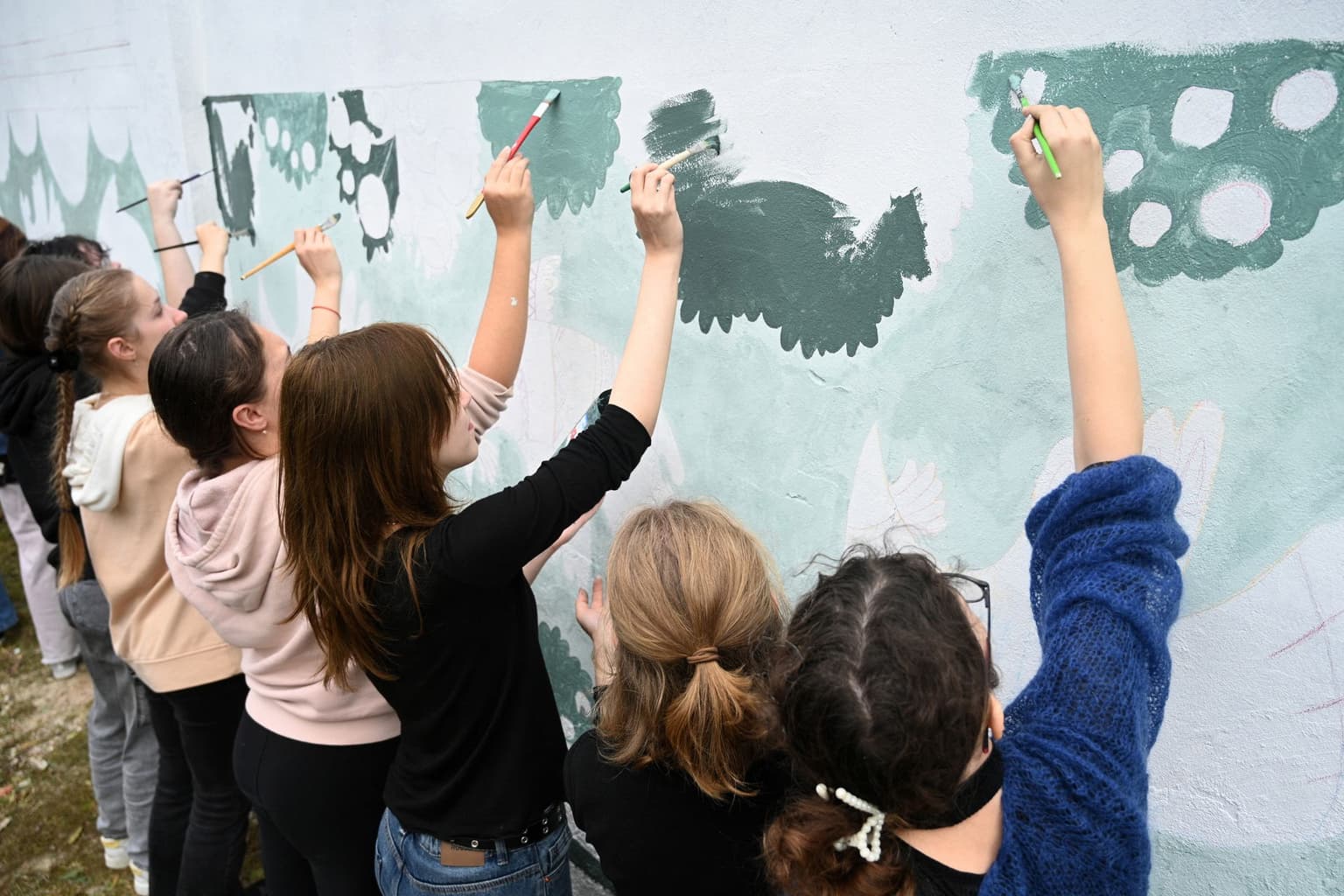
Students paint a mural during the Kulparkiv Fest to mark World Mental Health Day in Lviv, Ukraine, on Oct. 10, 2024, amid the Russian invasion of Ukraine. (Yuriy Dyachyshyn/AFP via Getty Images)
 on Google
Jacqueline Mahon
UNFPA Representative to Ukraine
About the author: Jacqueline Mahon is the United Nations Population Fund (UNFPA) representative to Ukraine.
After the start of the full-scale invasion, Olha (name changed due to safety concerns) and her husband took in his mother to live with them.
When her husband left for the front line, Olha stayed in the apartment alone with her mother-in-law. The relationship between the two women deteriorated and became violent. After repeated assaults by her mother-in-law, Olha was forced to leave the apartment with almost none of her belongings.
A neighbour helped her contact a psychosocial support mobile team, which transported her to a crisis shelter. There she began receiving counselling and support to rebuild her sense of safety and control.
Her story reflects the pressures reshaping relationships across Ukraine and the silent struggles many endure behind closed doors. Children who witness violence may carry those patterns into adulthood. Men returning from the front line often struggle to reintegrate. Women trapped by curfews or blackouts find fewer opportunities to seek help.
A city can repair a bridge, but if its homes remain violent or unstable, recovery will remain fragile and elusive.
As winter deepens in Ukraine, attacks on homes, hospitals, and critical infrastructure continue. Across the country, millions are left in darkness and cold as strikes cripple the energy grid. This is the reality Ukrainians wake up to, again and again.
If Ukraine's recovery plans focus only on reconstruction and not on mental health, the country risks rebuilding its cities while its homes remain unwell.
These repeated blows do more than destroy infrastructure. They accumulate into a national exhaustion felt in homes, families, and communities — a psychological strain that cannot be measured in power outages or shattered buildings.
If Ukraine's recovery plans focus only on reconstruction and not on mental health, the country risks rebuilding its cities while its homes remain unwell.
Mental health needs are already surging, and the toll is becoming impossible to ignore.
Surveys show that 58% of people in Ukraine report symptoms of anxiety, and 83% experience extreme stress linked to shelling, displacement, and loss. The United Nations Population Fund (UNFPA) estimates that as many as ten million people could develop a mental health condition because of the war.
Even when an attack does not hit you or your household directly, you live with the fear that the next one might. That uncertainty war brings has seeped into the daily lives of everyone in Ukraine. It does not just disturb sleep or concentration — it rewires the nervous system. You live braced for impact. This constant readiness leaves people drained, foggy, and exhausted.
In my work across the country, people describe symptoms that appear immediately: sleeplessness, irritability, sudden anger. Others say they surface years later in a broken relationship, a violent outburst, or a moment of panic they cannot explain.

These are the "hidden explosions," the war plants inside families and communities, long after physical debris has been cleared.
Since the full-scale invasion, reports of domestic abuse, sexual assault, and other forms of gender-based violence have surged. Nearly 2.4 million people — mostly women and girls — are at risk and urgently need access to response services.
These are not isolated cases. Years of stress, fear, and economic pressure have created a social landscape primed for rupture. In some households, that rupture comes as shouting or slammed doors; in others, as intimate partner violence.
The violence of the front line moves into communities and homes: through missile strikes, through the untreated trauma many men carry when returning from war, and through the grief of families who have lost loved ones. These pressures erode the dynamics of relationships and destabilize the very spaces where people should feel safest.
Speaking about mental health is often the first step toward breaking these cycles.
Across Ukraine, communities are already responding to these challenges. Survivor relief centres, shelters, and crisis rooms — many led by former internally displaced people and survivors themselves — provide psychosocial, legal, and social support in one confidential space. These centres serve displaced people, survivors of gender-based violence, and anyone navigating the war's disruptions.
At the same time, psychosocial support mobile teams travel to hard-to-reach areas, including front-line zones where services are scarce.
These initiatives demonstrate a simple truth: community-led solutions are already emerging, and Ukraine's recovery must invest in them.
Local people understand their own realities, the risks they face, and the relationships that shape their daily lives.
The national response to mental health is also being elevated at the highest level through the leadership of the First Lady, Olena Zelenska.
Ukraine's recovery will be measured not only by the reconstruction of power plants, roads, or homes, but by whether those homes are safe; whether survivors are heard; and whether communities have the capacity to prioritize care.
Mental health and gender-based violence cannot be treated as side issues. If they are, the war will continue living inside Ukraine's homes long after the fighting ends.
However, if Ukraine confronts these challenges directly — with national investment, community-driven solutions, and a recognition that mental health is essential infrastructure — the country can rebuild a future defined not only by restored cities, but by the well-being and strength of the people who inhabit them.
Editor’s note: The opinions expressed in the op-ed section are those of the authors and do not purport to reflect the views of the Kyiv Independent.