Teaching journalism the Russian way: How RT Academy spreads propaganda in Global South
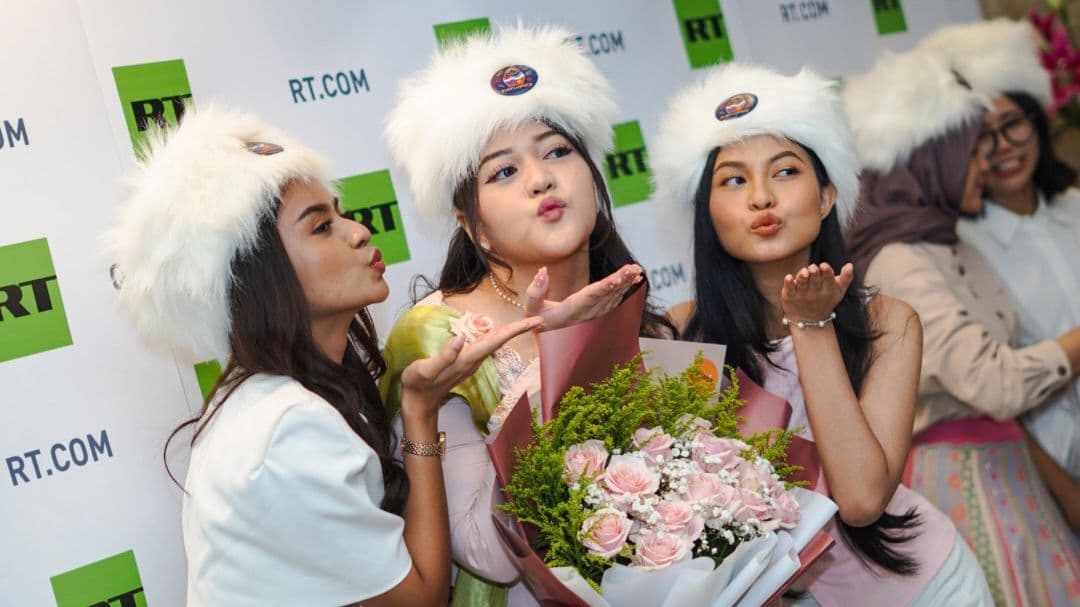
Members of Rusfluence, a Russia–Indonesia Influencer Club, pose for a photo at an event hosted by RT Academy for Indonesian media and content creators on Nov. 30, 2025. (Rusfluence / Instagram)
 on Google
Russia is scaling up its educational programs for journalists in Southeast Asia, Africa, China, and India, pushing a pro-Kremlin agenda and propaganda under the guise of an "alternative narrative" and a "fight against fakes."
In December 2025, Russian state-run media outlet RT (formerly Russia Today) held a three-day journalism training event, RT Academy, in Jakarta, Indonesia, for more than 250 journalists, media students, and content creators from Indonesia, Malaysia, South Korea, Cambodia, Thailand, and the Philippines.
The sessions, offered free of charge, were held at Russia's cultural center, RT's Indonesia and ASEAN Bureau, and a partner university in Indonesia.
RT framed the program around universal journalistic themes and techniques, covering topics such as "fact-checking digital sources" and "applying ethical standards in social media storytelling."
Local media reported that sessions also addressed "the role of journalism in democratic societies," as well as the "growing risks posed by misinformation and AI-driven content."

Yet RT's long record of spreading disinformation and pro-Kremlin narratives under the guise of independent journalism casts doubt on these stated goals. Critics argue the program is less about journalistic standards and more about expanding Russian influence in countries Moscow increasingly views as politically receptive.
Teaching 'fighting disinformation' by spreading it
The Jakarta training was led by RT journalists and executives, including Anna Kovtunova, head of RT Academy; Maria Zeleranskaya from RT's international newsroom; Dmitry Leontev, a senior producer; and Oksana Boyko, host of Worlds Apart, RT's controversial talk show.
The agenda also included a panel featuring members of Rusfluence, a Russia-Indonesia Influencer Club presented as a youth cultural exchange initiative. Members of the group have previously sent handmade matryoshka dolls to Russian soldiers fighting in Ukraine, accompanied by messages praising their "bravery" and Russia's "heroes."
Rusfluence founder Anastasha Wibisono told Russian state media that the gifts expressed support for Russia's "just cause." The group is closely linked to Russian authorities, with many events organized in coordination with Russian diplomatic missions in Indonesia.

Volodymyr Solovian, head of the Hybrid Threat Analysis Group at the Ukrainian Crisis Media Center, points to RT Academy’s close links with other Russian state-linked initiatives abroad.
He notes that many RT Academy events — particularly workshops, masterclasses, and offline meetings with local journalists and students — are held at Russian cultural centers, also known as Russian Houses.
These centers have drawn increasing scrutiny over allegations of propaganda, disinformation, and, in some cases, espionage. While many Western countries have shut them down, Russia's diplomatic and cultural presence is growing in Asia and Africa.
“As a result, beyond their direct engagement with RT Academy, participants of these events are also exposed to propagandistic content produced by other institutions of Russia's 'soft power,'” Solovian says.

RT Academy promotes courses on "content verification" and "combating fake news," describing its mission as providing "objective coverage." Promotional materials encourage participants to “question more" and challenge mainstream narratives.
Yet despite its claims of fostering media literacy, Stephen Hutchings, a professor of Russian Studies at the University of Manchester, warns that the RT Academy's curriculum often reinforces Kremlin messaging, giving the appearance of professional training.
Lessons frequently highlight supposed "bad practice" taken from reputable Western outlets, including the BBC and Deutsche Welle, particularly in coverage of Russian atrocities in Ukraine.
Solovian echoes this assessment, noting that propagandistic narratives are embedded primarily through contrasts drawn with Western media.
“In this framing, Russian propagandists project their own manipulative practices onto outlets like the BBC, DW, CNN, and others,” he told the Kyiv Independent.
The BBC, after joining an RT Academy online course for African journalists in 2024 and reviewing the lesson materials, found that the program included clear propaganda narratives. One lesson on breaking news, for instance, featured a story from Mariupol, occupied by Russia, in which surrendered Ukrainian soldiers were labeled "neo-Nazis and radicals of various kinds."
In another seminar supposedly dedicated to exposing fakes, RT anchor Ihor Kurashenko denied the Bucha massacre, where Russian forces killed hundreds of Ukrainian civilians in 2022, calling it "the most famous fake."
"Russia denies these accusations. The Ukrainian side has still not provided details of this tragedy. The Permanent Representative of the Russian Federation to the U.N. has been requesting a list of the supposedly killed people for two years,” he claimed.
The Kremlin has long used Bucha in state propaganda, denying the extensively documented crimes committed by Russian forces.
The Ukrainian Prosecutor General's Office has documented over 1,400 civilian killings in the Bucha District, including 637 in Bucha itself. Among the victims were 37 children. Many were executed, their bodies left on the streets or buried in mass graves.
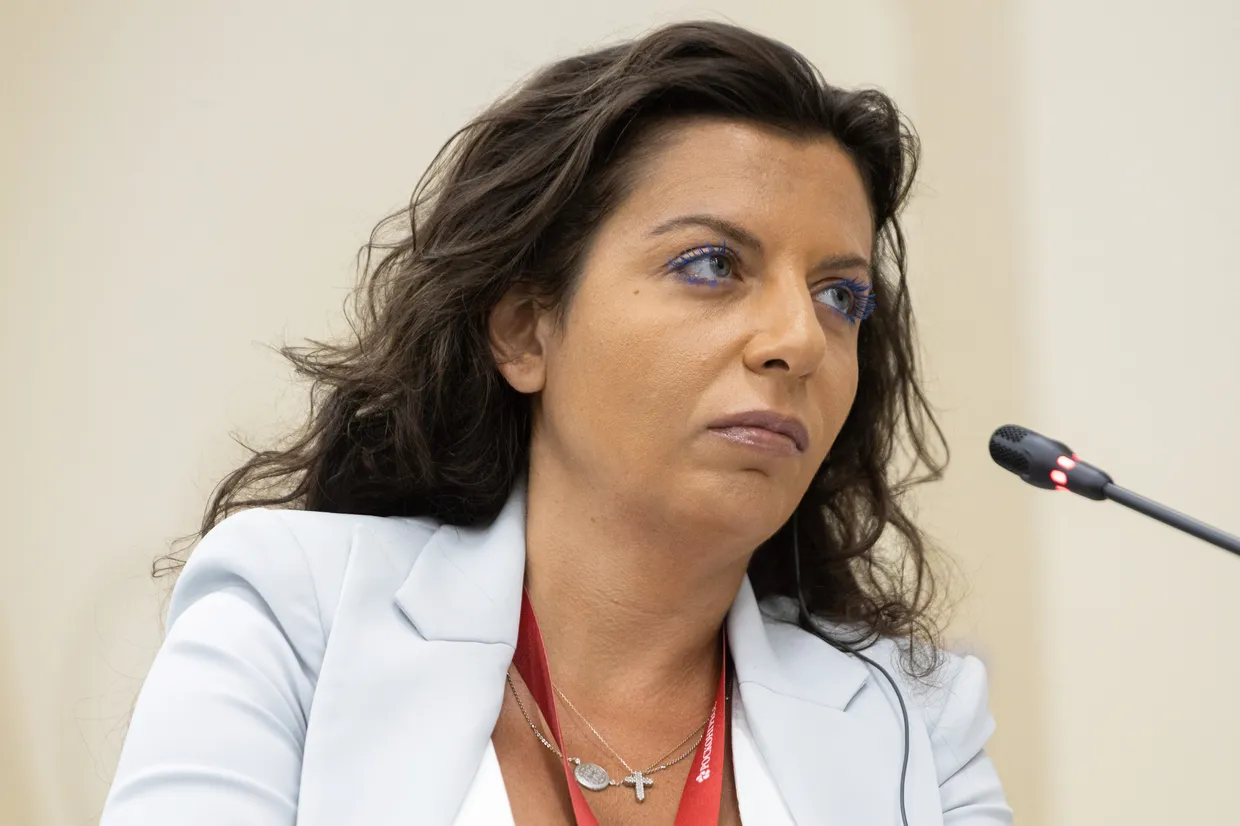
The RT Academy's approach reflects a long-standing rejection of impartiality and objectivity in RT's news reporting. As RT editor-in-chief Margarita Simonyan has said, "There is no objectivity — only approximations of the truth by as many different voices as possible."
Hutchings emphasizes that the Academy teaches reporting aligned with Kremlin epistemological principles and Russian state messaging, particularly narratives framing Western powers as imperial aggressors while justifying Russia’s war in Ukraine.
RT's Global South pivot
Many Western countries have restricted or banned RT due to its role in justifying Moscow's aggression and manipulating global audiences. In response, Moscow has shifted its media strategy toward regions where RT remains widely accessible: Asia, Africa, the Middle East, and Latin America.
RT recently began broadcasting in India and has announced plans to establish a major English-language hub in South Africa, as Africa remains one of the key targets of Russian state influence.
Established in 2023, RT Academy has since conducted online and in-person training programs for journalists from ASEAN countries, India, China, Senegal, Ethiopia, and beyond. Participation is free and fully funded by the Russian state, underscoring that the program is more a tool for expanding influence under the guise of journalistic training than an educational initiative.

Hutchings says RT Academy appeals to young journalists in the Global South for three reasons: the training is free and accessible, participants gain access to RT's global network, and sessions are led by recognizable RT presenters.
"With their historical hostility to perceived U.S. imperial arrogance, audiences in these regions are especially receptive to the 'anti-Western hegemony' and 'anti-colonial' narratives that Russia uses to defend its violent aggression in Ukraine," Hutchings told the Kyiv Independent.
A tool of influence, not education
Russian President Vladimir Putin, speaking at the launch of RT's channel in India, said: "The goal is not just to propagate Russia and its culture. RT is trying to convey truthful information about our country and what is happening in the world."
In practice, RT's version of truth closely aligns with Moscow's geopolitical interests. Joseph Siegle, director of research at the Africa Center for Strategic Studies, an academic institute within the U.S. Department of Defense, told NewsGuard that RT's journalism training mirrors broader Russian efforts to cultivate sympathetic media voices.
"It is highly unlikely that this is an authentic journalism course," Siegle said. "It resembles other Russian efforts to woo African voices to provide more favorable coverage of Moscow and parrot Russian talking points."

Solovian notes that Russia aims to attract as many participants as possible to RT Academy in a short time, signaling an effort to project RT's global influence. According to the RT Academy website, the courses have reached around 7,000 participants since their launch.
He adds that, at least for African participants, courses are already offered in French in addition to English, and RT Academy has announced plans to expand the range of teaching languages in the coming years.
Hutchings warns that although RT Academy is still relatively new, it poses a growing threat to democratic discourse, particularly in the Global South. There, he argues, Russian narratives are “increasingly aligned with those of China as part of a powerful authoritarian axis" and are finding fertile ground.
Editor's note: This article was published as part of the Fighting Against Conspiracy and Trolls (FACT) project, an independent, non-partisan hub launched in mid-2025 under the umbrella of the EU Digital Media Observatory (EDMO). Click here to follow the latest stories from our hub on disinformation.