Slovak opposition vows break from Fico's Ukraine course
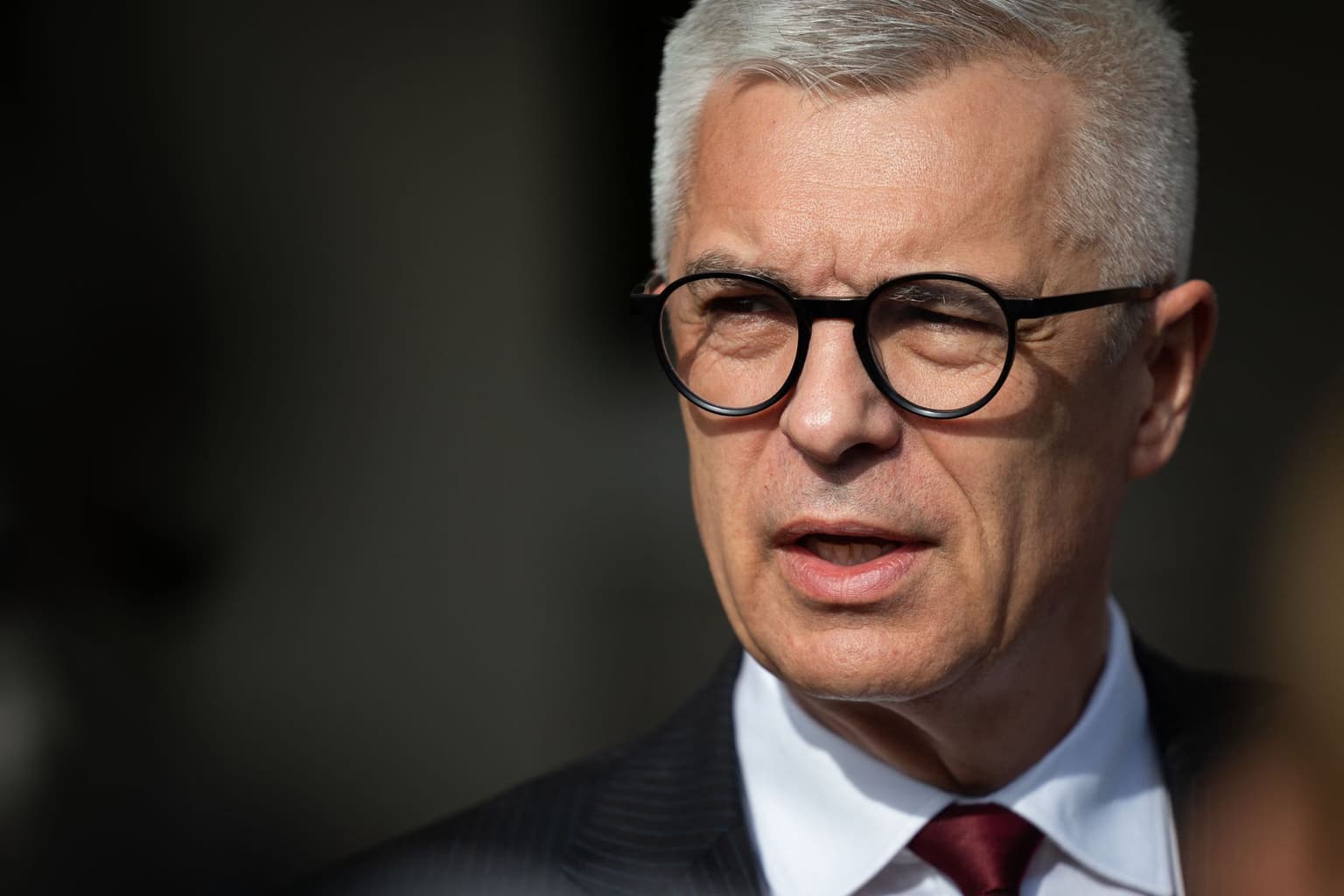
Slovakia's former minister of foreign affairs and presidential candidate Ivan Korcok in Senec, Slovakia, on April 6, 2023. (Tomas Benedikovic / AFP via Getty Images)
 on Google
Since returning to power in 2023, Prime Minister Robert Fico has transformed Slovakia from one of the most Ukraine-friendly countries to one of its sharpest critics.
A Russian-friendly populist, Fico has halted military aid to Ukraine, traveled to meet Russian President Vladimir Putin in Moscow, and obstructed EU backing for Kyiv.
Slovakia's pro-EU opposition wants to change course after next year's elections.
Fico's Ukraine policy has been "disastrous" and a "huge loss of credit for Slovakia," says Ivan Korcok, a seasoned diplomat who headed the Slovak Foreign Ministry when Russia's all-out invasion of Ukraine started.
In an online interview with the Kyiv Independent on March 30, Korcok, now a politician in Slovakia's strongest opposition party, accused the current government of "siding with Moscow."
"(Fico) is (...) betraying the Slovak national interest."
Korcok, 61, served as Slovakia's foreign minister between April 2020 and September 2022. In 2024, he ran for president but lost the runoff to Fico's ally, Peter Pellegrini, after securing only 47% of the vote.
Now, Korcok is responsible for the foreign policy at Progressive Slovakia (PS), a liberal party leading the polls with around 20-21%, just ahead of Fico's Smer party.
Talking to the Kyiv Independent, Korcok denounced Fico's policy as "anti-Slovak" and voiced his party's full support for Ukraine's struggle against Russian aggression.
"(Fico) is, first of all, betraying the Slovak national interest," Korcok said. Backing Kyiv is "not about being pro-Ukrainian" — it is in Slovakia's own interest, he added.
"By supporting Ukraine, we are pro-Slovak, because I am a Slovak patriot."
The Bratislava-Budapest alliance
Within the EU, Fico has been a close ally of Hungary's Prime Minister Viktor Orban.
Throughout the full-scale war, Orban has persistently obstructed sanctions against Russia and assistance to Ukraine, at times in cooperation with Fico.
A media investigation released on March 31 suggested that Budapest was lobbying against EU sanctions at Moscow's behest, at times in cooperation with Bratislava.
As Orban faces a potential defeat in the parliamentary elections on April 12, Korcok says Fico would take on the role of the EU's leading opponent of Ukraine if the Hungarian leader is ousted.

Fico and Orban are currently embroiled in a bitter dispute with Kyiv over the suspension of oil transit via the Druzhba pipeline, which funnels Russian crude to Hungary and Slovakia via Ukraine.
Kyiv says the disruption was caused by a Russian attack on western Ukraine, Budapest and Bratislava accuse the Ukrainian leadership of lying.
In early March, Fico vowed Slovakia would "take up the baton from Hungary" and block the 90-billion-euro ($104-billion) EU loan to Ukraine that Budapest is currently obstructing.
Commenting on the Druzhba dispute, Korcok said that Ukraine is justified in trying to weaken Russia's war funding. The economic difficulties Slovakia is facing are a consequence of Russian aggression — not Ukraine, he stressed.
"While Fico is missing Russian oil every morning, President Zelensky is missing peace," Korchok commented. Oil exports play a key role in funding Moscow's war machine.
"It would, however, help de-escalate the situation if… Ukrainian authorities allowed and permitted the EU fact-finding mission on the ground to see what needs to be done," he added.
Ukraine has thus far denied EU experts access to the damaged Druzhba facility, citing "security situation."
Should Orban win another four years in power, Slovakia's position could be vital to the EU's efforts to curb him. Article 7 of the EU Treaty allows the remaining 26 members to limit the voting rights of a member found to be in breach of the bloc's basic principles.
As Fico vowed to block this mechanism, the Slovak opposition's stance could be decisive after 2027.
Korcok declined to comment on a possible use of Article 7, saying he wants to avoid giving the Hungarian government grounds to claim external interference in its politics.
But while asserting impartiality in Hungary's election, Korcok gave some indication of where he stands.
"(The election) will be a test, a test whether Viktor Orban, with his type of illiberal governance, can get another mandate and continue his divisive policy within the EU," the Slovak politician said.
Ukraine in Fico's crosshairs
Across Central Europe, populists have turned on Ukraine to score political points. Slovakia is no different.
For Fico, Ukraine is "an instrument of division within the society," Korcok said. "He is misusing the Ukrainian tragedy to maintain and drive the division within the country."
Anti-Ukrainian rhetoric was a key part of Fico's 2023 campaign. He claimed that military support for Kyiv prolonged the war and alleged "Ukrainian fascists" caused the war in Donbas — borrowing a page from Russian propaganda.
Fico is using this method "when the very existence of our neighbor Ukraine is at stake, at the very moment when Russia is completely destroying the entire security architecture of Europe," Korcok said.
The strategy has been polarizing, as the Slovak population remains divided on Ukraine. Fico's pro-Russian leanings have sparked mass popular protests in recent years.


But some observers have noted a divergence between what Fico tells his voter base and his actual policies.
Despite pledging not to send a "single bullet" to Kyiv, Fico has allowed Slovak defense companies to continue doing business with Ukraine. Unlike Orban, he has also not opposed Ukraine's EU accession efforts.
In spite of this, Korcok rejected the framing that Fico's anti-Ukrainian rhetoric at home is just a cover for behind-the-scenes pragmatism in Brussels.
"Whatever he says, either in Slovakia or in Brussels, he is losing credibility. He has no influence within the European Union," Korcok commented.
"I don't buy this narrative about Fico's pragmatism, because he's destroying the credibility of Slovakia."
There is still a long way to go until the next elections, and current polls suggest a tight race.
The landlocked country remains heavily reliant on Russian oil and gas, and is seen as among the most vulnerable to Russian disinformation campaigns.
But Korcok is hopeful.
"Every week, I am traveling across Slovakia," he said. "And I know from my direct engagement with Slovak citizens that they are fed up."