Russia's war is erasing Kostiantynivka's Soviet-era mosaics — this is why it matters
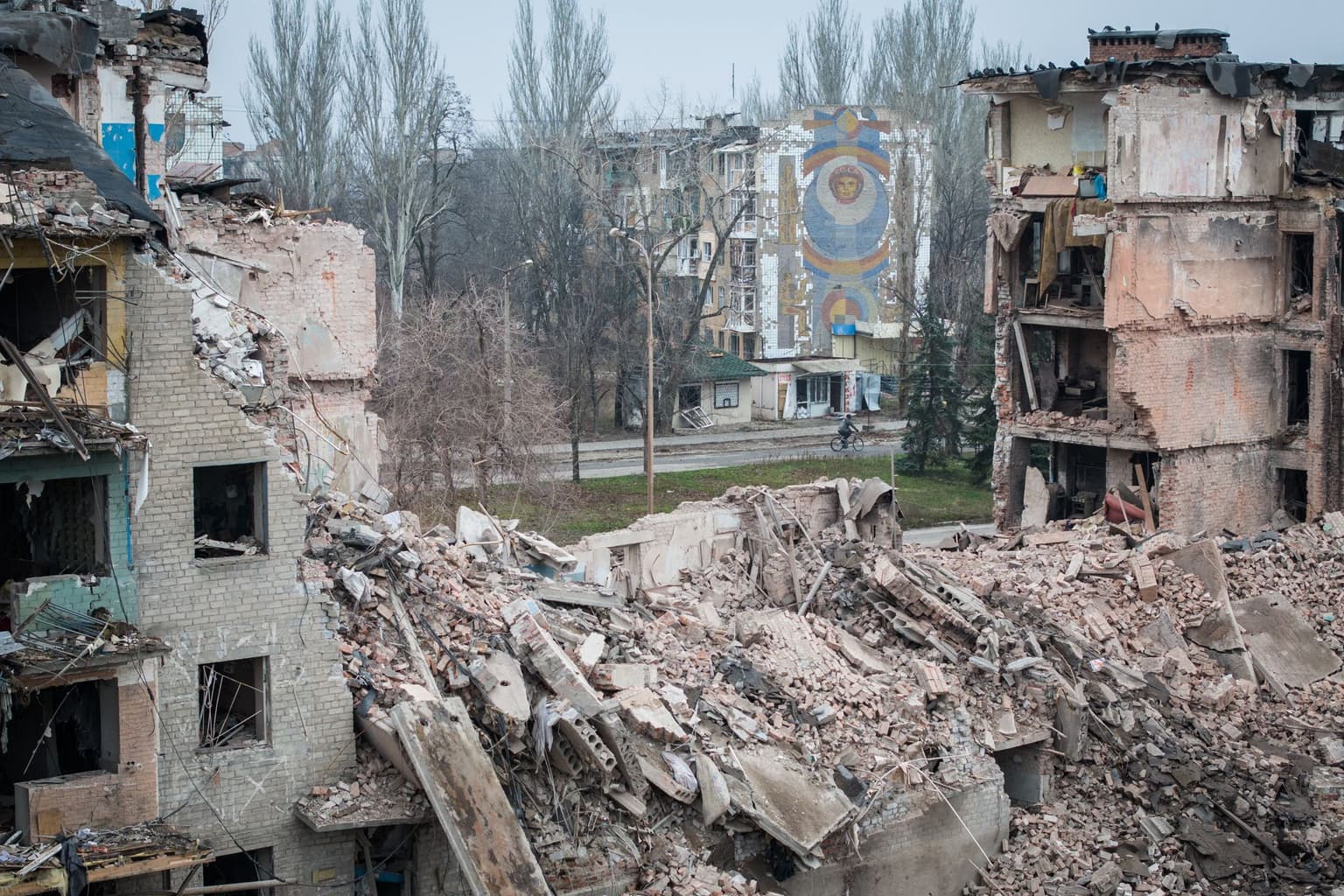
Mosaics in Kostiantynivka, Donetsk Oblast, Ukraine, on Dec. 4, 2025. (Oleg Petrasiuk / 24th Separate Mechanised Brigade named after King Danylo)
 on Google
The mosaics covering the facades of factories, cultural centers, and apartment blocks across eastern Ukraine were designed with a specific kind of permanence in mind. They survived the Soviet collapse, the chaos of the 1990s, and decades of post-industrial neglect.
What these mosaics couldn't survive was Russian artillery. As Russia’s full-scale war enters its fifth year, the fighting is erasing art that was meant to be indestructible.
Photographer Oleg Petrasiuk has captured not just images of endangered artwork, but evidence of a cultural landscape in the process of disappearing in Ukraine’s eastern city of Kostiantynivka in Donetsk Oblast. These photographs document what happens when artillery and bombs don't distinguish between military infrastructure and the accumulated memory of place — when a shell that destroys a building also destroys the mosaic that defined it, the artwork that gave it identity, the visual landmark that made it home.


This is documentation as a salvage operation, an attempt to preserve in pixels what can no longer be preserved in tesserae, to create a digital archive of monuments that may soon exist nowhere else. Yet, this work poses significant questions about what we choose to remember and how.
During the decades of socialist construction, Moscow dispatched artists across Ukraine and the broader Soviet-controlled space with a specific mandate — to cover the facades of factories, metro stations, community centers, and apartment blocks with mosaics. The work paid well, sometimes exceptionally so by Soviet standards, which ensured a steady supply of talent ready to execute the state's vision.
They were ideological monuments masquerading as public art, and their genius lay in how thoroughly they colonized the visual landscape.
But the real investment wasn't in the artists — it was in the medium as a successful tool of propaganda. Unlike posters that could be torn down, books that could be burned, or films that could be banned, mosaics were structural. They were built into the walls, fused with the buildings, inseparable from the spaces where ordinary people lived, worked, and waited for buses.
This was propaganda as geology — slow, patient, designed to persist long after the regime that commissioned it had calcified into history. The mosaics depicted heroic workers, bountiful harvests, cosmonauts ascending toward socialist futures, all rendered in tesserae that wouldn't fade or tear or yellow with age.


They were ideological monuments masquerading as public art, and their genius lay in how thoroughly they colonized the visual landscape. They couldn't be avoided because they were simply there, part of the environment.
After 1991, Ukraine faced a question that would become familiar across the former Soviet space — what to do with a landscape saturated in Communist imagery?
These mosaics posed a particularly interesting problem. They couldn't be dismissed as purely propagandistic, because many of them weren't. The iconography was prescribed — the heroic worker, the abundant harvest, the radiant future. But within those constraints, many artists had found room for a distinctive compositional sensibility, an unexpected color palette, or a formal sophistication that exceeded the ideological mandate. Serious artists learned to smuggle their aesthetic ambitions inside officially sanctioned forms.

As art historian Olena Borisova notes, these particular mosaics, seen in Petrasiuk’s photographs, located on the city’s Cosmonatus Boulevard, capture the spirit of industrialization promoted during the space race.
"Their themes are entirely in the spirit of the time — outer space, technological progress, and the glory of the local industrial giant, the Kostiantynivka Auto Glass Factory. It was here that aircraft and rocket portholes were once produced, as well as the ruby Kremlin stars and the crystal fountain for the 1939 World’s Fair in New York," Borisova wrote.
Now these mosaics find themselves on the front lines of a war that has turned questions of preservation from academic debates into desperate triage. The mosaics' structural permanence, once their greatest strength as propaganda, has become their fatal vulnerability. They cannot be evacuated like museum collections, rolled up like paintings, or moved to secure storage like sculptures.


They are fused into the buildings, inseparable from the walls. To remove them would require resources that don't exist in active war zones, and wouldn't matter anyway when the buildings themselves are being destroyed. The same quality that made them indestructible propaganda now makes them immovable targets.
So the work of preservation has been reduced to its most minimal form — documentation. If the mosaics cannot be saved physically, they can at least be recorded digitally — photographed, cataloged, and archived before they're reduced to rubble and dust.
The geography of this destruction is grimly specific. While Soviet mosaics can be found throughout Ukraine — in Kyiv metro stations, on Lviv apartment blocks, across the facades of provincial cultural centers from Chernihiv to Odesa — some of the most significant concentrations exist in the industrial cities of Donetsk Oblast.
This isn’t coincidental. The greater region historically known as the Donbas was the coal-and-steel heartland that powered Soviet industrialization and earned it disproportionate attention from state planners and propagandists alike. The region was showered with investment, infrastructure, and ideological decoration.
Cities like Mariupol, Lysychansk, Sievierodonetsk, and Bakhmut became open-air galleries of Soviet monumental art, their mosaics depicting miners descending into shafts, steelworkers tending furnaces, the muscular optimism of industrial modernity rendered in millions of colored tiles. These were among the finest examples of the form — ambitious in scale, sophisticated in execution, commissioned when Soviet confidence was at its height.

Now these same cities have become synonymous with destruction during Russia’s war. Some have been destroyed, reduced to rubble along with the buildings they adorned. Others survive in fragments, half a worker’s face still visible on a bombed-out wall, a section of bright geometric pattern clinging to concrete amid the ruins.
What took months to create and decades to endure can be erased in seconds by a single shell.