The hidden cost of Putin’s war: A more dependent Russia
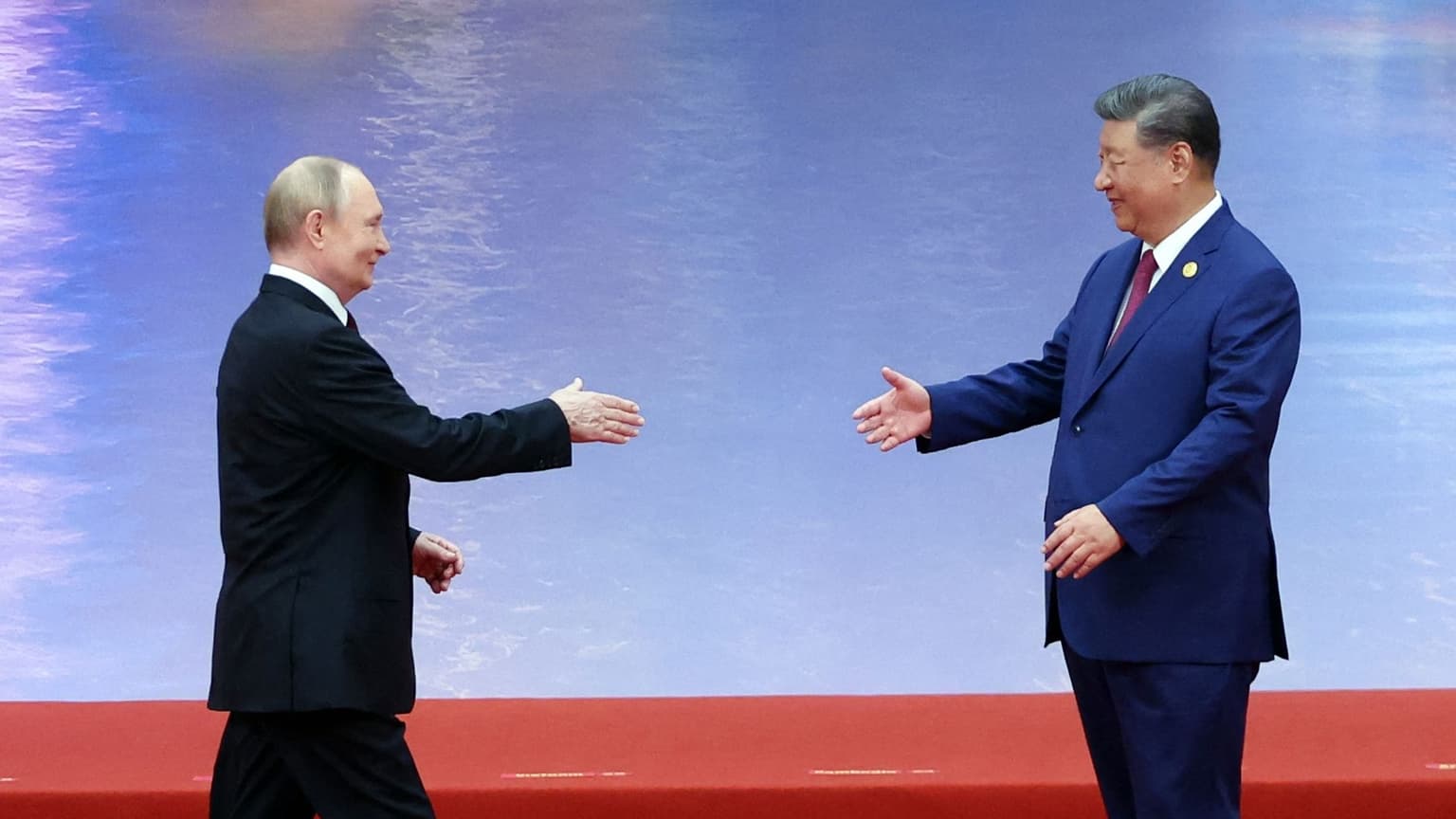
In this pool photograph distributed by the Russian state agency Sputnik, Russia’s President Vladimir Putin, Chinese President Xi Jinping in Tianjin, China, on Aug. 31, 2025. (Alexander Kazakov / Pool / AFP via Getty Images)
 on Google
Russian President Vladimir Putin has increasingly characterized his all-out war against Ukraine as a struggle for "sovereignty," yet what limited territorial gains Russia has achieved since 2022 pale in significance to the staggering dependence on China that has emerged.
While the Kremlin had already been pursuing a "pivot to the East" for some time, this was never presented as the rapid wholesale embrace of Beijing necessitated by the protracted conflict. In fact, Western sanctions have left Moscow with little choice as the toll on the economy has grown.
"Russia is indeed being drawn into an asymmetrical partnership with China and may have to make concessions that affect its sovereignty," Dumitru Minzarari, a lecturer in security studies at the Baltic Defense College in Tartu, Estonia, told the Kyiv Independent. "However, this is not how Putin views the situation, and therefore, he acts as if Russia's sovereignty is not affected."
"In a short-term perspective, Russia's sovereignty is not at threat, so perhaps this is what Russian strategic planners rely on — being able to stop short of becoming politically dependent on China in certain issue areas," Minzarari said.
Since 2022, China has become Russia's main trading partner — accounting for some 30% of exports and 35% of imports — as trade with Europe, once Moscow's main export market, has collapsed from about half to just 8% as of mid-2025. Before the war, China accounted for 16% of Russian exports and 30% of imports, according to an analysis by the Vienna Institute for International Economic Studies.
By January 2024, the Chinese renminbi had come to account for as much as 40% of Russian trade, versus less than 2% prior to the full-scale invasion, before moderating to closer to a third, according to estimates by the Center for Eastern Studies (OSW) in Warsaw.
With most of Moscow's crucial hydrocarbon exports now destined for China — at considerable discounts — Beijing has growing leverage over Russia. India too has emerged as a major buyer, compensating for some of the loss in exports to Europe, but has proven vulnerable in recent months to American pressure to shun Russian oil, if only temporarily.

With the Russian economy dominated by the extraction and export of raw materials, the country relies on imports of higher-value goods from China, as evidenced by a boom in Chinese cars on the streets of Moscow. Russia also depends on Beijing for a whole host of vital "dual-use goods," which have both civilian and military applications, in light of Western sanctions.
Despite the averred neutrality of Beijing in the war, Chinese supplies of drone components, for instance, underpin Moscow's sustained bombardment of Ukrainian cities — and the resultant killing and wounding of civilians. Beyond Ukraine, Beijing also supports the Kremlin's so-called "shadow war" in view of a shared interest in seeking to subvert the West.
China cannot, however, replace everything Russia once imported from the West, and shortages of advanced industrial machinery and specialized equipment for the oil and gas industry, among others, have proven particularly problematic. Beijing also appears to have limited its supplies of heavy weaponry and ready-made arms to Moscow, as well as condemning the unbridled nuclear threats of the Kremlin. And despite strong statements of support for Russia, China continues to hedge its bets in maintaining important — and much more valuable — economic ties with the Western world.
Likewise, Chinese direct investment has failed to compensate Russia for the loss of Western finance and remains low.
The repercussions for the Russian economy have become increasingly stark. Russia's war against Ukraine consumed 13.5 trillion rubles (around $140–$145 billion) in 2025 alone, representing over 6% of the country's GDP — compared to between 3 trillion and 3.6 trillion rubles per annum in 2019-21.
Meanwhile, Western sanctions and high interest rates have constrained borrowing options, dramatically increasing the cost of servicing the swelling national debt of Russia. In 2024, interest rates reached a record 21% as persistent inflation ran consistently well in excess of the Central Bank's 4% target. While the interest rate has since fallen to 16% in December, this has raised doubts over the degree of independence the Central Bank now enjoys.
In December, Russia turned to borrowing in Chinese renminbi for the first time, raising a total of 20 billion renminbi ($2.83 billion at today's exchange rate) at yields of 6% and 7%. Moscow plans to replace maturing U.S. dollar and euro debt in the coming years with further issuances of renminbi-denominated bonds, a finance ministry representative was recently reported as saying.
Russian and Chinese priorities are not always as close as the two countries' much-publicized "special relationship" of the Xi Jinping era would suggest.
China is steadily encroaching on what the Kremlin considers to be its traditional sphere of influence, particularly in Central Asia, a crucial region to Beijing's Belt and Road Initiative. In 2022, Xi repeatedly affirmed unequivocal support for the sovereignty, independence, and territorial integrity of the five former Soviet republics of Central Asia during his trip to Kazakhstan and Uzbekistan.

China has reportedly driven a hard bargain over a proposed pipeline, Power of Siberia 2, which could significantly expand Russian capacity to reroute gas volumes eastwards. While Russian gas export monopoly Gazprom claims the project has been approved, Beijing has still not publicly confirmed, raising doubts over whether the pipeline will materialize.
The coordinated October blacklisting of Russia's two largest oil groups, Lukoil and Rosneft, by the EU, the U.K., and the U.S. has already hurt exports and triggered major upheaval. Several Chinese state-run oil groups paused oil purchases in light of the risks of secondary sanctions.
India agreed to halt imports of Russian oil in exchange for relief from American tariffs as part of a trade agreement announced by Donald Trump on Feb. 2. The U.S. president said this would help end the war in Ukraine.
Putin nevertheless remains unwilling to make any serious concessions for now, with Russian forces grinding slowly forward in Ukraine at an enormous cost in lives.
However with signs of weakness ever more apparent in the Russian economy, time may not be on the Kremlin's side. As the West tightens sanctions and vital hydrocarbon revenues face further pressure, the Kremlin has little choice but to further entrench its reliance on China.
read also
 Karol Luczka
 Karol Luczka