Putin, the people, or both? The unresolved question of responsibility in Russia
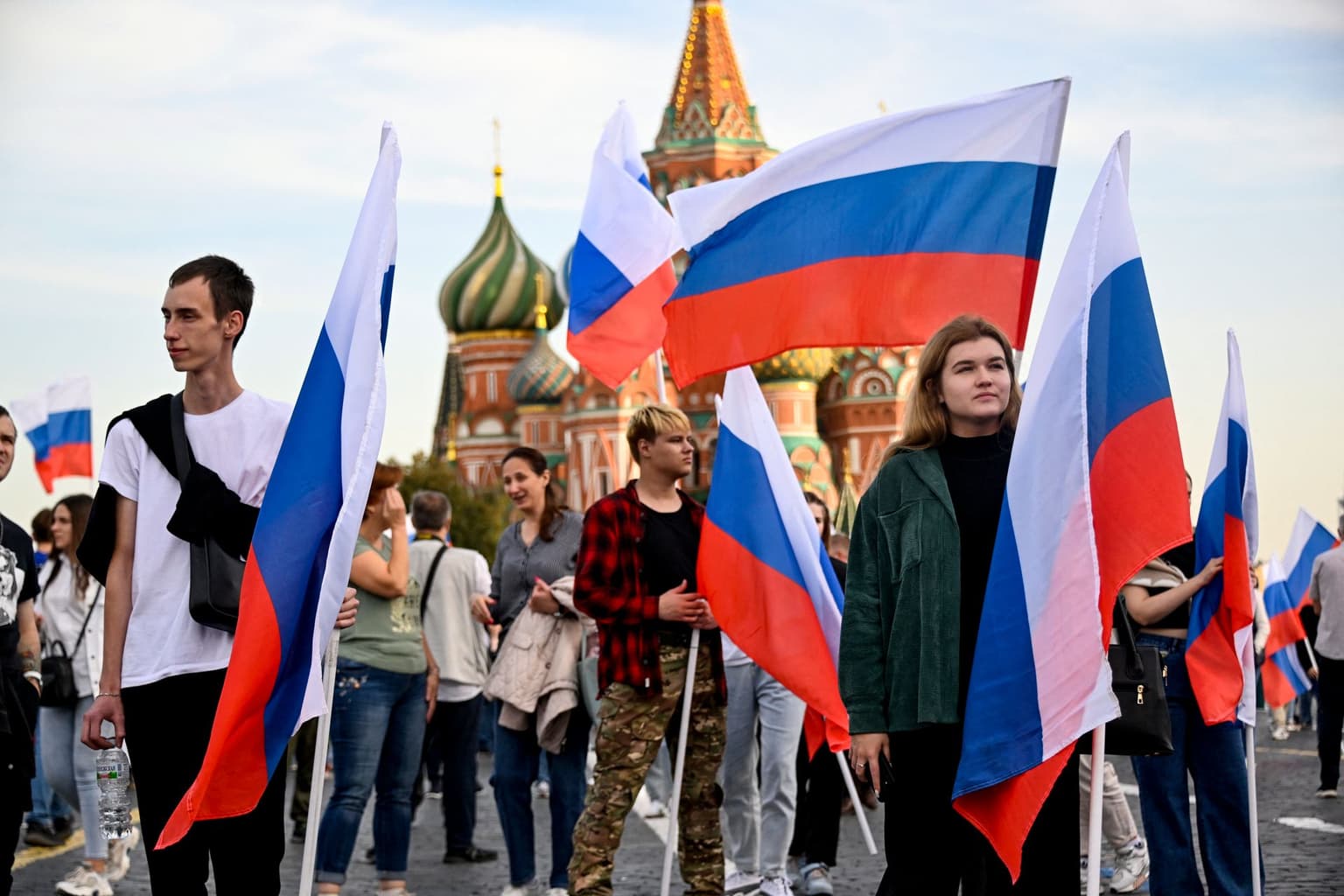
People celebrate the first anniversary of Russia’s annexation of four Ukrainian Oblasts at Red Square in Moscow, Russia, on Sept. 29, 2023. (Alexander Nemenov / AFP / Getty Images)
 on Google
Archil Jangirashvili
About the author: Archil Jangirashvili is a Georgian lawyer and academic specializing in law, political ethics, and human rights.
The question of whether Russian society bears responsibility for Vladimir Putin’s actions has been raised repeatedly since the beginning of Russia’s full-scale invasion of Ukraine.
This debate is not confined to Eastern Europe; it also actively circulates in Western political and academic circles. Often, it produces a comforting illusion: the source of today’s threats emanating from Russia is Putin alone, while Russian society remains merely frightened, silenced, and therefore absolved.
This is not a call for collective punishment. It is a discussion about moral and political responsibility — concepts democratic societies have confronted before and cannot afford to selectively forget today.
One of the most frequently repeated arguments suggests that Russians cannot be held responsible because they live in fear and are therefore unable to resist the regime.
But if fear alone were sufficient grounds for absolution, the same logic would have applied to German society during the Nazi era. Fear existed then as well. So did dissenters. Yet history did not conclude that responsibility rested solely with Adolf Hitler.
The idea that Russian society is largely innocent is not a neutral humanitarian position.
In practice, it functions as part of Russia’s broader hybrid warfare and propaganda ecosystem. By individualizing guilt and collectivizing victimhood, this narrative shields the political culture that has enabled repeated acts of aggression beyond Russia’s borders.
This uncomfortable truth is acknowledged even by some prominent Russian cultural figures who oppose the war.
In one interview, Russian musician Andrei Makarevich was repeatedly asked whether it is fair to impose responsibility on those who do not support the war. His answer was strikingly direct: yes, responsibility extends even to those who oppose Putin.
The harsh reality is that collective political choices often affect those who personally disagree with them. During the Nazi era, many Germans viewed mass murder as an unspeakable evil, yet they too lived with the consequences of a collective political trajectory they had failed to stop.
A Russian who claims to oppose Putin but proudly waves the flag of the Russian Federation does not stand outside this historical continuity.
Responsibility, however, does not automatically imply punishment. It implies acknowledgment, moral clarity, and consequences — including sanctions, isolation, and the dismantling of destructive political traditions. Without responsibility, there can be no meaningful transformation.
This leads to a deeper and more troubling question: who exactly constitutes the so-called "Russian people"?
When commentators talk about "the people," they often mean one of two things. The first is categorical: most Russians support Putin, voted for him, or at the very least do nothing to stop the crimes committed in Ukraine. From this perspective, they are not merely passive observers but participants — whether active or silent — in a system that produces mass violence.

The second interpretation is softer and far more popular in the West. It portrays Russian society itself as a victim: a population that neither chose Putin nor supports the war but remains immobilized by fear. This view has generated a convenient formula: Russians may hate Putin, but they love Russia.
When Russians say they oppose Putin but still "love Russia," my question goes further: do they imagine the same geographical Russia, merely without Putin, or do they envision a fundamentally different country altogether — one that would unite Russians as a linguistic and cultural people, rather than as an empire holding together conquered nations, and whose geography would be radically different from that of today's Russian Federation?
This distinction matters because today's Russian state is not a culturally neutral container.
Russian territorial configuration is the result of centuries of imperial expansion, forced assimilation, and the suppression of non-Russian identities. The current Russian Federation encompasses numerous peoples — Chechens, Ossetians, Avars, Yakuts, Buryats, Chukchi, Nenets, Bashkirs, and many others — whose incorporation was neither voluntary nor benign.
A Russian who claims to oppose Putin but proudly waves the flag of the Russian Federation does not stand outside this historical continuity. That flag is not merely a symbol of statehood; it is the political heir to both the Russian Empire and the Soviet Union.
It embodies wars of conquest, annexation, and the denial of nations’ right to self-determination. To identify with it while rejecting the system it represents is a contradiction that cannot be resolved by rhetoric alone.
So, the question is whether this war is also the result of years of inaction. Inaction that was visible and undeniable long before February 2022: in Abkhazia, in Chechnya, in the Georgian war of 2008, and in the annexation of Crimea.
Wasn't this catastrophe enabled by repeatedly looking away?
In reality, there is only one Russia: a state that is the heir to a violent past and a political culture built on imperial continuity.
A Russia that presents itself as a civilizational unity while embodying the forced cohesion of conquered nations. Until this illusion is dismantled — both inside Russia and in the minds of those who still believe in it abroad — the question of responsibility will not disappear.
Editor’s note: The opinions expressed in the op-ed section are those of the authors and do not purport to reflect the views of the Kyiv Independent.