One battle after another: Kyiv's historic markets lose ground to trendy food halls
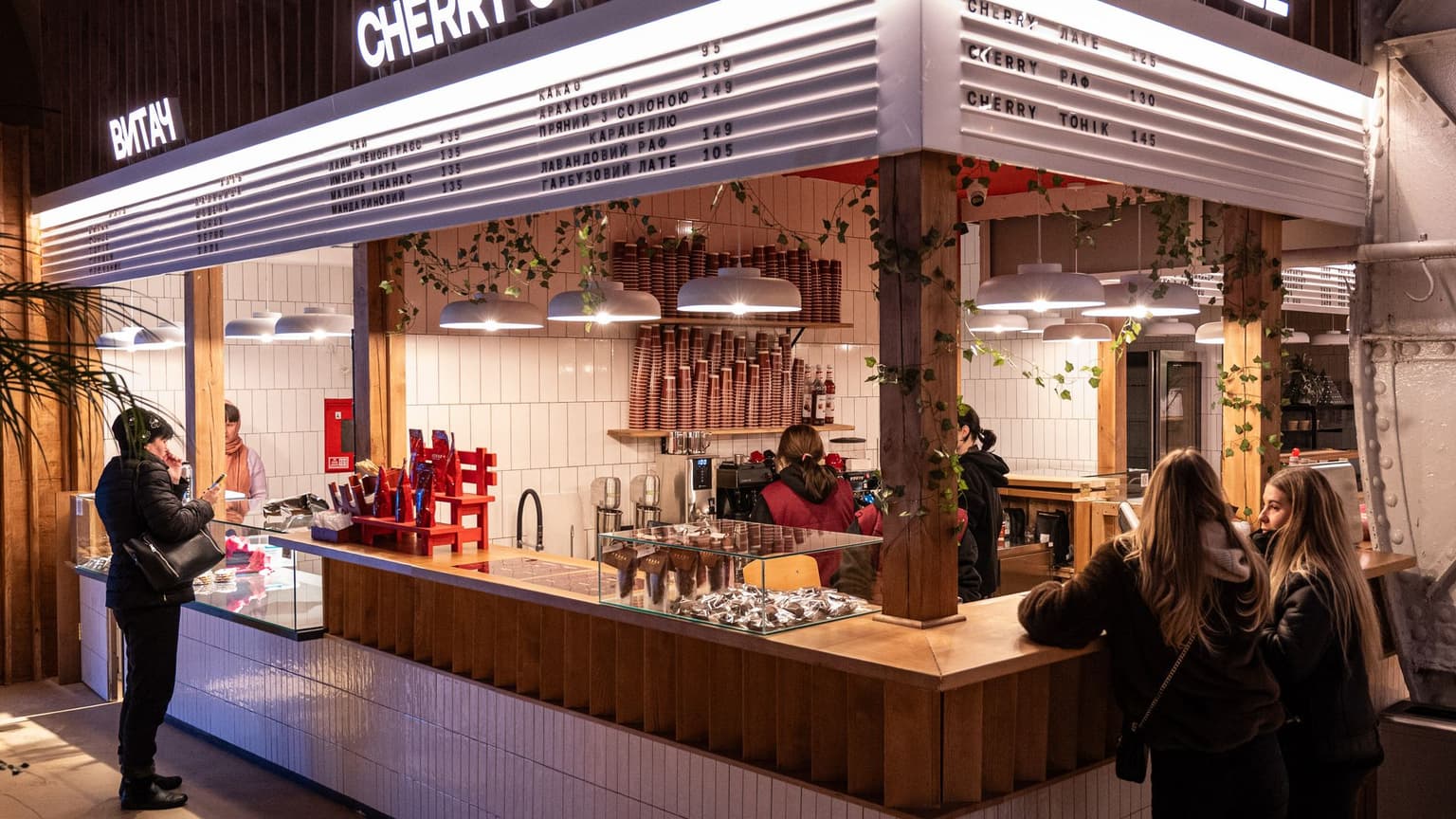
A view at the coffee shop at the Bessarabskyi market in Kyiv, Ukraine on Feb. 11, 2026. (Danylo Antoniuk/ The Kyiv Independent)
 on Google
The food hall development revolution spreading across Europe has reached Ukraine's historic markets.
At the end of 2025, Kyiv's historic Bessarabskyi market — a more than 100-year-old, 900-square-meter brick building located at the western end of the city's main thoroughfare Khreshchatyk — was reopened as a brightly-lit, upscale food court.
While the status-protected exterior remained unchanged, the market's center now features a large bar, with most of the interior converted into a dining area lit by oversized straw chandeliers. Some grocery vendors remain along the outer edges of the hall.
Kyiv Food Market, an already upscale food hall in Kyiv’s Arsenalna area, also completed renovations in December last year. The upgrade closely resembles the style of the changes made at Bessarabskyi.
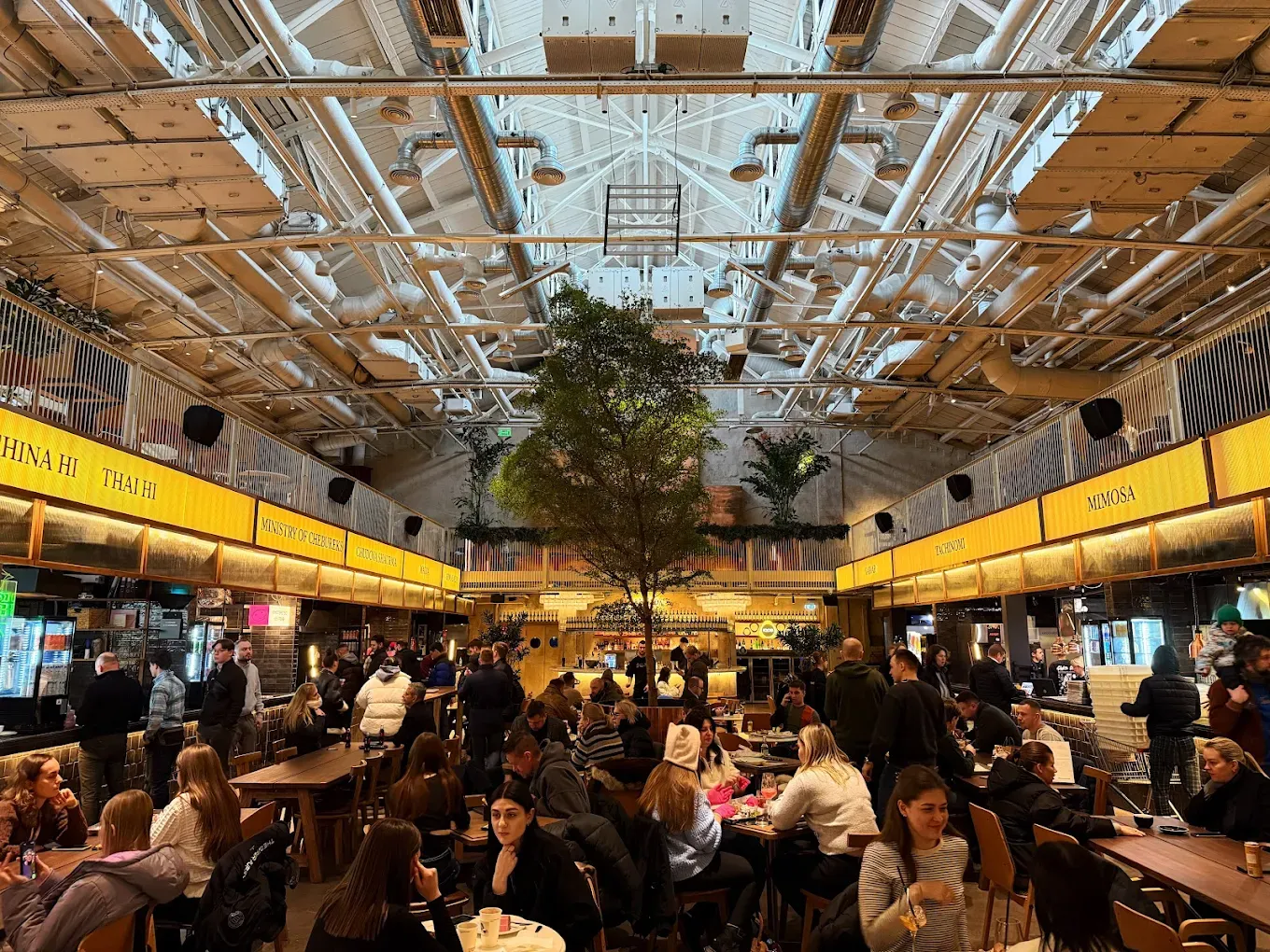
The response to the changes at Bessarabskyi among the civically minded has been anything but positive.
"Bessarabskyi market has completely lost its soul," said Olha Terefeyeva, an activist from Save Kyiv Modernism, an organization fighting to preserve Kyiv's architectural heritage.
It's a trend that's taken hold over the last decade across Europe. As people's shopping and dining habits change, traditional food markets are losing foot traffic. In their place, developer-backed "food halls" are cropping up.
There were over 135 food halls across Europe as of 2024, up from 100 in 2017, with at least 10 currently in development, according to commercial real estate giant Cushman & Wakefield. In its reports on the sector, the firm has touted the transformative potential and promise of these gastronomic zones for both investors and communities alike.


To be sure, the Bessarabskiy market had languished for years in need of an upgrade. Despite the charm of its mountains of fruit and vegetables and stalls selling seeds, nuts, and chocolate-covered dried fruit from the Caucasus and Central Asia, the market had grown dim, damp, and increasingly unpopular with locals.
Simon Anderson, the founder of Next Phase, a U.K. company that specializes in turning grocery markets into food halls, told the Kyiv Independent that one way for a dying market to generate revenue through the food hall model is through a bar.
"There was a grocery market in Bessarabskyi Market. A food court was built there, and now the market has died."
Converting a space into a food hall also requires boosting dwell time, Anderson explained, which is usually done by adding seating and keeping the venue comfortable — increasing operating costs and pushing out small vendors.
As a result, traditional grocery markets are frequently excluded from this model, forced to relocate, or drastically downsized, he said.
But for Yevhen Klopotenko, the celebrated Ukrainian chef and activist, these kinds of renovations strike a devastating blow to dying food markets.


"There was a grocery market in Bessarabskyi Market. A food court was built there, and now the market has died.
"There are only 10-15 places where you can buy groceries there now," Klopotenko told the Kyiv Independent.
Klopotenko has been fighting against the same style of renovation happening to another market: the Soviet-era Zhytnii (meaning rye in Ukrainian) market located in Kyiv's central Podil neighborhood.
Zhitnii market: ruination or privatization?
Few cases have provoked as much debate as the prospect of renovating Zhytnii Market.
The modernist 1980s landmark has a tiled canopy roof and a base decorated with metal reliefs narrating Ukraine’s trade history. Like Bessarabskyi, the building — which hasn't been renovated since it was built — has fallen into disrepair.
For years, local authorities have tried to find tenants to carry out repair work as part of their contract, but to no avail.
In January 2025, the Kyiv City Council decided that privatization was the best solution to renovating the market.


Local engineering firm Inzhur, together with AVR Development, a company run by Julian Chaplinsky, Lviv's former head architect and the former deputy minister of community and territorial development, proposed a major overhaul of Zhytnii.
The plan included a white-painted interior, restaurants, an 800-seat food hall, event and fitness spaces, and a significant downsizing of the traditional market.
The proposal sparked outrage, with activists warning it highlighted the risks of privatizing historic public spaces.
"In five or seven years, someone will come and ask: 'How old is your city? We’ll say a thousand years. They’ll say: 'Show us something that proves it. And we’ll say: 'We have nothing. We built a hotel, we built a food court, we replaced everything," Klopotenko told the Kyiv Independent.
In response to arguments that the planned renovations would make Zhytnii less accessible, inclusive, or true to the market's original purpose, Chaplinksy said he visited the market himself to better understand the criticisms.

"A grandmother who comes to the market to sell two liters of homemade sour cream — that simply doesn’t exist anymore… I saw a few stalls selling expensive fruit — expensive cherries, pineapples, bananas — run by regular entrepreneurs, not grandmothers from villages," Chaplinsky told the Kyiv Independent.
After the city announced that Zhytnii was on the market, Klopotenko and architect Pavlo Peker came up with a separate plan for renovating the market called Zhitnii Will Live.
The plan was based on survey data of people living near the market. The survey found that an overwhelming majority of Podil residents, 80%, want Zhytnii to retain its main function as a food market. Almost nobody wants the market's function to change, Klopotenko said.
The survey aimed to "show that citizens also have a voice," Klopotenko said. He has advocated for greater community involvement in decisions about renovating historic buildings, amid fears that privatization could open the door to demolition.
Even without demolishing a building, developers in Ukraine can still push through major changes. In the case of Bessarabskyi, the company behind the $3.5 million renovation has not been publicly disclosed, raising concerns among activists such as Olha Terefeyeva of Save Kyiv Modernism.
The Bessarabskyi renovation was done by a group of 16 investors, 15 entrepreneurs and Beverages LLC, according to Natalia Dzhulai, who publicly identified herself as a project manager on the Bessarabskyi renovation without a company name in an interview with Forbes Ukraine.
The Kyiv Independent reached out to Dzhulai, but did not receive a response.
And the risks that privatization or developer-led renovations of historic sites could ignore public wishes are even greater during wartime.
How the war changed Ukraine's construction sector
At the start of the full-scale invasion, Ukraine’s Cabinet of Ministers passed a series of resolutions easing construction regulations in the name of administrative streamlining.
In many cases, developers were allowed to simply notify authorities of construction instead of securing permits, speeding up projects and weakening legal safeguards.
The impact became clear in 2024, when Zelensky Manor (no relation to Ukraine's President Volodymyr Zelensky), a late-19th-century wooden merchant’s house, was demolished a day before a vote to grant it heritage protection.

Zhytnii market has fared better: it was added to the protected heritage list at the end of last year, theoretically shielding it from demolition.
But wartime protections remain fragile. Since 2022, developers can alter protected buildings if authorities fail to reject an application within 30 days — a "silent consent" mechanism that effectively shifts responsibility away from officials.
In 2025, the same rule was extended to restoration permits with a 10-day window, introduced as part of EU-linked reforms and passed without public consultation.
Attempts to correct the system have only deepened the confusion. Some government bodies still require permits while others have eliminated them, creating a patchwork of legal loopholes that critics say leaves ample room for corruption.
In practice, that confusion has real consequences: buildings slip through the cracks — costing not only pieces of cultural heritage but also the community life they sustain, particularly in the case of food markets.
"There has been a market in that same place for about 600 years…a lot of people have a tradition of going to the market every Sunday. They see the vendors there; many people repair clothes there; some go simply to socialize; there are jobs there. It’s a whole ecosystem," Klopotenko said.