On Russian oil, the US has already blinked — Europe must not do the same
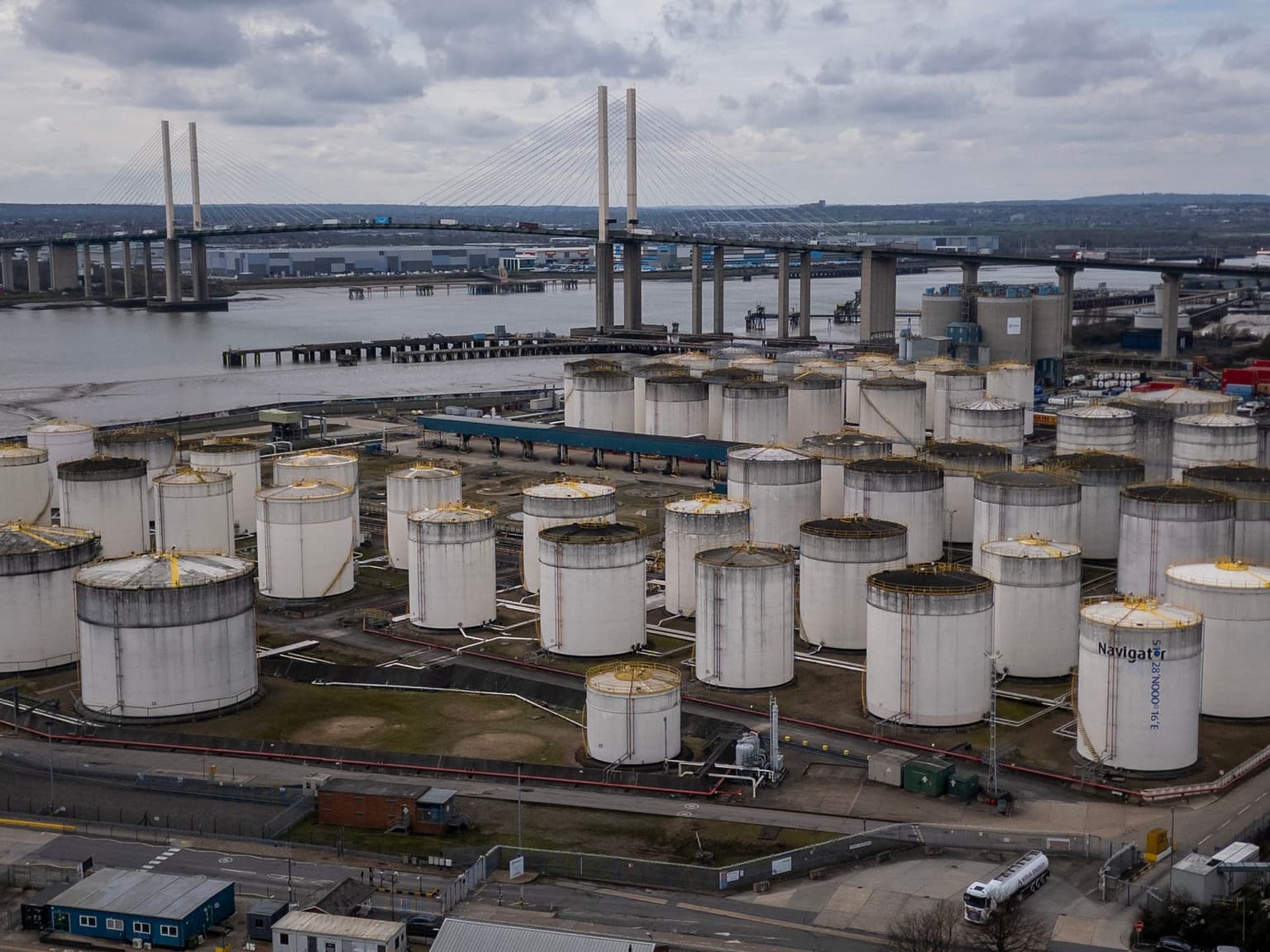
A general view of Navigator Terminals, an Oil storage depot along the River Thames on March 10, 2026 in London. (Dan Kitwood/Getty Images)
 on Google
Alexander Kirk
Sanctions campaigner at Urgewald
Vladimir Putin is feeling generous. With tankers stalled in the Strait of Hormuz and European energy prices spiking, the Russian president has offered to resume long-term gas supplies to the continent his missiles are helping to destabilize. Before anyone in Brussels or Berlin reaches for the phone, they might pause to recall what energy dependence on Russia actually costs.
While Ukrainian cities are shelled and soldiers die, Western governments are looking nervously at the price of oil, wondering whether their sanctions, one of the strongest levers over Russia, can survive a market shock.
Brent crude briefly hit $119 a barrel, its highest level since 2022, after war-related disruption in the Middle East and the near-closure of the Strait of Hormuz. European gas prices have surged alongside it. In chancelleries across the continent, officials are scrambling to make the familiar calculations: how much principle can we afford?
The answer must be: all of it. Every last drop.
The United States has already blinked. Washington granted a 30-day waiver allowing Indian purchases of Russian oil at sea to continue, citing supply fears. Officials insist this changes nothing about the broader sanctions framework. But this is precisely how sanctions die — through waivers, through quiet exemptions, through signals that the rules are negotiable when the price at the pump gets too high.
The Kremlin has watched this pattern for three years, and even before, after its first invasion of Ukraine in 2014. It knows how to wait.
Some will argue that governments need flexibility during an acute supply shock, that temporary measures are not a strategic retreat. But there is a world of difference between a time-limited technical measure and the slow normalization of a permission structure that lets Russian oil flow whenever markets panic.
The danger is the lesson it teaches: that sanctions are a fair-weather commitment.
Consider what is at stake with the Russian oil price cap. Constructed by the G7 and the EU, it was designed to do two things simultaneously: keep Russian crude moving to global markets to prevent a supply crisis, and cap the price Russia receives so the Kremlin earns less blood money per barrel.
The EU has just lowered that cap to $44.10 a barrel. That is the right direction. But the cap is only as strong as the will to enforce it. When oil prices surge and governments are desperate for supply, the temptation to look away becomes irresistible. A cap that is not enforced is not a cap. It is a political convenience that Ukraine pays for in blood.

Every barrel of Russian oil reaching the market above the cap price, every loophole left open, every waiver extended, puts more money into the war machine destroying Ukrainian homes, Ukrainian hospitals, Ukrainian lives. Weakening sanctions does not stabilize energy markets. It funds the war.
At Urgewald, we have spent three years pushing for tougher sanctions, and what we see in Brussels and Washington is resolve fraying in real time. We have recently been campaigning for Putin's Arctic LNG fleet to be included in the next sanctions round. These tankers carry Russian liquefied natural gas to global markets, with revenues flowing directly to the Kremlin. They should be designated, grounded, and cut off. But there is a broader principle. Sanctions only deter when they are unpredictable and unavoidable.
The moment Moscow calculates that an oil price spike buys it a reprieve, they lose their sting. They must bite hard and come without warning, denying Russia any chance to hedge before the pressure lands.
We must be honest about why this keeps happening. Governments buckle when oil and gas prices spike because the vulnerability is structural. So long as European economies depend on fossil fuel imports, every supply disruption becomes a political emergency. Every petrostate and authoritarian exporter knows it has the leverage. Russia knows it.
The Kremlin does not need to win the sanctions battle. It only needs to wait for the next crisis, the next spike, the next moment a European government decides the price of solidarity is too high.
The answer is to remove the vulnerability altogether. Renewables, electrification, efficiency, and storage are all answers.
They are the only way to permanently deny Putin the leverage he has exploited for years. A Europe that no longer needs Russian oil cannot be blackmailed by it. A government not terrified of energy price spikes can hold a sanctions line without flinching. That transition is still too slow, still underfunded, still treated as tomorrow's problem while Ukrainians pay right now.
Hold the sanctions line today, and accelerate the transition that makes holding it permanently possible. A Europe that does not run on fossil fuels cannot be blackmailed into abandoning them.
Editor's note: The opinions expressed in the op-ed section are those of the authors and do not purport to reflect the views of the Kyiv Independent.
read also
 Polina Moroziuk
 Volodymyr Ivanyshyn
 Abbey Fenbert