I build robots to save lives: Here’s why Europe must invest in Ukraine’s civil security
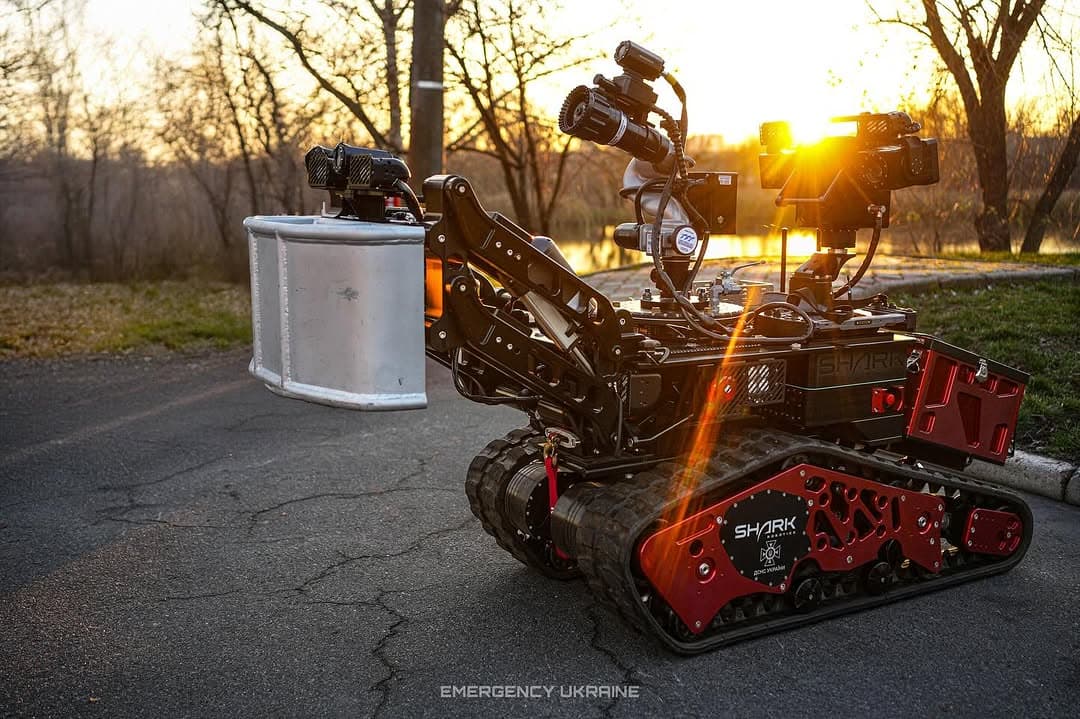
The Colossus firefighting robot is seen at an undisclosed location in Ukraine in an undated photo. (State Emergency Service / Instagram)
 on Google
Cyrille Kabbara
About the author: Cyril Kabbara is the founder and CEO of Shark Robotics.
This week, my company, Shark Robotics, a French high-tech scale-up and a world leader in civil protection robotics, delivered 40 Colossus robots to Ukraine’s State Emergency Service (SESU).
The purpose is simple and essential: to protect those who protect all the others.
This mission is personal to me. Before creating Shark Robotics, I served as a French Army soldier in a special reconnaissance unit. I was deployed to Afghanistan, Africa, and other conflict zones. Each mission was intense, violent, and exhausting, but they all taught me the same lesson: on the ground, technology can save your life.
For a long time, this was not true for firefighters and rescuers. They faced life-threatening environments with limited tools. That is why I founded Shark Robotics: to bring technologies to those who run toward danger.
Our robots first gained global attention in 2019 when a Colossus helped extinguish the Notre-Dame Cathedral fire in Paris. Now they serve in Ukraine. And its impact is measurable: SESU reported on Nov. 25 during the delivery ceremony in Kyiv that operational casualties have been divided by three since the robot entered service.
If emergency services fail, society fails.
Today, as Ukrainian rescue teams operate after Russian missile strikes, amid smoke, fire, structural collapse, and the fear of double-tap attacks, I see the same courage and discipline I once witnessed on the battlefield, ultimately for the same purpose.
These men and women are not only saving civilians. They are preserving the continuity of a nation under attack: keeping hospitals open, safeguarding power plants, reopening roads, and holding communities together.
To do that, they must be protected.
Across Europe, the meaning of “security” has changed. For decades, we separated military defense from emergency response. Ukraine has proved that this distinction no longer exists. When Russia targets residential buildings, power grids, or water systems, the first people who prevent collapse are not soldiers — they are rescuers.
Civil protection is no longer a secondary aspect of war. It is one of its front lines.
Ukrainian emergency teams operate in quasi-military conditions: repeated high-intensity emergencies, mass-casualty events, structurally unstable buildings, Chemical, Biological, Radiological, and Nuclear (CBRN) risks, and constant exposure to double-tap strikes.
Their work is not only humanitarian. It is strategic.
If emergency services fail, society fails. And when society fails, victory becomes impossible.


During my visits to Ukraine, I have seen how innovation is transforming emergency response: reconnaissance drones, structural-risk sensors, AI tools for mass-emergency coordination, and more. Resilience is now technological, not because technology replaces people, but because it protects them.
Robotics is a key part of this transformation.
When a Colossus robot moves into a burning structure in Kharkiv or Odesa, it is not just performing a task. It is acting as a shield between rescuers and Russian attacks.
But the robot is only part of the story. What matters just as much is the long-term cooperation we are building around it: Ukrainian operators trained, perspectives of industrial partnership, and a feedback loop between field teams and our engineers in La Rochelle, allowing us to improve each next generation, for the benefit of the end-user.
This is resilience in action: technology tested under fire, improved through real experience, and shared across borders.
In an era marked by hybrid threats, infrastructure sabotage, and increasingly frequent disasters, Europe urgently needs the expertise Ukraine has been forced to acquire. Ukraine is not only fighting for its survival, but also teaching Europe how to be resilient.
Today, coordination between national civil-security systems remains fragmented. In addition to recent proposals to strengthen the EU Civil Protection Mechanism and invest more in preparedness, Europe now needs joint exercises, peer-review tools, and new training platforms to systematically integrate Ukrainian expertise into EU planning. The EU also needs to fast-track the validation and certification of new technologies.
The bloc already has important tools, but these efforts should be taken to the next level, with civil protection elevated to a strategic priority on par with defense.
After all, robotics, drones, and autonomous systems are reshaping civil security today just as profoundly as they have transformed modern battlefields.
A joint European procurement scheme for civil-security technologies, mirroring models used in defense, would help scale innovation faster, reduce costs, and ensure that battlefield-tested solutions from Ukraine reach responders across the continent.
As a French and European citizen and as CEO of Shark Robotics, working closely with civil-security actors, I believe the partnership between France and Ukraine carries a powerful message.
When Ukrainian rescuers deploy French-made robots on the front lines of their country’s survival, it is a reminder that the security of Ukraine and the security of Europe are inseparable.
Those who run toward danger to protect others embody the deepest meaning of Europe: solidarity, courage, and the defense of human dignity.
Protecting them is not only a moral responsibility. It is a strategic necessity and one of the clearest ways Europe can help Ukraine win the war.
If we agree this work is essential, then we must also admit we can still do better. Europe has the capacity, the expertise, and the interest to do more. What remains is the will to act and organise ourselves accordingly.
Editor’s note: The opinions expressed in the op-ed section are those of the authors and do not purport to reflect the views of the Kyiv Independent.