How Russia is using Cold War-era treaties to undermine Ukraine, Europe
Russia is exploiting the bilateral investment treaties to challenge sanctions, exposing Ukraine and Europe to costly international arbitration.
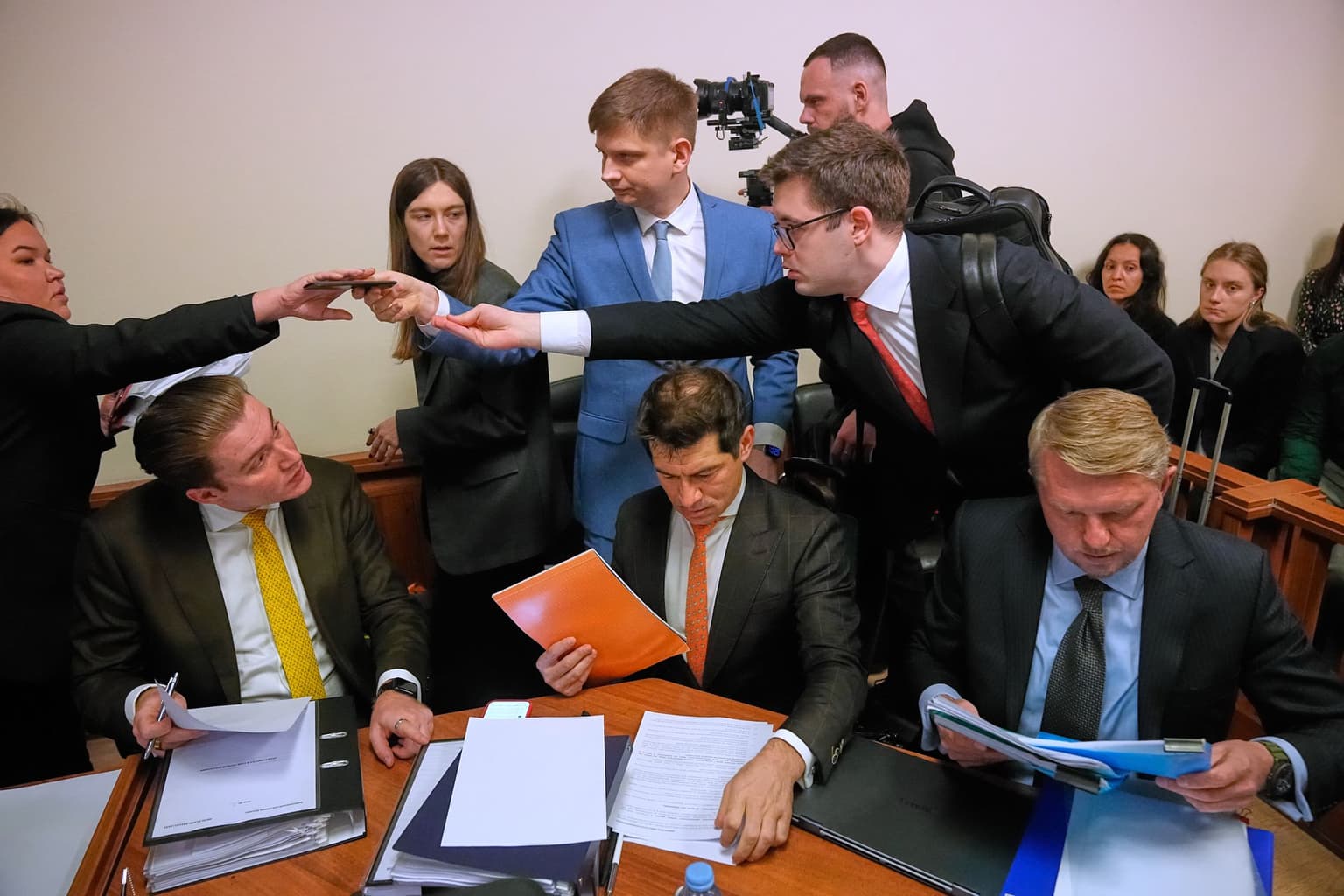
Participants gather in Moscow's Arbitration Court for a hearing regarding a lawsuit by Russia's Central Bank against Belgium-based financial clearinghouse Euroclear in Moscow, Russia, on Jan. 16, 2026. (Pavel Bednyakov / AP)
 on Google
As sanctions increasingly weigh on the Russian economy, businesses and tycoons linked to the Kremlin are launching billions of dollars in claims under Cold War–era treaties — opening legal fronts against Ukraine and its Western supporters beyond their own courts.
The Ukrainian-born Russian financier Mikhail Fridman is behind five claims and is seeking 16 billion euros in damages over Luxembourg’s freezing of his assets, while a company he co-owns with Pyotr Aven is claiming $1 billion over Ukraine’s nationalization of Alfa-Bank, now Sense Bank. Major firms, including Gazprom, Tatneft, and Rusal, are pursuing similar claims.
These claims, among dozens of others — which rely on a controversial feature of bilateral investment treaties known as investor-state dispute settlement, or ISDS — are part of a growing wave of cases challenging sanctions imposed in response to Russia's full-scale invasion.
Last year, the pace of known claims against sanctions on Russia rose quickly, with 13 new ISDS cases filed, according to a December report by a group of European non-governmental organizations.
Before 2025, there were 11 known cases directly challenging sanctions imposed by Ukraine, the EU, the U.K., and Canada.
In the nine cases where the claims values have been publicly disclosed, they total around $48 billion. The true scale of the issue is likely much larger.
The investment treaties in question were never designed with national security in mind. As a result, Kremlin-linked individuals and businesses have been able to use them to challenge sanctions, drain Ukraine's resources, and potentially claim billions in damages.
Since the proliferation of investment treaties in the 1980s, many bilateral agreements have included ISDS rules allowing foreign investors to take disputes to private tribunals instead of local courts. The USSR struck bilateral investment treaties with European countries during perestroika in the late 80s, beginning with Finland in 1989.
Critics have called the proceedings opaque and inconsistent. They also cost Ukraine, war-torn and cash-strapped, millions in legal fees.
Fridman, in addition to the five known claims he has filed, has also threatened sixth. Another three of his claims are based on bilateral treaties between EU members and Ukraine, while a fourth is based on a bilateral treaty between Ukraine and the U.K.
Many of the assets blocked by sanctions are financial securities and are largely held in Europe by institutions based in Belgium and Luxembourg, namely the Euroclear and Clearstream depositories.
Even though the EU’s 18th sanctions package blocked ISDS awards within the bloc, claimants can still take cases elsewhere. Cases against the EU can be heard by tribunals outside the bloc, with London, Geneva, and Hong Kong popular venues.
Though Ukraine has been more proactive, it still faces difficulties. Ukraine moved to terminate its investment treaty with Russia in 2022, but the withdrawal only took effect in January 2025 — and a "sunset" clause protects existing investments for another decade.
But 24 treaties between Ukraine and other European countries remain in effect, which allow individuals to make claims based on assets located in those jurisdictions.
"(Investment treaties) tend to have far less political salience than trade agreements and are rarely among the key priorities of political decision-makers," Lukas Schaugg of the International Institute for Sustainable Development told the Kyiv Independent.
"In practice, many states have maintained these treaties for decades without ever giving them serious attention, and questions typically only arise when a state is facing an ISDS claim or a concrete threat of one," Schaugg said.
"So the most likely explanation is bureaucratic inertia and low political visibility rather than a calculated decision to preserve the treaties."
While Ukraine initially used these treaties to pursue claims against Russia after the 2014 invasion, they offer symmetrical protections — allowing Russian companies and individuals to bring cases of their own, Eric Chang, a lawyer specializing in investor-state arbitration, told the Kyiv Independent.
"At least some of Russia’s law fare efforts leveraging ISDS appear to be aimed at neutralizing Ukraine’s legitimate enforcement of successful treaty awards," Chang said.

"Using ISDS to attempt to neutralize another (valid) ISDS award might be viewed as an illegitimate use of law fare and possibly an abuse of process."
Costs and consequences for Ukraine and Europe
These cases are also expensive. Defending a single arbitration costs an average of $5.3 million, with Ukraine forced to hire external legal counsel for each one, said Lukas Schaugg of the International Institute for Sustainable Development.
"For a country dedicating every available resource to its defense against Russian aggression, these are resources that could otherwise go towards protecting its people," Schaugg said.
"That does not consider the consequences if Ukraine is ordered to pay compensation, which could far exceed the average cost."
For the EU, the risks are higher. The bloc still maintains 16 investment treaties with Russia covering 17 member states, leaving countries potentially exposed as the war enters its fifth year. Lithuania is the only member to have terminated its treaty.
"By removing disputes around EU law from member state courts, ISDS undermines the autonomy of the EU legal order," Schaugg said.
According to Schaugg, "in 2009, the European Court of Justice already ruled that this creates an incompatibility that member states must eliminate, and yet they have failed to do so — so far, having neither renegotiated nor terminated the bulk of those treaties."

The case of Belgium
Threats of costly claims mounted in autumn after the EU announced a plan to finance a 140 billion euro loan to Ukraine using the immobilized assets of the Central Bank of Russia, most of which are administered by Euroclear in Belgium. The move quickly drew threats of costly claims from Russia.
Former Russian president Dmitry Medvedev, now chair of the security council, warned of endless litigation — and other extrajudicial consequences — in a typically shrill post on social media.
Belgian Prime Minister Bart de Wever’s opposition to the "reparation loan" frequently echoed Russian responses.
He claimed his country could face massive damages under its 1989 investment treaty with the Soviet Union — which was never formally terminated after the USSR’s collapse and with Russia recognized as its primary successor — and alluded to the possibility of other serious retaliation by Moscow — despite legal analysis to the contrary.
"And who believes that Putin will calmly accept the confiscation of Russian assets?" de Wever asked during an on-stage interview with a Belgian newspaper in early December.
"Moscow," de Wever continued, "has let us know that in the event of a seizure, Belgium and I personally will feel the effects for eternity."
In September and October, Russian investors filed four notices of dispute against Belgium — the first step in ISDS proceedings — over assets frozen by EU sanctions in Euroclear.
With the clock ticking to put plans in place for Ukraine, the EU in December instead approved a 90-billion-euro joint loan, excluding the Czech Republic, Hungary, and Slovakia, while continuing to work on the broader reparation plan. Later that month, reports emerged that Belgian officials and Euroclear executives had been targeted in a campaign of intimidation by the Russian intelligence service.
The episode underscores the risks these treaties pose. Belgium’s apparent coercion highlights the urgency of terminating bilateral investment treaties to remove a legal lever Moscow can exploit — and to strengthen European security more broadly.
Cancelling bilateral investment treaties would also remove a significant avenue of potential influence — and buttress sanctions — as Russia intensifies a broader campaign of "active measures" against Ukraine and the West at a crucial stage of the war.
"The battle on the legal front resembles the kinetic one: as each side innovates, the other responds in kind," Chang said. "Ukraine innovated with drones and then attacked key energy and defense infrastructure in Russia; Russia has now caught up."
"Law fare is just another tool in both countries' arsenals, and I do not see an end to this legal front anytime soon."
Author's note:
Hi, this is Liliane Bivings, the editor of this article. Thank you for reading. Russia's war against Ukraine extends far beyond the battlefield. We at the Kyiv Independent are committed to shedding light on Russian aggression wherever it is and telling stories just like this one.
If you'd like to support our work and help us continue reporting on Russia's war everywhere, please consider becoming a member of the Kyiv Independent.