Kyiv's National Botanical Garden's battle to keep plants alive amid war, sub-zero temperatures
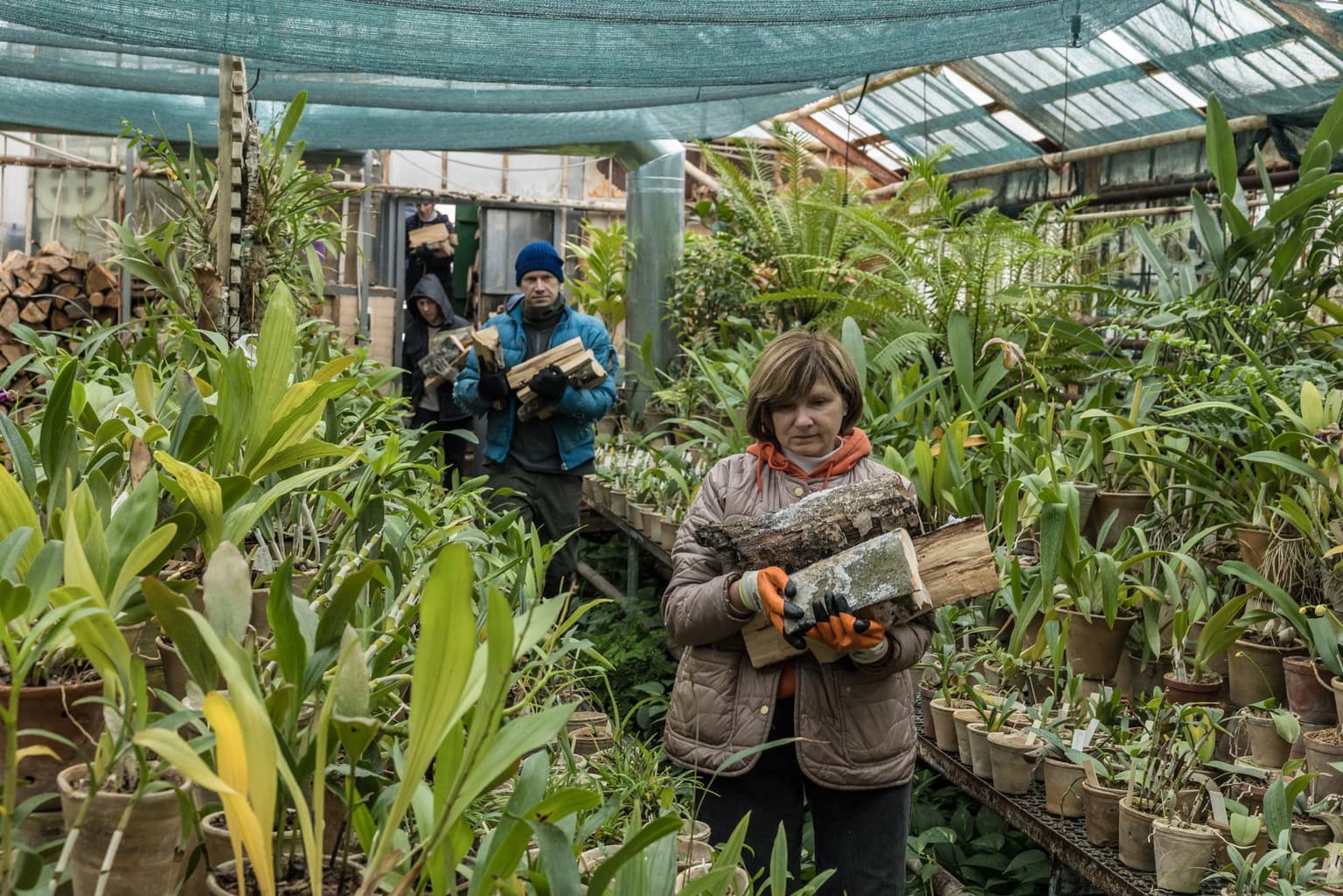
Employees of the Kyiv National Botanical Garden bring wood to the greenhouse in Kyiv, Ukraine, on Jan. 30, 2026. (Oksana Parafeniuk / The Kyiv Independent)
 on Google
On a bitterly cold winter morning inside Kyiv’s M.M. Gryshko National Botanical Garden, scientist Liudmyla Buyun checks a thermometer mounted against the glass wall of a greenhouse. She pauses, notes the reading, and moves on. The routine repeats several times a day, and sometimes through the night.
"This is not a job that ends when you go home," says scientist Liudmyla Buyun. "For many of us, this is our life."
Winter has pushed the National Botanical Garden into a daily fight to keep thousands of tropical and subtropical plants alive, as a combination of Russia's relentless assault on Ukraine's energy infrastructure, and extreme cold strain systems never designed for prolonged disruption.
Since late December, Russia has carried out multiple waves of missile and drone strikes targeting power generation and transmission facilities across Ukraine. In Kyiv, those strikes have repeatedly disrupted heating across large parts of the city. On Jan. 9, 2026, a major attack on the capital’s energy grid left roughly 6,000 residential buildings without heat. Further strikes on Jan. 20 and Jan. 24, and Feb. 3 again cut heating to thousands of homes.
Across Kyiv, residents have adapted as best they can to dark apartments and cold radiators, adding layers, sleeping under blankets, waiting for electricity to return. Plants cannot adapt that way.


When the power goes out, pumps stop circulating hot water through the heating system. Heat pumps fail. Backup generators can keep water moving through pipes, but they cannot generate warmth. With outages increasingly difficult to anticipate, staff are often forced to react rather than prepare. Inside the greenhouses, temperatures begin to fall within hours.
In January, following a series of large-scale missile strikes that caused widespread blackouts across Kyiv and other regions, the garden endured four consecutive nights without heating. Outside, temperatures fell to -15 degrees Celsius (5 degrees Fahrenheit). Inside, staff lit open flames, fed wood-burning stoves, and took turns on overnight shifts, doing what they could to slow the loss of heat.
Inside the sprawling complex, away from public exhibition spaces, Buyun, a doctor of biological sciences and a leading researcher in the department of tropical plants, checks another thermometer. She has worked at the garden her entire adult life, first as a student, then as a researcher, and later as a department head.
For many staff members, the garden is not just a workplace. Couples work side by side. Their children grew up between the greenhouses. Colleagues speak of dynasties.
"We had never experienced this before in the entire history of the collection."

Roman Ivannikov, the head of the tropical plant department, poses for a portrait in a greenhouse at the Kyiv National Botanical Garden in Kyiv, Ukraine, on Jan. 30, 2026. (Oksana Parafeniuk / The Kyiv Independent)
During the coldest nights, Buyun and her colleagues wrapped the most vulnerable plants in fabric, built temporary enclosures, and moved pots by hand toward whatever warmth they could find. One rare Cypripedium micranthum orchid, part of a decades-old collection, was carried back and forth each evening, boxed and unboxed depending on which corner of the greenhouse held the heat longest.
Buyun photographed the orchid every night and sent the images to her daughter, who now lives abroad.
"She asks how the plants are doing," Buyun says. "That’s usually the first question."
Some of the plants she tends have been cultivated here for nearly eighty years. Azaleas planted in the late 1940s still bloom in good years. Others exist in only a handful of collections worldwide.
"These are not greenhouse cucumbers," she says quietly. "You cannot destroy them and plant them again."

The garden’s largest greenhouse rises like a fortress of glass and steel, its slanted walls built to trap heat beneath a dense canopy of palms, vines, and cacti brought from far warmer climates. Inside, the air smells faintly of damp soil and vegetation. Nearby, leaves that should be glossy and upright hang lower than they should, their edges yellowed where cold stress has already begun to show.
"This looks alive," says Roman Ivannikov, the head of the tropical plant department, pointing toward a row of green foliage. "But that means very little."
For tropical and subtropical plants, he explains, 15 degrees Celsius is the lower limit of normal life. Below that threshold, growth slows, flowering fails and immunity weakens. Damage does not always appear immediately. It can surface weeks or months later, when plants fail to bloom, produce sterile seeds, or simply die.
When temperatures begin to fall, staff respond instinctively. Pots are moved closer together. Stems are wrapped in fabric. Thermometers are checked repeatedly. The most vulnerable plants are watched for signs that may not appear until long after the cold has passed.
This winter, temperatures inside some of the garden’s greenhouses have dropped to zero, and on several nights even lower.


"The National Botanical Garden is not a park", Ivannikov insists, though visitors often mistake it for one. It is a scientific research institute under Ukraine’s Academy of Sciences, and a custodian to the country’s largest collection of tropical and subtropical plants.
More than 4,000 species are cultivated here, many gathered through expeditions and exchanges dating back to the decades after World War II. The collection holds national heritage status, a designation granted by the government to objects considered irreplaceable for the country’s future.
Much of the greenhouse infrastructure was designed in the post-1950s era for continuous heat supply, not for unpredictable or prolonged power interruptions.
Replacing the collection, Ivannikov says, would be nearly impossible.
"In many places where these plants were collected, those ecosystems no longer exist," he says. "They have been built over, cleared, destroyed. And even if they did exist, the international procedures to legally collect and transport plants today are so complex and expensive that rebuilding a collection like this is not realistic."
"We do everything we can."

Liudmyla Buyun, 65, a doctor of biological sciences and a leading researcher in the department of tropical plants, poses for a portrait in a greenhouse with orchids at the Kyiv National Botanical Garden in Kyiv, Ukraine, on Jan. 30, 2026. (Oksana Parafeniuk / The Kyiv Independent)
"We had never experienced this before in the entire history of the collection," Ivannikov says. "We were improvising."
According to staff, the garden had never before faced multiple consecutive winter nights without heating.
Some plants have already been lost. They were not the rarest specimens, he notes, but common species used to shape the visual landscape of the exhibition halls. More valuable plants are deliberately distributed across different greenhouses, a strategy meant to reduce the risk of total loss if one space fails.
Even so, the damage is not always obvious at first. Brown patches may appear on ferns, and leaves can necrotize and fall away, but the most serious consequences, Ivannikov says, may only become clear months from now.
"It is one thing to keep them physically alive," he says. "It is another to restore them to a normal physiological state."
As the cold deepened, staff from other departments began volunteering to help, carrying firewood and monitoring temperatures through the night.
Each morning, the routine repeats. Curators walk their assigned greenhouses, check the thermometers, and share readings in a group chat. Decisions are made quickly. Which plants can tolerate another cold night. Which must be moved. Which risks are unavoidable.
Standing beside a cluster of orchids with darkened leaves, Buyun pauses before moving on to the next section of the greenhouse.
"We do everything we can," she says.