How Hungary's election campaign spilled across borders
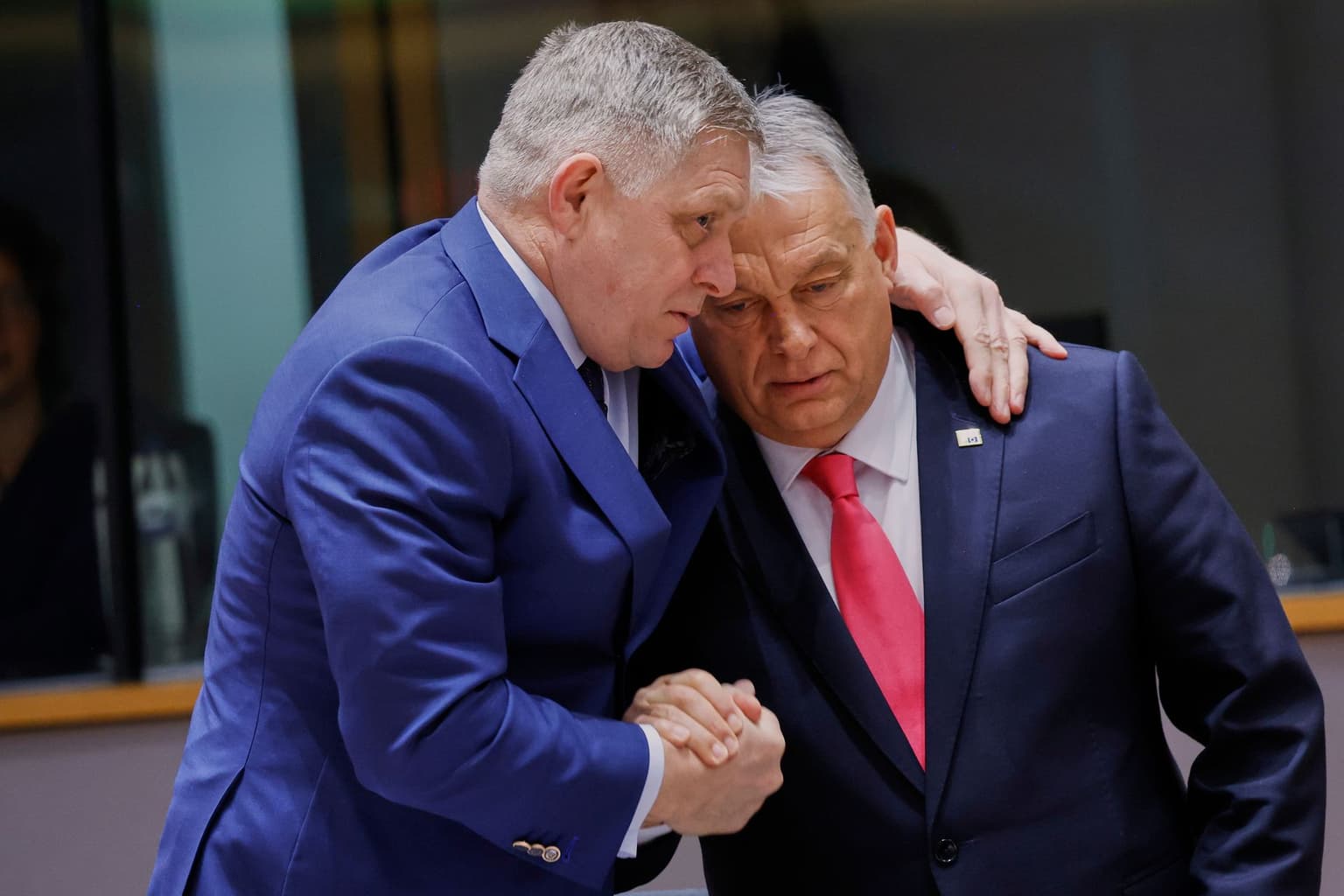
Slovak Prime Minister Robert Fico (L) speaks with Hungarian Prime Minister Viktor Orbán (R) during a roundtable meeting at an EU summit in Brussels, Belgium, on March 20, 2025. (Omar Havana / AP)
 on Google
Peter Techet
Research Associate at the Institute for the Danube Region and Central Europe
Hungary's parliamentary election campaign ahead of the April 12 vote is being fought even beyond the country's borders — and with an unexpected reversal of roles.
Prime Minister Viktor Orban has shown restraint toward Slovakia's left-nationalist prime minister, Robert Fico, while Orban's main challenger, Peter Magyar, has adopted nationalist rhetoric, presenting himself as a defender of the Hungarian minority in Slovakia.
In doing so, Magyar and his Tisza party accuse Orban not only of corruption, economic decline, and democratic backsliding, but also of betraying ethnic Hungarians abroad. The trigger for this escalation lies in a seemingly historical issue: the Benes Decrees.
In late 2025, Slovakia's parliament introduced a new provision into the Criminal Code, making public criticism of the Benes Decrees punishable by up to six months in prison. Adopted with the votes of the governing parties, the amendment did not merely protect historical memory — it criminalized dissent.
The Benes Decrees, issued by Czechoslovak President Edvard Benes during and after World War II, provided the legal basis for the confiscation of property from nearly three million ethnic Germans and tens of thousands of Hungarians.

While often justified as measures against fascist collaborators, the decrees imposed collective guilt on entire ethnic groups, including some Jewish Holocaust survivors who had previously declared German or Hungarian nationality. The broader purpose was the ethnic homogenization of postwar Czechoslovakia.
For decades, Prague and Bratislava have argued that the decrees are obsolete remnants of history.
In the Czech Republic, this claim is formally accurate: the expropriations and expulsions were completed long ago. In Slovakia, however, the argument collapses. The decrees continue to be applied today.
The Slovak Land Fund has repeatedly ordered uncompensated expropriations — including during infrastructure projects around Bratislava — on the grounds that property confiscations mandated in 1945 were merely "forgotten" and must now be carried out retroactively.
When Slovakia's liberal opposition party Progressive Slovakia criticized this practice, the government did not end the expropriations. Instead, it criminalized criticism of the legal framework underpinning them.
Orban's response was carefully calibrated. After initially declining to comment, he later emphasized that Hungarian law does not criminalize debate over historical issues such as the Benes Decrees and that Budapest was seeking clarification from Bratislava about the scope of the new provision.
Government officials repeated their rejection of the principle of collective guilt underlying the decrees and promised support for affected ethnic Hungarians.
Notably absent, however, was any direct condemnation of the Slovak law itself or political pressure on Fico to reverse it.
This restraint reflects a strategic calculation. Hungarians in Slovakia do not hold dual citizenship and therefore cannot vote in Hungarian elections. Fico, by contrast, is a valuable political ally for Orban at the European level — particularly since Hungary has lost Poland, once its most reliable partner in Brussels, following the electoral defeat of the Law and Justice party.
Maintaining the alliance with Slovakia clearly outweighs defending Hungarian minorities abroad.
This is not an isolated case. In May 2025, during Romania's presidential election, Orban openly supported George Simion, leader of the far-right AUR party and a vehemently anti-Hungarian nationalist, in the hope of securing another "sovereigntist" ally in European politics. Minority protection was again subordinated to geopolitical ambition.
Orban's approach is rooted in a broader ideological framework often described as "sovereigntism" — the vision of Europe as a collection of ethnically homogeneous nation-states.
Orban has embraced this worldview explicitly, declaring in a 2017 speech that "ethnic homogeneity" must be defended. Taken seriously, this ideology makes Orban's indifference toward the Benes Decrees almost logical: their very purpose was ethnic homogenization.

Peter Magyar has seized on this contradiction.
Leading Fidesz in the polls for over a year, he has positioned himself as a more credible defender of Hungarians beyond Hungary's borders. His rhetoric is openly nationalist. When criticizing Fico, Magyar referred to Slovakia as "Felvidek" — "Upper Hungary" — the historical name used before the Treaty of Trianon in 1920.
The choice was deliberate, aimed at disillusioned Fidesz voters: a signal that he is national-minded too — just not corrupt, and more willing to confront allies when Hungarian minorities are affected.
Whether this strategy will succeed electorally remains uncertain. But it has already forced an uncomfortable debate into the open. Orban's long-standing claim to be the guardian of all Hungarians now clashes with his willingness to tolerate — and indirectly legitimize — discriminatory practices against them when they originate from friendly governments.
The renewed controversy over the Benes Decrees also exposes a deeper European failure.
During the EU accession process, it was already problematic that the Union admitted states whose legal systems still contained discriminatory norms, without insisting on their repeal. The assumption that these norms were politically irrelevant proved complacent.
In Slovakia, they have re-emerged as objects shielded from democratic debate by criminal law.
Hungary's election campaign has thus spilled across borders — and into Europe's unresolved past. The question now is whether the European Union is willing to confront the persistence of discriminatory legal legacies of a member state.
Editor's note: The opinions expressed in the op-ed section are those of the authors and do not purport to reflect the views of the Kyiv Independent.
read also
 Martin Fornusek
 Martin Fornusek
 Martin Fornusek