This place in Ukraine keeps birds safe from the war
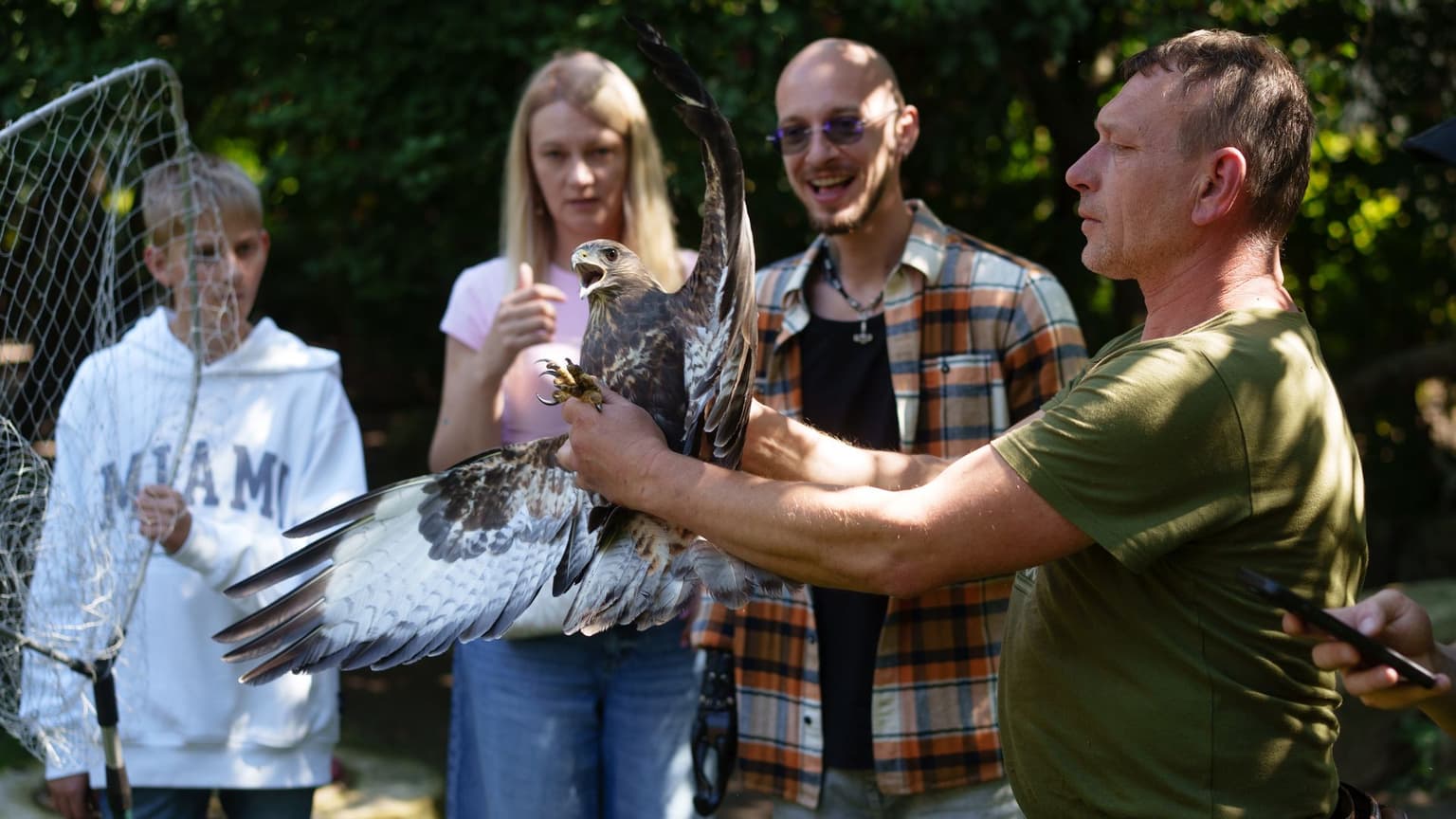
Veterans from the Superhumans rehabilitation center visit the Free Wings rehabilitation center in Kozhychi, Lviv Oblast, Ukraine, on Aug. 27, 2025, where they interact with birds as part of their recovery process. (Serhii Korovayny / The Kyiv Independent)
 on Google
KOZHYCHI, Lviv Oblast — When approaching the quaint yard of Viktor Shelvinsky's house, one can scarcely believe it serves as a haven for hundreds of birds of all kinds.
But quickly, the entry gate gives way to a spacious garden filled with aviaries of different shapes and sizes, housing storks, buzzards, pheasants, owls, and parrots.
Shelvinsky, a 48-year-old veterinarian, has built the Free Wings (Vilni Kryla) rehabilitation center around his house on the outskirts of Lviv. He takes care of approximately 470 birds — some found injured in nature, and others entrusted to Shelvinsky's care by their owners due to the circumstances of war.
The well-tended sanctuary, filled with lively chirps and green shrubs — even in the dreary December weather — stands as a testament to humanity in wartime Ukraine.

Shelvinsky moves restlessly around the house as he serves tea and coffee while answering calls from anxious bird owners, asking for advice.
He lives here with his wife, Yuliia, and their little son, Zhenia. The pair practically runs the bird sanctuary — located in Kozhychi, a small village in western Ukraine, a few kilometers west of Lviv — on their own, with some help from Viktor's parents.
The couple met, fittingly, through a bird. In the first month of the full-scale invasion, Yuliia found a woodpecker in her home's garden in Kyiv Oblast. He was unable to fly after swooshing head-first into her window.


Getting a hold of a veterinarian who knows his way around birds was difficult in the chaotic first weeks of the all-out war. Her search for advice online led her to Viktor.
The Free Wings sanctuary, founded by Shelvinsky 29 years ago, is home to 63 different species, from exotic pets to birds commonly found in Ukrainian forests and mountains.
Some birds came from front-line regions; owners or passersby bring them when they can, in other cases, Viktor and Yuliia organize their transport.
Many animals have bone fractures, head injuries, and amputations. Most are released back into nature after they are nursed back to health, while others stay here on an effectively permanent basis.


Some injuries are a direct result of the war. Shelvinsky shows an owl that was brought to him by a military serviceman from the northern Sumy sector of the front.
Soldiers found the bird with an injured wing after it got entangled in an anti-drone net — a not-so-rare situation these days, Shelvinsky notes.
But not all the birds were brought to the sanctuary with physical wounds.
"It doesn't matter whether there's an injury," Shelvinsky says, looking at a green parrot who perches on an outstretched arm, greedily pecking at seeds.
"If you're exhausted, hypothermic, and hungry, you don't need to break your leg" to require care, he explains.
As an example, Shelvinsky introduces Conor, a male blue-green-orange macaw, who shares a cage with his female companion, Varvara.

Conor, as the veterinarian explains, belonged to a 50-year-old military officer, which is why the bird sometimes spews military terminology like "plus-plus" — a Ukrainian version of "roger that" used during radio talk.
After the owner was killed in a Russian drone strike on Dnipro, Conor became severely depressed, Shelvinsky says. The owner's widow found herself unable to care for the bird, which still spoke in the voice of the killed soldier.
Conor changed hands several times before he ended up in the Free Wings sanctuary, where his mental state began to improve.
The birds are "so attached to (their owners) that when you start a call…" Shelvinsky says, interrupting himself to break up a sudden brawl between Conor and Varvara.
"When you start a video call (with the owners), the birds completely change their behavior," he continues.
The spouse of Conor’s late owner is not in contact with Viktor anymore, he says, but others — for example, military service members who leave the birds in the sanctuary before departing for the front — call regularly.

A concrete forked path runs through the garden, linking the compound that encompasses aviaries, sheds, Shelvinsky's home, and a guest house.
Last summer, Shelvinsky built the road to make the sanctuary more accessible for its guests, many of whom are veterans, including those in wheelchairs or using prosthetics after losing limbs in the war.
Other visitors come throughout the year: students, veterinarians, artists, and families with children.


At the outbreak of the full-scale invasion, the place became a temporary home for refugees fleeing the hostilities, who brought their own birds, dogs, and cats.
Sheltering and feeding animals during wartime is an uphill battle.
Shelvinsky explains that the parrots alone consume about 300 kilograms of feed per month, with a price tag of about Hr 50,000 (close to $1,200). And that's not counting all the rest of his diverse flock, some of whom eat meat or fish.
Both foreign and Ukrainian volunteers donate food to the rehabilitation center, including UAnimals, an NGO founded in 2016 that now focuses on saving animals from front-line regions. Other times, visitors bring something to help out.
Shelvinsky does not complain; he speaks about his work without pathos, but with unmistakable care.
One of the first animals he shows is a pair of Egyptian geese from the Askania-Nova natural reserve in Kherson Oblast, which were brought here before the full-scale war.
A mass poisoning of birds took place there in 2021. Now, the reservoir has been occupied and looted by Russia.
"The female doesn't fly, but the male can," Viktor says, pointing to an open roof in their cage.
"He always flies out… and then flies back to her."

Note from the author:
Hi, this is Martin Fornusek. I hope you enjoyed reading this article as much as I enjoyed writing it.
If you would like to read more stories about hope and the resilience of humanity in Ukraine amid Russia's war, please consider supporting our work by joining our community.
Thank you!