Dr. Strangelove or: How the West taught Putin to stop worrying and love his bombs
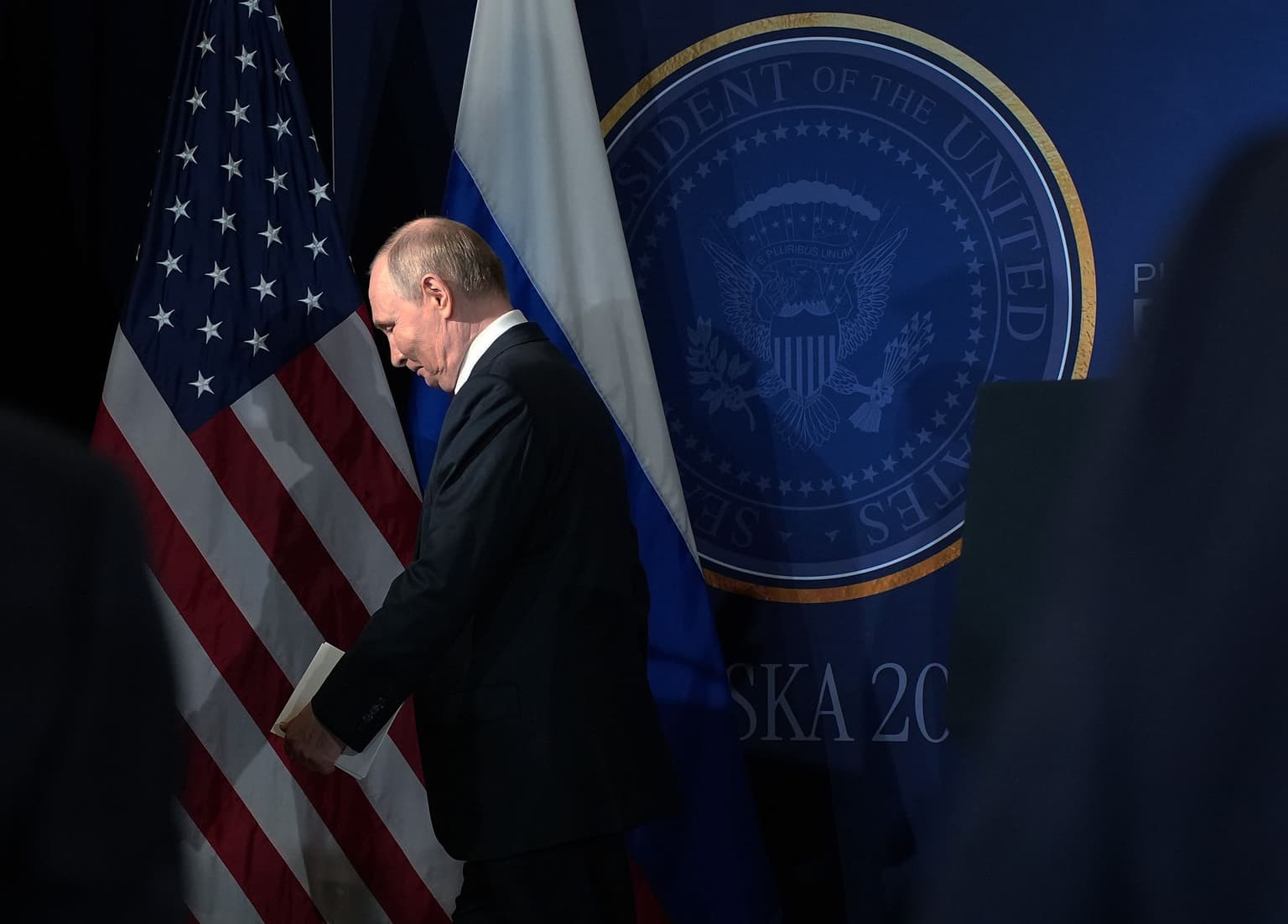
Russian President Vladimir Putin in Anchorage, Alaska, US, on Aug. 15, 2025. (Andrew Harnik / Getty Images)
 on Google
Andrew Chakhoyan
Academic director at the University of Amsterdam.
In Netflix's House of Dynamite, a ballistic missile hurtles toward the United States, the nightmare scenario that keeps defense planners awake at night. Yet the West's Russia policies, over the past decade, have done more to increase the odds of such a catastrophe than prevent it.
Washington's unwitting effort to teach Moscow that nuclear threats work and aggression pays has culminated in a 28-point dictator’s wishlist, bizarrely presented as a "peace plan."
The United States, the world’s most powerful nation, is chasing Kyiv for territorial sacrifices while meekly pleading with the predator state to accept them.
This approach to peacemaking is as helpful as pouring vodka on a raging fire. Expansionist wars end only in one of two ways: the aggressor is defeated, as Hitler reminded us in 1945, or the cost of continuing outweighs the gains, as Russia learned in Afghanistan in 1989. There is no third way.
Zoom out from the 24-hour news cycle and the absurdity slaps you in the face. Russia invaded Ukraine in 2014. For nearly a decade, Western capitals buried their heads in the sand, offering only halves of half-measures. Moscow predictably read this as a green light to escalate. But after 2022, when Russian tanks rolled over Ukraine’s sovereign border en masse, looking the other way ceased to be a viable option.
In early 2025, the Trump administration recognized that peace negotiations are a two-step process – hostilities must be halted first, and everything else comes after. Within 24 hours of the March Jeddah talks, Ukraine accepted the unconditional ceasefire – demonstrating it wants peace, not war.

And Russia? Before the Americans put a ceasefire on the agenda, it was murdering Ukrainian children in their beds with depraved regularity, and so it continues to this day. Russia commits unimaginable, most heinous war crimes; the world watches.
Rejecting peace at every turn, the aggressor was given the famous "two weeks" deadline, on repeat. But those came and went without serious consequences. Russia effectively spat in the face of American negotiators, and the White House failed to find the resolve and wisdom to respond.
Empty demands, unbacked by pressure, do not deter colonial revanchism. They invite, incentivize, and assure it.
If Ukraine were to offer preemptive concessions, it would derail the very goals Western leaders are pursuing. Only the willfully blind wouldn't see that yielding to a violent aggressor, like Russia, is a straight line to a larger war. To advocate for peace through strength is not warmongering; abandoning it, is.
History has run this macabre experiment — repeatedly. Europe's political class convinced itself in 1938 that handing Hitler the Sudetenland would secure "peace for our time." Instead, it taught the Nazi regime that democracies lacked resolve. The result wasn't stability — it was a continent-wide inferno.
When Russia invaded Georgia in 2008, the West pushed Tbilisi into a ceasefire while Moscow consolidated territorial control. The aggressor paid no price. Six years later, Russia returned to this script in Crimea, then Donbas. Every off-ramp became the runway for the Kremlin's escalation.

No Western concession can alter Moscow's trajectory toward Beijing, because that alignment is structural. Russia's extractive economy is export-dependent, and its military-industrial base cannot function without Chinese inputs. Most critically, Russia's imperial ethos requires perpetual confrontation with the West as a way to legitimize despotic rule. That naturally drives Moscow into Beijing's arms.
A Russia kicked out of Ukraine has at least a theoretical chance to rethink its colonizer identity and decouple from China. A Russia rewarded in Ukraine has no such incentive — it will cement a junior-vassal status under Chinese domination, locking in the very geopolitical shift Washington says it fears.
"Even if America and Europe are not interested in the war, Russia’s war is very much interested in them."
Moscow's nuclear threats follow a pattern: whenever it faces pushback, Russia rattles its doomsday saber. It didn't use weapons of mass destruction when its army collapsed outside Kyiv, nor when Ukraine liberated large swaths of Kharkiv Oblast, nor when Crimea came under attack. More tellingly, Xi Jinping — to whom Putin now effectively reports — has ruled nukes out. This naked blackmail is a performance meant to frighten Western publics, not signal Moscow’s willingness to commit imperial suicide.
By breaking the nuclear taboo, the long-standing norm that responsible states do not threaten first use, the Kremlin bears sole responsibility for eroding the nonproliferation regime. But when the West caves and refuses to accept the basic premise that aggression must be punished, it does not allay nuclear risk.
It makes confrontation or an accident born of brinkmanship more likely, not less.

The West ignores this at its peril: even if America and Europe are not interested in the war, Russia's war is very much interested in them. As Casey Michel, a prominent Russia analyst and head of the Combating Kleptocracy Program at the Human Rights Foundation, has noted, the long-term security of the United States turns on a simple question: whether an expansionist nuclear power can dismember a non-nuclear neighbor, and what signal Washington sends if it succeeds.
We live in a house of dynamite, that much is true. But the fuse cannot light itself; it is the KGB man who plays with matches, then reaches for the gun, while the rest of the dwellers look on in shock instead of forcing him to stop. That is the deeper lesson the Netflix film left unaddressed.
Systems fail not because they are fragile, but because people with the power and responsibility to stop a malignant actor hesitate until it is too late.
The danger is not that Russia will suddenly do something unthinkable; it is that the unthinkable is routinely tolerated: “of the nearly 53,000 verified civilian casualties from the start of the full-scale invasion, more than 3,000 have been children.” If Moscow walks away with anything resembling victory, this won't stay contained to Ukraine.
For the world that prospered under a hard-won security order, the choice couldn't be clearer: help Ukraine kick the aggressor out and defuse the threat, or keep indulging fantasies of "deal-making" and usher in a bigger war.
Editor’s note: The opinions expressed in the op-ed section are those of the authors and do not purport to reflect the views of the Kyiv Independent.
read also