Chart of the week: The different paths of Eastern Europe's civil society
(Nizar al-Rifai/Luca Léry Moffat/The Kyiv Independent)
 on Google
In Eastern Europe, shifting global orders have been a lived experience for decades. Just over thirty years ago, the end of communism and the retreat of Russian dominance paved the way for market economies and pluralistic societies, sometimes overnight.
Since that rupture, civil society — the organizations that exist in the space between the ordinary citizen and the state — has been integral to the political, social and cultural transformations across much of the region. But that fast-paced change has also been volatile — at times successful in bringing about positive change, and at others, facing backlash.
To shed some light on the story of civil society in Eastern Europe, the Kyiv Independent spoke with Maria Popova, professor of political science at McGill University and an expert on the region.
The conversation has been edited for clarity.

The Kyiv Independent: What is the bird's eye view history of civil society in Eastern Europe?
Maria Popova: In the nineties, the dominant theory was that civil society was underdeveloped in Eastern Europe compared to the rest of the continent because of the legacy of communism. Essentially, communism killed organizational life, and people didn't think of civil society as a way to change things in the polity. That was the overwhelming assumption in the political science field — that there was no civil society in Eastern Europe.
I think the color revolutions pushed back against this. There were these massive mobilizations that suggested civil society is there, and ready to make a huge difference to political outcomes. Within the countries that joined the EU, the story is also that European integration helped the mobilization of civil society and the growth of involvement of civil society organizations in policy-making.
That's the overarching arc of history — that the nineties were a low point followed by a significant rebound.
The Kyiv Independent: Could you bring to life some of the individual country stories that we see in the graph?
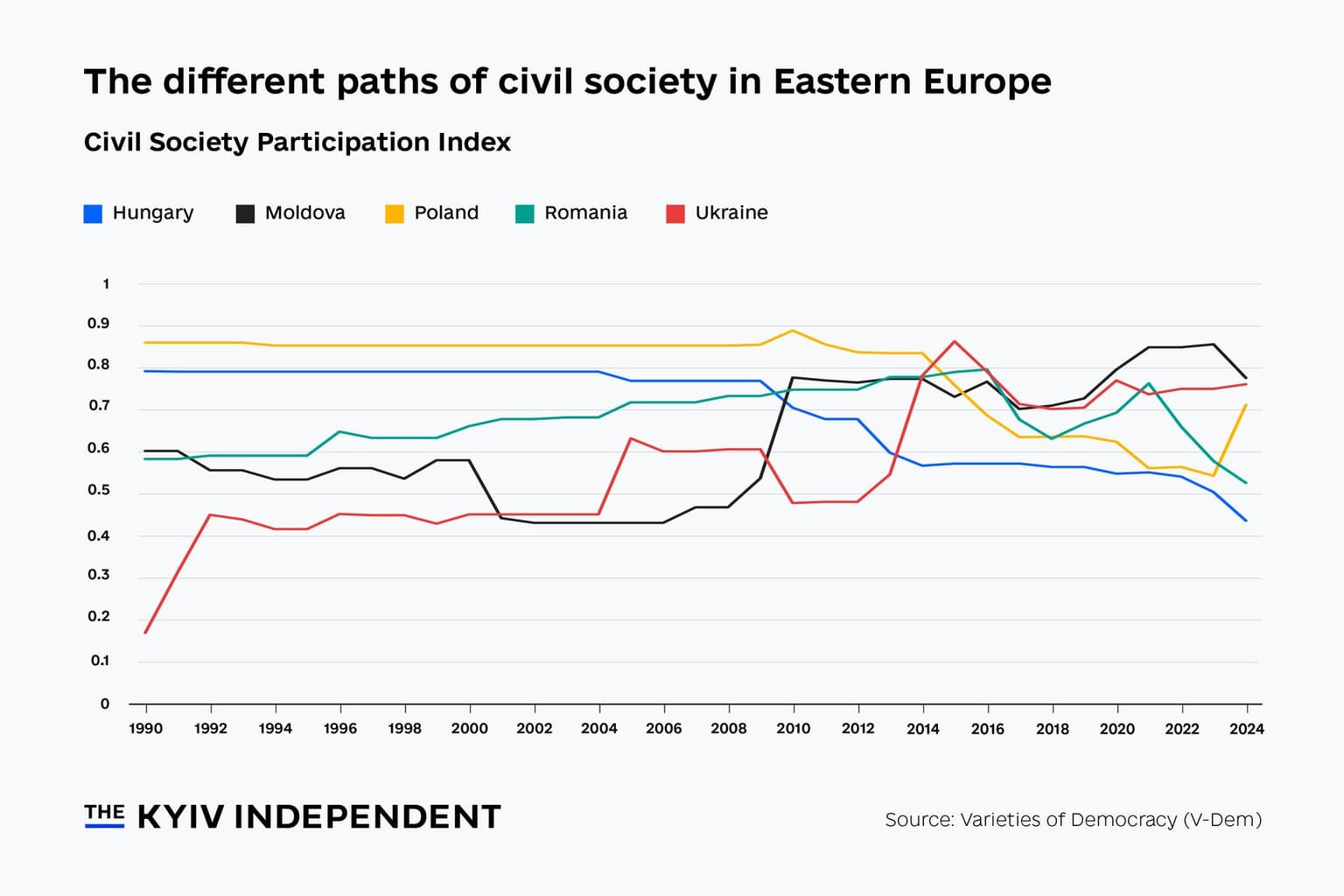
Maria Popova: In Ukraine, we see a big rise after the Orange Revolution in 2004, which led to the mobilization of civil society and more autonomy from the state. This is essentially when Ukraine democratized conclusively. Before the Orange Revolution, Ukraine was a competitive authoritarian regime — there was political competition, but not really entrenched democracy, because everyone was hoping to destroy their opponents and establish and consolidate power.
But the Orange Revolution is the moment at which most of the political spectrum in Ukraine understood that political competition is here to stay, and that they would have to adhere to the democratic rules of the game. On the graph, the index is still lower than that of the other countries in the 2000s, but it approaches them dramatically.
You also see this in Moldova following the 2009 protests against the Communists' victory in elections. There's a little dip in the mid-teens, which is probably tied to when Moldovan oligarch Vladimir Plahotniuc dominated politics.

In fact, President Maia Sandu last year managed to extradite him back to Moldova to face charges, with European help. He's the main suspect in a bank fraud case, which saw the siphoning off of 12% of the country's GDP.
As of 2024, Moldova is on top, which is really a testament to how effective a reformer Sandu has been. If you look at Moldova across all sorts of indices, it's on top of everything. It's impressive progress, with an overhaul of the judicial system, the anticorruption institutions, and the party system. And she managed to win a referendum, presidential, and parliamentary elections despite huge Russian interference.
In Romania, I think the dip in 2018 could be explained by the backlash against anti-corruption agencies. There was a very effective anti-corruption agency named the DNA, which in 2015 was at its height. They prosecuted many politicians across the political spectrum for corruption, and were getting convictions in 80% of the cases. They were making a huge difference and were extremely popular with everyone (but the political class, of course).
"The lesson to learn is that populist parties are skeptical of civil society organizations."
Back in April 2015, I was in Romania talking to a prosecutor, who had to interrupt the interview with me to take a call with the first chair of the newly-formed Ukrainian National Anti-Corruption Bureau (NABU), which wanted to learn from the Romanians since they were doing so well.
Fast forward a few years, and the Romanian political elite banded together and dramatically weakened the DNA. And we saw similarities in Ukraine last year with the summer protests: once anti-corruption institutions start being somewhat independent, there's going to be backlash.
But despite this, the person who was in charge in Romania is now the inaugural European prosecutor of the newly formed prosecutor's office, Laura Kövesi. When she was appointed by the European Council, the Romanians voted against her since they had just chased her out of the job, whereas the French and Germans said that they were so impressed with what she had done in Romania.
For Hungary, the decline is simply Orban marginalizing civil society. The Orban regime does not consult civil society organizations, and there is lower political competition in Hungary. And in Poland, the Law and Justice party, which had followed Orban's playbook, lost the election in 2023, and we already see some recovery since.

The Kyiv Independent: How has Ukrainian civil society changed following the full-scale invasion?
Maria Popova: There is some forthcoming work from Oksana Huss and Alexandra Keudel, who explore how Ukrainian civil society has switched from an accountability institution to a more cooperative and symbiotic relationship with the state. Whereas before it was all about reining in the state, it's now more about being constructive and doing things like sharing best practices.
The Kyiv Independent: Is there a recipe for preserving a strong civil society, and what can we learn from the weakening of civil society in Hungary and Poland?
Maria Popova: I think that the lesson to learn is that populist parties are skeptical of civil society organizations. They vilify civil society organizations as grant eaters and leeches, and this is at the root of the state's ability to marginalize them and exclude them from the policy-making process. That's the story of Poland and Hungary: the successful branding of civil society as leeches or agents of foreign influence. It started in Russia, Orban borrowed it, and now the Georgian government is doing it.
The Kyiv Independent: Why does civil society matter?
Maria Popova: It's crucial as an accountability institution when the government oversteps boundaries in different ways. Whether through corruption, violation of rights, or the underprovision of services, civil society often steps in.
Across Eastern Europe, the state was weakened after the collapse of communism. You had a population expecting a paternalistic state to provide everything, as low quality as the communist provision was, but the state was no longer willing or able to do so. Civil society filled that gap. For example, in the presence of corruption in the healthcare system, patient organizations provided and pushed for the state for services.