Canadian AI software could flip Russia's disinformation war on Europe
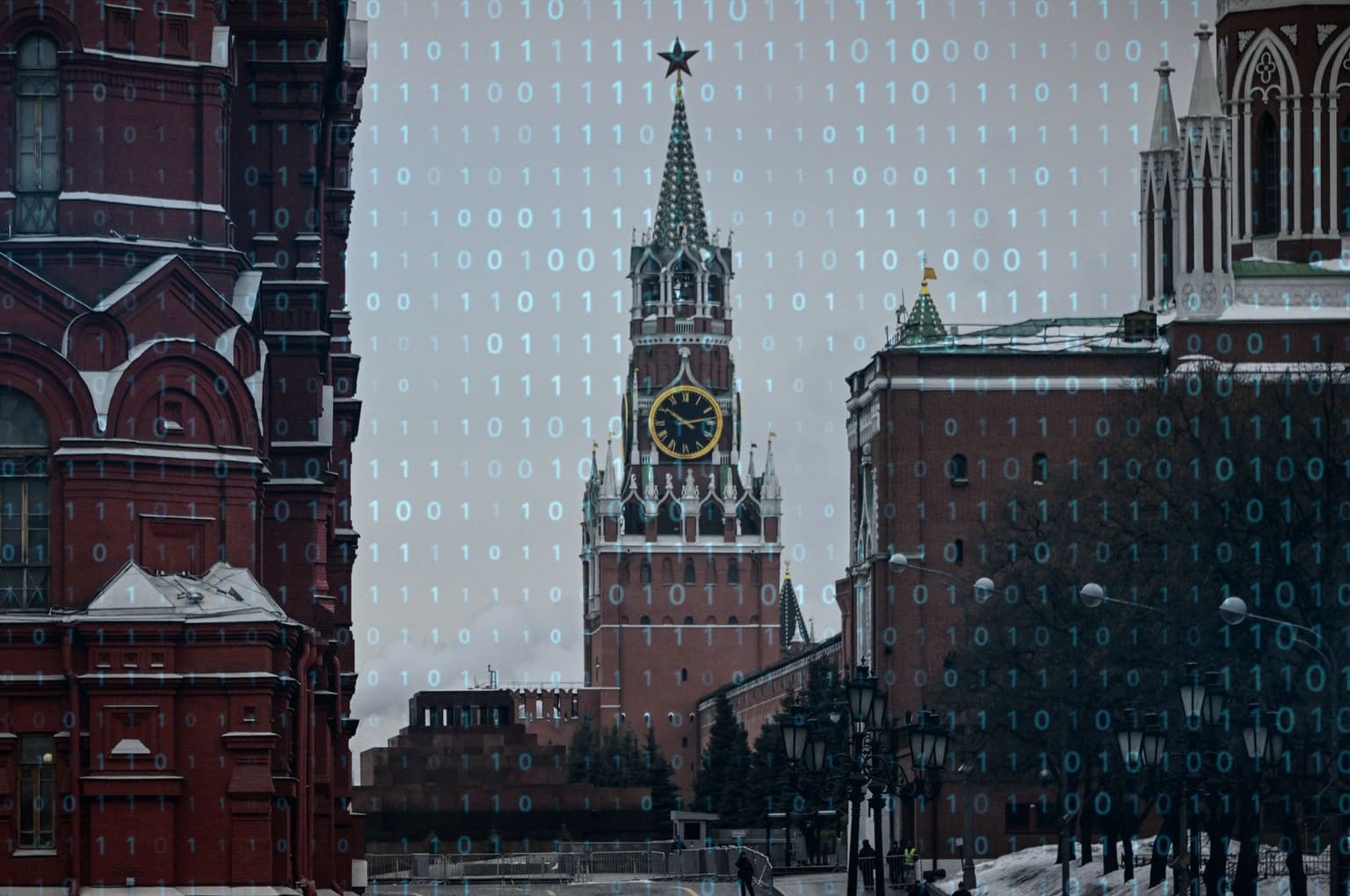
Red Square in Moscow, Russia, on March 5, 2024 with the Binary Code. (Photo: Alexander Nemenov / AFP via Getty Images, Collage: The Kyiv Independent)
 on Google
A new artificial intelligence (AI) agent could equip Europe to better defend itself against the barrage of Russian disinformation attacks.
Cipher is Canadian-developed AI software that has proven to accurately and quickly detect Russian disinformation targeting Canadian networks, on both the far right and the far left of the political spectrum.
Now that Cipher has passed the testing stage, the researchers are training the AI agent to distinguish those same narratives in the Russian language.
The researchers hope it can be rolled out in Europe for those at the forefront of efforts to combat Russian operations that sow distrust in Western democracies and institutions.
Marcus Kolga, who runs the foreign disinformation monitoring platform DisinfoWatch in Canada, tested Cipher to see how well it stood up to his 20 years of experience reporting on foreign interference.
"What would usually take, for an analysis piece, maybe half a day to a day, was really being crunched down to a few hours, and (it) was scarily accurate," says Kolga, who tested out Cipher in its early stages and still uses the AI agent to expedite his work.
Scaling up monitoring
Cipher is a human-in-the-loop AI agent system that requires a user to oversee the process to detect Russian disinformation campaigns in English.
The software automates the detection of online disinformation, enabling monitoring and analysis to scale up and withstand the sheer volume produced by Russian operations.
The tool uncovered persistent efforts to deliberately sway Canadian public opinion on Ukraine with the goal of eroding the support Kyiv receives from one of its staunchest allies.
Brian McQuinn, an associate professor in international studies at the University of Regina, is one of the project leads. He has been researching the role of social media in armed conflict.
McQuinn worked with Kolga on the 2023 report The Enemy of My Enemy, which detailed how Russia uses information operations to undermine Canadian support for Ukraine amid the Russian invasion.
The research led McQuinn to consider whether AI could support Kolga's work in monitoring and tracing the spread of information online.
Tracking the shifts
The Cipher project began three years ago under the AI safety research program at the Canadian Institute for Advanced Research (CIFAR). McQuinn worked with project co-lead Matthew Taylor, an associate professor in computing science at the University of Alberta, who directed a five-person team of engineers in creating the sophisticated software.
Beyond mapping out where Russian disinformation is spreading online, with reports processed down to the last 24 hours, Cipher also shows trending themes.
This type of analysis provides experts with more detail on how Russian operations are shifting over any period of time.
"We are able to track and show on a day-to-day basis ... where are the Russian networks investing their limited resources (and) what themes they are targeting day in, day out, and how they are changing over the weeks and over the months," says McQuinn.
"It really shows you the extent to which they are responding to events almost in real time."

Exploiting geopolitical events
Deceptive narratives are often disseminated by Russian state-controlled outlets such as RT and Sputnik, then amplified by social media influencers. From there, they spread across Canadian social networks, occasionally making their way into mainstream news coverage.
While Kolga covers all foreign interference in the Canadian context, Russian campaigns make up the bulk of the work he sifts through. He says he has observed that these operations adapt in real time, exploiting geopolitical developments for political gain.

When the U.S. conducted an operation to capture Venezuelan leader Nicolas Maduro on Jan. 3, Russian operations were quick to push narratives that Western governments are imperialist and engage in regime changes, says Kolga.
When former Canadian Deputy Prime Minister Chrystia Freeland announced her resignation from the country's parliament to be appointed President Volodymyr Zelensky's economic advisor on Jan. 5, Kolga said he could see a peak of targeted attacks.
These aimed to discredit Freeland by pushing claims that her Ukrainian grandfather was a Nazi collaborator during World War II, an accusation her office has previously denied.
From there, it is Kolga's job to compile an analysis report that seeks to "inoculate" audiences against the disinformation, laying out the facts and the historical context behind Russian operations that promote specific narratives.
Pre-bunking Russian disinformation
The next challenge for the Cipher team is fine-tuning it to more accurately predict how Russian disinformation will spin the narrative around any expected events. Experts like Kolga can then get ahead of the attacks to suppress how far they could spread.
"You can actually start to predict the narratives that are going to come, and therefore you're pre-bunking them, and in many ways that's the most effective strategy," says McQuinn, explaining how Cipher could further advance disinformation monitoring.
McQuinn hopes that Cipher will be piloted in the Baltic countries and eventually in Ukraine for those working in parallel to Kolga.
"For us to have this sort of a tool to help us defend against it is a small step, but it's an important step in eventually building some resilience and inoculating Canadians against these information operations," says Kolga.
Editor's note: This article was published as part of the Fighting Against Conspiracy and Trolls (FACT) project, an independent, non-partisan hub launched in mid-2025 under the umbrella of the EU Digital Media Observatory (EDMO). Click here to follow the latest stories from our hub on disinformation.