Bloom amid ruin: Ukraine’s struggle through the journey of one rose
"Something beautiful should always be in your life, even in dark times."
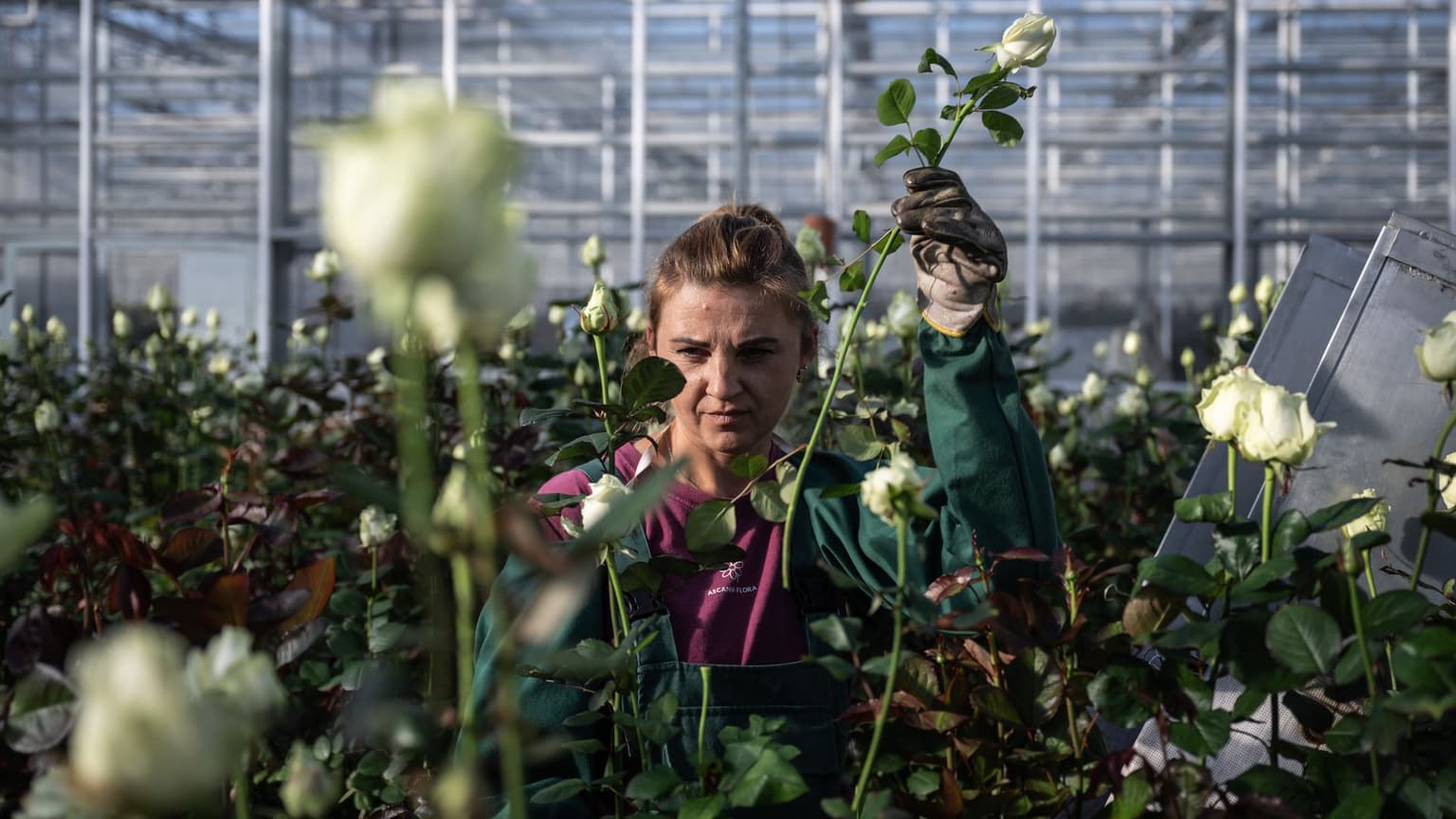
A woman cuts roses in a greenhouse of Ascania-Flora, Ukraine's biggest producer of roses, near Kyiv, Ukraine, on Nov. 7, 2024. (Viacheslav Ratynskyi / The Kyiv Independent)
Editor's note: This story was originally published in The Kyiv Independent's first-ever print edition, titled "The Power Within," in July 2025. You can order a copy in our e-store.
Billions of flowers grow every year in Ukraine, but it only takes one to tell the story of its people in wartime.
As a single rose grows and is nurtured, blossoms, and then is cut to be transported and sold in any one of Ukraine’s numerous flower shops, it encounters many lives and surroundings as it makes its journey.
Like a quiet bridge between lives, it links people together on its path to a home, celebration, or, sadly too often these days, a grave, accompanying the heavy toll Russia’s war has taken on Ukrainians.
This is the story of one white rose from its war-affected greenhouse to a birthday celebration, and the people and places along its way.
Roses amid chaos
One breath of the floral, humid air upon entering the five-hectare greenhouse within the Ascania-Flora complex outside of Kyiv, Ukraine's biggest producer of roses, is enough to forget the war — the pain, death, and destruction — occurring beyond its walls.
As well as the proper climate, light, water, and rich soil, flowers "need peace to grow," the company's commercial director Viktor Fedorenko says.
When Russia launched its full-scale war against Ukraine in February 2022, the fate of the 20-hectare greenhouse complex in the village of Kvitneve — its name rooted in the Ukrainian word "kvitka" (flower), a fitting reflection of its blooming fields — hung in the balance.
"It started with explosions at 5 a.m.," recalls Ivan Syvak, deputy chief agronomist at Ascania-Flora. "Then, the chaos began."

As Russian troops moved to swiftly occupy parts of Kyiv Oblast, the Ascania-Flora complex found itself just a few kilometers away from the front lines.
It stopped operating commercially on the second day of the invasion, but Syvak and a few other staff members continued to visit the greenhouses to check on the plants.
"I came here on March 8, Women’s Day, to check on everything," Syvak recalls, his voice starting to tremble.
"The flowers were no longer for sale, but we took some of them home since they were about to be thrown into the garbage."
That day, around noon, when he was at the greenhouse, he learned that Russian tanks were already driving through his home village nearby. "I was standing here, just like I am now, but with nowhere to go."
Like many other businesses across Ukraine, Ascania-Flora suffered significant losses — over $9 million due to the destruction of their first 2.4-hectare greenhouse, developed in the early 2000s, and located about 10 kilometers from their current site.
"It was freezing outside, and a strike nearby shattered the glass. The flowers there froze," Syvak recalls.

As Ukrainian forces drove Russian troops out of the area in April 2022, Ascania-Flora slowly returned to life. They resumed full operations only in the summer of that year, harvesting up to 200,000 roses daily.
But the next stage of the war would bring new challenges.
Russian attacks on Ukraine's energy infrastructure, which continue to cause power outages to this day, posed a grave threat to their operations. The power generators they invested in were insufficient to provide the costly lighting required for the roses to grow.
"We can maintain the climate conditions, the temperature, and humidity at minimal levels, but not the lighting as it requires so much power," says Fedorenko.
"I don't know of any greenhouse farm in Ukraine that could be completely autonomous in this regard."
From hand to hand
During the war, flowers have come to mean more to people than ever before.
"The demand started growing as soon as (Russian troops) retreated from Kyiv Oblast," Syvak says as he walks along the rows of rose bushes he has cared for the past 24 years.
"This one is ready to be cut down," he says as he points at an ivory-white Avalanche rose, one of the most popular kinds they grow.
As a reaction to cold, narrow red lines appear on the petals of these roses, distinguishing them from other types.
"I worked here for 19 years, and for 19 years, I've been cutting the same kind — the white Avalanche rose," greenhouse employee Svitlana Ustenko, 44, says, holding a stem carefully in her gloved hand, then quickly snipping it at the bottom.

"I may have grown used to it, but I still like it a lot," Ustenko says.
Although the job is physically tough, she finds joy in working with roses, appreciating their stability and beauty in such a dark time.
"You just live one day at a time, not knowing what tomorrow will bring. You can't plan anything," Ustenko says. "Before (the full-scale war), I used to dream of building something or buying something expensive. Now, those thoughts are gone."
Delivering roses in wartime
After the white rose is cut, it’s laid flat to “rest.” Then, its lower leaves are trimmed, and it joins nearly two dozen other Avalanche roses in a stunning bouquet. Now, it's ready to leave its warm home — either to bring joy to a lucky recipient or, sadly, to rest on someone's grave."
I remember the first time delivering roses since the start of the full-scale war," 42-year-old driver Vadym Kostenko says.
"I drove a small batch to Poltava, and it felt insane — there is war, and I'm delivering roses."
Kostenko, who has been delivering roses mostly across the Kyiv region for nearly 25 years, gently loads the flowers into his van, which can carry around 7,000 flowers.
"The full-scale war changed a lot for me," he says as he drives the roses to Kyiv. "I wouldn’t even look at gas prices (before the war). But now it has increased by up to 70%."
"There is war, and I'm delivering roses."

He explains that it has become hard to maintain his pre-war lifestyle with the current inflation levels.
"If in the past, I could save some money, now I spend it on basic needs like food, utility services, gas, and maybe some clothes," Kostenko says.
Another source of pain for him is the distance — not the kilometers he travels almost daily to deliver the flowers — but the separation from his wife and son, who are among the 6.3 million Ukrainian refugees abroad. He has not seen them for three years.
"I got used to being alone," Kostenko says, the sorrow etched in his eyes.
The uncertainty of tomorrow
The Avalanche rose bouquet has arrived at a spacious flower store in Kyiv's downtown. It won't linger there for long, pleasing the eyes of staff and customers, soon to find a new home.
Orest Kovalyshyn, the 28-year-old director of the flower store chain Flora de Luxe in the capital and Kyiv Oblast, recalls the start of the full-scale invasion: "We opened the store on Feb. 24 (2022). Some people even stopped by to get flowers that day." They stopped working on the following day.
A little over a month later, Russian troops were pushed out of Kyiv Oblast. The city breathed a sigh of relief — and it wanted flowers. The flower chain reopened in April 2022, Kovalyshyn says.

"(People were buying flowers) just to elevate the mood, to put them at home," Kovalyshyn recalls.
But a month of downtime cost them a couple of hundred thousand hryvnias (around $4,800) as they were forced to dispose of thousands of flowers delivered before the war. One of their stores was also heavily damaged by Russian missile attacks in 2022 and 2023.
"We never managed to restore it," says Kovalyshyn.
Despite the war, people celebrate weddings and birthdays, buying flowers to mark special moments. Soldiers have also become a significant part of their clientele, purchasing flowers for their loved ones upon returning from the front lines.
Inevitably, some are sold for sad occasions, such as funerals and memorial services. Those are easy to spot. In accordance with the local tradition, funeral bouquets must have an even number of flowers. The living always get an odd number.

Since the flowers must be stored in a cold environment, Kovalyshyn invested in power generators to maintain the required temperature in the stores as Kyiv suffered lengthy blackouts following Russian strikes on energy sites.
Despite the difficulties, they recently opened a new store, seeing the growing demand for flowers.
Running a small business during the war is beyond challenging, Kovalyshyn says. "We don't have long-term plans because no one knows what tomorrow will bring, whether your store will be hit or not."
Since their expenses have increased, it has affected prices too, says Kovalyshyn.
"And if the prices continue to grow, not all people will be able to afford flowers."
Small joy
It's the middle of a work day, and only occasional customers stop by the store, mostly selecting the roses. A woman stops near the Avalanche bouquet that arrived earlier that day.
"It’s my dear sister’s birthday today," she says, smiling.
The woman’s name is Olena Holovach. A 64-year-old pediatrician, she lives nearby and stops by the store every time she has something to celebrate.
"I can’t buy the whole bouquet," she says, implying that 20 roses would be too expensive. She takes seven instead, paying about Hr 500 ($12) for them.

Holovach says she rarely splurges on something beyond food and healthcare. She hasn’t been able to afford to go on vacation or take weekend getaways since the start of the invasion: "I can do without it for now."
Her son-in-law joined the fight for Ukraine's freedom as a paramedic in the early days of the invasion, forcing her family to set aside any thoughts of fun while he is at the front line.
"And flowers… That's how I was taught in our family, that something beautiful should always be in your life, even in dark times."
"It's a small joy. Something that can bring a smile to your face."