Here's why Minneapolis reminds me of what I once saw in Ukraine
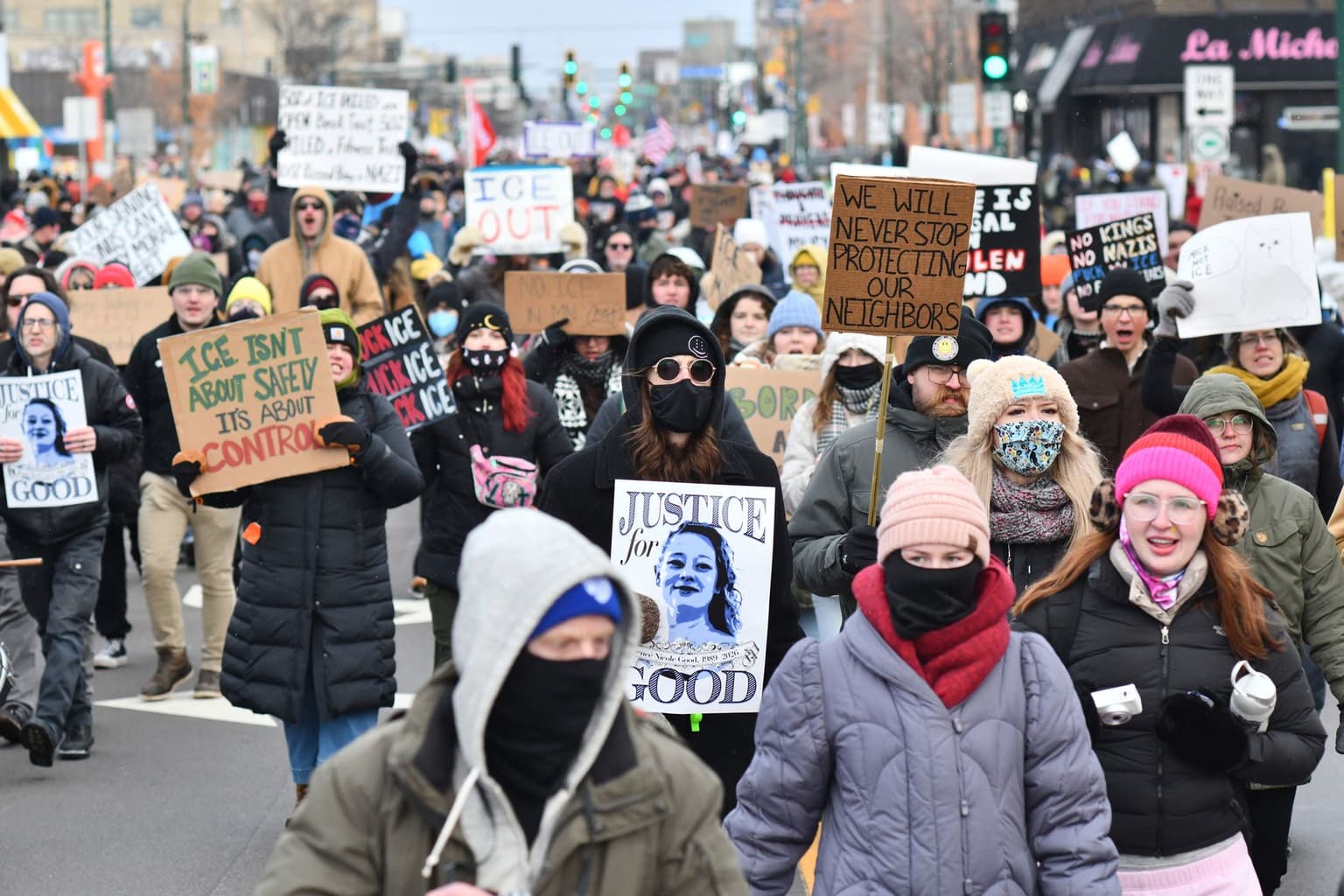
Protesters hold signs and march from Powderhorn Park in Minneapolis, Minnesota, U.S. on Jan. 10, 2026, against Immigration and Customs Enforcement (ICE) after the fatal shooting of Renee Good by an ICE agent. (Octavio Jones / AFP via Getty Images) 

Oleh Kotsyuba
Director of publications at Harvard University’s Ukrainian Research Institute
"Democracy dies in darkness," Judge Damon Keith reportedly warned — a line Bob Woodward would later popularize in his later work on Watergate.
Today, the task of shining a light on the actions of those in power often falls to people with smartphone cameras: First-person accounts of the abuse of power are supported by video recordings, which makes accountability harder to evade.
That is why the killing of Renee Good in Minneapolis on Jan. 7, 2026 — about a mile from where George Floyd was killed in 2020 — reverberated so quickly.
Reports of ICE brutality have long circulated, especially in crackdowns that hit some of the country's most vulnerable people: poor, darker-skinned immigrants doing manual work, often constrained by language barriers and limited resources. But the videos of Good's death, filmed from multiple angles, shocked Americans nationwide.
Race and citizenship — and the rights attached to them — inevitably shape how the public reacts. Yet the scale and intensity of the response point to something broader: a growing crisis of legitimacy for the Donald Trump administration, and the risks that crisis poses for American democracy.


An objective investigation into what led to the shooting of Renee Good and how it unfolded is still pending despite hasty claims and accusations from the senior officials of the Trump administration. Key facts remain unclear, including whether ICE agents gave conflicting instructions and whether Good was in fact using her car to protest ICE's actions in Minneapolis as a form of peaceful resistance.
Still, the recordings do clarify one critical point: The agent appears to have fired when he was not in immediate danger. Rather, the footage suggests that shooting through the front windshield and an open side window looked less like self-defense than punishment for defiance.
As JD Vance framed it, the shooting was a response to Good's "unlawful obstruction" of legitimate law enforcement. However, when the government asserts authority in ways that a growing share of the public experiences as arbitrary or vindictive, the government and its law enforcement begin losing legitimacy.
After all, in democratic societies, governments derive legitimacy primarily from the consent of the governed who, in free and fair elections, choose representatives to act on their behalf. When those representatives no longer act on behalf of the citizens who elected them, they lose legitimacy.
Watching protests erupt in sub-zero temperatures across several states, often featuring personal vehicles as a tool of resistance, I was reminded of Ukraine's 2013–2014 Revolution of Dignity (EuroMaidan).
When the legitimacy of Viktor Yanukovych's government collapsed following a sharp turn from the EU and values of democracy to Russia and authoritarianism, people revolted and creatively used everything available to them for protest.
One Ukrainian innovation of the time was a whole movement called Avtomaidan, loosely translated as "car protest," in which ordinary people used their own vehicles to keep demonstrations supplied and mobile when authorities tried to choke them off. Cars carried protesters when public transit was shut down, delivered food, firewood, and medicine to those holding the line overnight, and formed barriers that slowed police and internal forces enforcing the will of a government many no longer recognized as legitimate.

Of course, America is not Ukraine, but perhaps this is a case in which America can learn something from Ukraine.
For one, legitimacy is a universal currency, and the federal government under Trump has been spending it fast. Federal agencies increasingly appear less like independent institutions and more like instruments of one man’s erratic will — asked to carry out orders that many see as unjust and cruel toward vulnerable communities and increasingly unmoored from democratic consent.
Trump's repeated declarations of national emergencies, eleven in total, ranging from a "border emergency" to an "energy emergency," alongside emergency actions imposing fitful international tariffs and sanctions, have become a lever for executive power.
Each emergency expands access to funds and enforcement tools while reducing the need to seek congressional approval. Over time, "emergency" turns from an exception into a governing model, a feature familiar to those of us with recent experience of authoritarianism.
We're witnessing today what that looks like in practice: the use of the National Guard to suppress peaceful demonstrations and intimidate protesters in predominantly "blue" states; the deployment of ICE agents into ethnically diverse communities with high Democratic support and a relatively low share of undocumented immigrants; and the increasing use of the DOJ and FBI for political ends.
This is a pattern of authoritarian drift that Ukrainians are closely familiar with: rapid consolidation of executive power, aggressive use of state capacity against perceived enemies (including former allies who dared defy the president), and a growing insistence that legality is whatever the leader says it is.
In pushing against all that, Americans can take a page from Ukraine's civil society playbook.
In this context, Trump's actions abroad matter, too. They appear to function as both a blueprint and a testing ground for what could be normalized at home: contempt for legal constraints, with the leader as the ultimate arbiter of what counts as lawful. The administration's international posture — from claims about the Western Hemisphere to territorial ambitions involving Greenland (and previously Canada), and to acceptance of Russia's claims to Ukraine — serves multiple purposes.
It energizes the base, distracts from domestic hardship tied to economic and trade policy failures, and models an approach to power that treats international law as a nuisance, not a rock on which international security is built.
Given the spirit of the U.S. Constitution and the nature of the American project that is built on checks, balances, and pluralism, such authoritarian tendencies will inevitably provoke a gradual erosion among the majority of the U.S. population of not only Trump's own legitimacy but also of the very institutions that uphold the federal government itself.
While the reaction to Renee Good's killing shows that the abuse of power won't go unnoticed, the more urgent question is whether Americans, and their institutions, can convert visibility into accountability before government by intimidation becomes the new normal.
Editor’s note: The opinions expressed in the op-ed section are those of the authors and do not purport to reflect the views of the Kyiv Independent.