Ukraine’s deep strikes make Russians feel the war
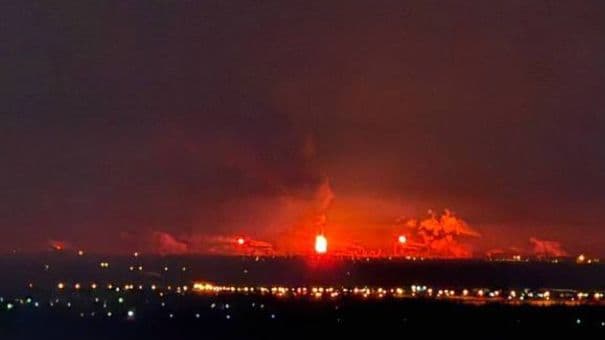
What purports to be a fire burning at Russia's Volgograd oil refinery following a drone attack that struck the site overnight in Volgograd, Russia, on Feb. 11, 2026. (Exilenova+/Telegram)
 on Google
Ukraine has increasingly pursued a strategy of "bringing the war back to Russia" — aiming to erode the perception that the full-scale invasion is distant and cost-free for Russian society.
This approach was explicitly articulated by President Volodymyr Zelensky in 2025, as Ukraine significantly expanded its deep-strike campaign inside Russia.
"The war was brought from Russia, and it is to Russia that the war must be pushed back. They must be the ones forced into peace. They are the ones who must be pressured to ensure security," Zelensky said.
An internal analysis by the Ukrainian NGO Join Ukraine, shared with the Kyiv Independent, suggests that strategy is beginning to reshape how the war is felt across Russia. The organization monitors social media discourse and public reactions across Russian regions and occupied territories, and found that Russians are increasingly confronting the war through casualties, drone attacks, internet blackouts, and economic disruption.
"Obituaries have become part of everyday life, and comments often include restrained sympathy alongside questions like 'What is this war for?'" Andrii Sukharyna, head of analytics at the NGO Join Ukraine, told the Kyiv Independent.
The shift identified in Join Ukraine's analysis is becoming visible beyond local reactions and online comment threads.
Former Russian Defense Minister Sergei Shoigu recently warned that "no Russian region can feel safe," while public reactions across regions suggest the war is no longer tied to the front line.

"This can be an important factor in increasing political pressure on the Kremlin, but only in combination with other elements — particularly external pressure through sanctions," Oleksii Melnyk, co-director of foreign policy and international security studies at the Razumkov Center, told the Kyiv Independent.
Melnyk described Shoigu’s statement as a "bomb" in the Russian information space — widely interpreted as an implicit acknowledgment that the "operation" had not gone according to plan.
While geography still shapes how Russians experience the war, the gap between regions is narrowing.
"If these reactions continue to be ignored, the tightening of control and accumulated frustration could eventually trigger an explosion in one region — and then a chain reaction," Melnyk said.
"The ingredients are already there: dissatisfaction with the authorities, a growing sense of insecurity, and increasing instability."
Border regions
The regions most directly affected by the war are Russia’s border areas — including Kursk, Bryansk, and Rostov oblasts — as well as occupied Crimea and parts of Donetsk and Luhansk oblasts.
According to the Join Ukraine analysis, these regions show the highest level of military-related discourse and the sharpest reactions to attacks.

"In these regions, we see the highest level of military-related discourse and the most acute reactions to events. Residents live in a state of constant anxiety due to regular drone attacks, air defense activity, and everyday disruptions such as internet outages and sirens," Andrii Sukharyna told the Kyiv Independent.
"They say everything was intercepted — but there was no real protection at all. No air defense, no security. It’s just embarrassing."
Per the analysis, these regions also show the most intense and polarized reactions.
On one hand, there is growing radicalization and calls for escalation — including demands for harsher retaliation, such as strikes with Oreshnik ballistic missiles or even nuclear weapons.
On the other, there is a growing feeling of fatigue and frustration. Residents criticize authorities for failing to ensure basic security, citing a lack of shelters, ineffective air defenses, and repeated disruptions to daily life.

One resident of Russia’s Kursk region reacted to official claims that Ukrainian attacks had been repelled:
"They say everything was intercepted — but there was no real protection at all. No air defense, no security. It’s just embarrassing."
In occupied Donetsk, a worsening water crisis has fueled open anger toward occupation authorities, especially toward Russian-installed leader Denis Pushylin, with residents dismissing official reports as disconnected from reality.
Rear regions
Further from the front line, Russians experience the war differently but no less tangibly.
Casualties remain one of the most significant factors shaping perception. The highest losses are recorded in Russia’s national republics and industrial regions, including Bashkortostan, Tatarstan, Sverdlovsk, Chelyabinsk, and Volgograd.
These regions, often economically struggling and politically less visible, have taken a disproportionate share of the human cost.
At the same time, some of these regions — like Volgograd, Samara, or Tambov — are industrial centers and refinery hubs, making them key targets for Ukrainian strikes.
This has made the war more materially visible there.


According to the analysis, residents are increasingly experiencing fuel shortages and rising prices, linking the war directly to their economic situation.
"This is an oil-producing country — yet fuel prices jumped from 53 to nearly 60 rubles. And officials still claim inflation is just 8%?" wrote one resident of Novosibirsk.
The need to import fuel from China is also perceived by some as a symbolic blow to Russia’s image as an "energy superpower."
"Patriots, how does it feel to ‘love Russian oil’ when it comes as Chinese fuel? But, please, try writing that from a ‘Russian’ phone, drinking Russian tea or coffee from a Russian kettle," another Novosibirsk resident wrote.
Distrust toward official narratives is growing as well. Claims by authorities that all aerial targets are intercepted often contrast with visible damage and fires at industrial sites.
Open protests remain rare due to the fear of repression, but dissatisfaction is increasingly expressed through localized grievances — particularly in regions like Kursk, Rostov-on-Don, and Voronezh, where residents openly question the state’s ability to protect their cities.
Remote regions
In more remote regions — including the Far East, the Urals, and Siberia — the war often remains more distant.
While overall battlefield casualty numbers are lower in absolute terms, per capita losses are among the highest. Despite this, for many residents in regions such as Yakutia, Khabarovsk, or Primorsky Krai, the war is often perceived as background noise.
According to the analysis, public attitudes are frequently characterized by detachment, with greater focus on local issues such as rising food prices, utilities, or economic ties with China. Obituaries and recruitment campaigns tend to be met with passive acceptance.
At the same time, support for the war in these regions is expressed through practical contributions.


"In these regions, people remain quite consolidated in their support for the ‘special military operation’ — not only in words, but through humanitarian aid, and without visible fatigue," the report notes.
"In places like Khabarovsk Krai, there is little engagement with the course of the war and few expectations about its outcome. Relative economic stability — supported by ongoing ties with China — reduces the perceived impact of casualties, sanctions, or international isolation."
Moscow
Across regions, there is also a widespread perception that Moscow is far better protected than the rest of the country, according to the analysis.
Experts argue this dynamic is critical for the stability of the system.
"As long as Moscow and St. Petersburg do not meaningfully feel the war, the Kremlin does not have to worry about political backlash," Melnyk said, adding that early signs of change are beginning to emerge.
In early March, Moscow experienced at least a week of widespread mobile internet disruptions, significantly affecting daily life. Authorities later introduced a "whitelist" system, allowing access only to selected websites during outages.

The impact has been tangible. Demand for alternative communication tools — including pagers, walkie-talkies, and landline phones — has increased, while sales of printed maps and travel guides surged as residents adapted to internet blackouts.
Mass mobile internet shutdowns have become a widespread Kremlin tool for information control across Russia since early 2025, turning the country into a global leader in internet restrictions.
According to the Join Ukraine analysis, this is one of the few unifying grievances across regions that are outraged that measures introduced "for security reasons" disrupt daily life but fail to stop drone attacks.
The report also points to signs of passive resistance — Russians increasingly reject state-backed digital platforms and actively share ways to bypass restrictions, including through VPNs.
For now, these reactions remain scattered rather than coherently organized politically, but they suggest the Kremlin is losing something it has long relied on: the ability to control not only the narrative of the war, but also how Russians experience it.