Trump administration is trying to reverse Kissinger, and even Kissinger is probably rolling in his grave
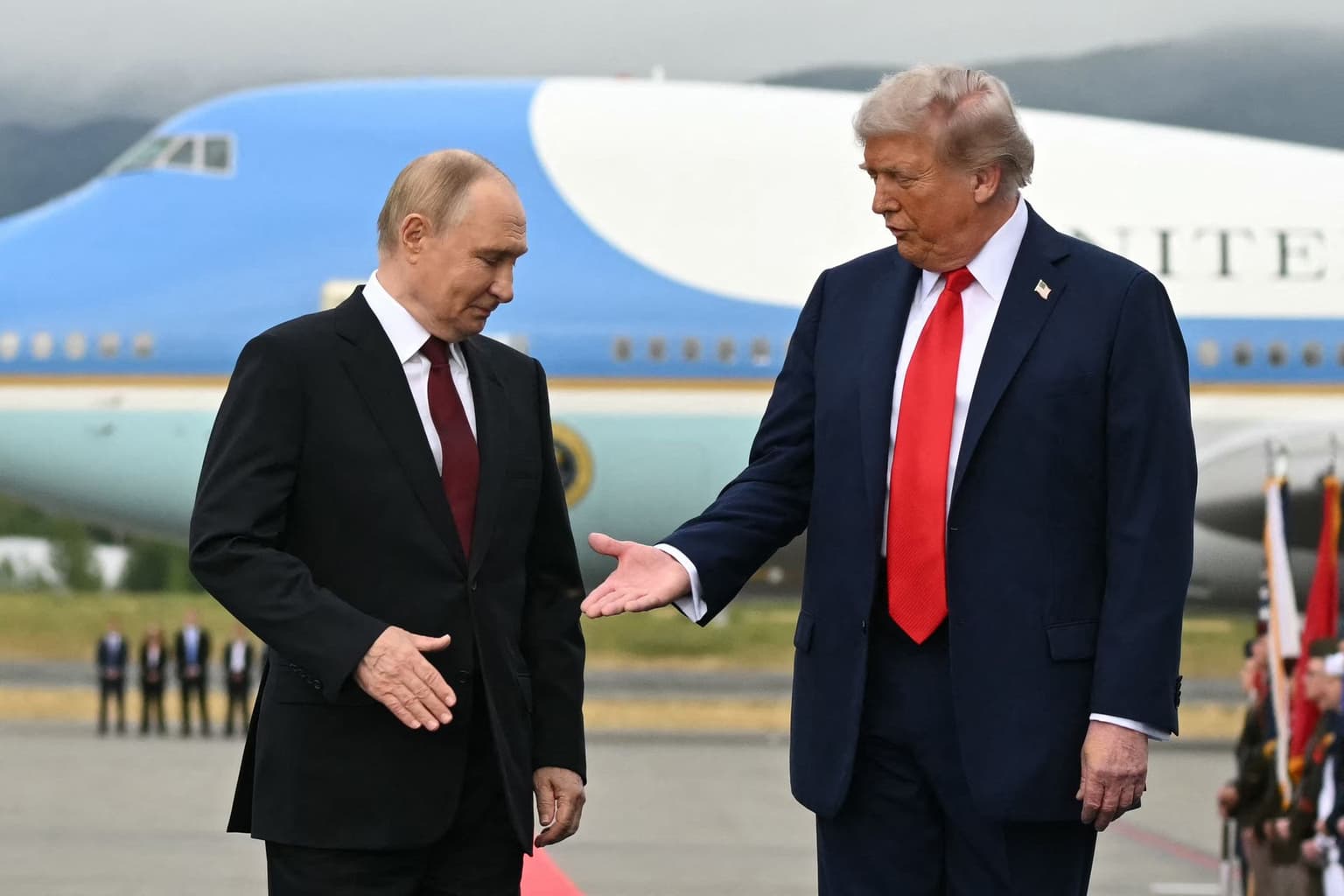
U.S. President Donald Trump (R) reaches out to shake hands with Russian President Vladimir Putin as they pose on a podium on the tarmac after arrival at Joint Base Elmendorf-Richardson in Anchorage, Alaska, on Aug. 15, 2025. (Andrew Caballero-Reynolds / AFP via Getty Images)
 on Google
Casey Michel
Director of the Combating Kleptocracy Program at the Human Rights Foundation
For years, an idea has percolated among certain Western officials that the best way to break the burgeoning partnership between Russia and China is to appease Moscow, including to the point of choking off all support for Ukraine.
Known colloquially as the "reverse Kissinger," it is an idea that builds on U.S. Secretary of State Henry Kissinger's efforts in the early 1970s to peel Beijing away from Moscow.
As the theory goes, it is only in offering Moscow what it wants — sanctions relief, new investments, and most especially a free hand in Ukraine — that the West can unwind the nascent alliance between Vladimir Putin and Xi Jinping, and fully block China's threat to democratic interests.
Once confined to the fringes of policy analysis, it is now an idea that has reached the White House.
As Politico reported in March, the Trump administration "believes that incentivizing Russia to end the war in Ukraine, welcoming it back economically and showering it with U.S. investments, could eventually shift the global order away from China." As one White House official added, finding a "way to align closer with Russia" could potentially create a "different power balance with China that could be very, very beneficial."
If you squint, you can spy the underlying logic of the idea. If only Moscow could be enticed — and if only the pesky, petty Ukrainians would stop putting up a fight — Russia could flip into a potential bulwark against Chinese expansionism and influence.
This view, however, is so myopic that it borders on the fantastical. Not only does it misread the basic history of Kissinger's original move, but it also completely misunderstands the budding relationship with Putin and Xi and the role that Ukraine continues to play as a potential plank for actually breaking that relationship in the first place.
Start with the history.
In 1971, Kissinger, as an emissary for President Richard Nixon, secretly traveled to Beijing for a meeting with Chinese leader Mao Zedong. The meeting sparked a series of back-channel discussions that resulted in a strategic realignment between Beijing and Washington, cementing a Sino-Soviet split that remained for the rest of the Cold War.
But the idea that this was somehow Kissinger's brainchild, or that Kissinger was somehow uniquely capable of steering China into the U.S.'s embrace, is farcical. The Nixon administration played no role in the Sino-Soviet split in the first place; indeed, the split between Moscow and Beijing had already taken place years before, with relations between the two communist powers already shredded beyond recovery.
Consequently, the broader collapse in Sino-Soviet relations long predated Kissinger's arrival.
As recent scholarship has detailed, relations between China and the Soviet Union were already frosty by the start of the 1960s, thanks largely to Beijing chafing against Moscow's claims of a leadership role in the communist world.
Verbal spats and personality clashes eventually devolved by the end of the decade into one of the most disastrous military clashes of the era. In 1969, a Chinese ambush of Soviet soldiers along their border in northeastern Asia resulted in months-long fighting between the two.
With hundreds of casualties and tens of thousands of artillery rounds expended — and with additional fighting along the Sino-Soviet border in Central Asia, as well — the border war quickly risked spilling into something far worse.
As scholar Miles Mauchun Yu wrote, Soviet leadership "seriously consider(ed) a nuclear strike against China." The Kremlin eventually opted not to launch nuclear weapons, but by the end of the 1960s, it was clear that relations between Moscow and Beijing had imploded.
It was into this breach that Kissinger entered the picture a few years later. He and his allies in Washington took advantage of an existing split, but they hardly engineered it.
Fast forward a half-century. Rather than a pair of imperial powers tipping toward potential nuclear war with one another, Moscow and Beijing are arguably closer than they've ever been.
This is reflected not only in the cozy relationship between Putin and Xi but in the broader economic shift of the past few years. Much of these new financial arrangements are downstream from Moscow's disastrous war in Ukraine, with China throwing lifeline after lifeline to a reeling Russia, and Putin willingly turning Russia into an effective Chinese vassal state.

More broadly, as scholar Zeno Leoni noted last year, Moscow and Beijing are now "co-strategists – working in tandem to revise the global order. Unlike Mao, Putin is not seeking U.S. protection from Beijing; if anything, he values Chinese backing as he confronts the West in Ukraine and beyond."
Both Xi and Putin view a world in which a listing United States and a prone Europe must cede ground and influence to revanchist, revisionist powers elsewhere – and allow both Moscow and Beijing their supposedly rightful spheres of influence.
All of which is to say: the space for a potential "reverse Kissinger" is non-existent.
Even Kissinger, despite all his flaws otherwise, recognized as much. In one of his final writings before his death in 2023, Kissinger called for Ukraine to join NATO. It was, perhaps ironically, a reversal of his previous position – and one that recognized how appeasing Moscow is one of the most foolish positions you could pursue, either then or now.
Instead of pushing a supposed "reverse Kissinger," officials across the West, including in the White House, would be far better served with something else: supporting Ukraine, however they can.
Ratcheting up the costs is the only way to eventually convince Beijing that it's no longer worth acting as a backstop for Russia — and, in time, finally convince the Kremlin that it will never, ever be victorious in Ukraine. Anything else is a dangerous illusion.
Editor's note: The opinions expressed in the op-ed section are those of the authors and do not purport to reflect the views of the Kyiv Independent.
read also
 Kate Tsurkan
 Dominic Culverwell
 Tania Myronyshena