'They don't consider their work heroic' — 4 energy workers die amid Kyiv repairs following Russian attacks
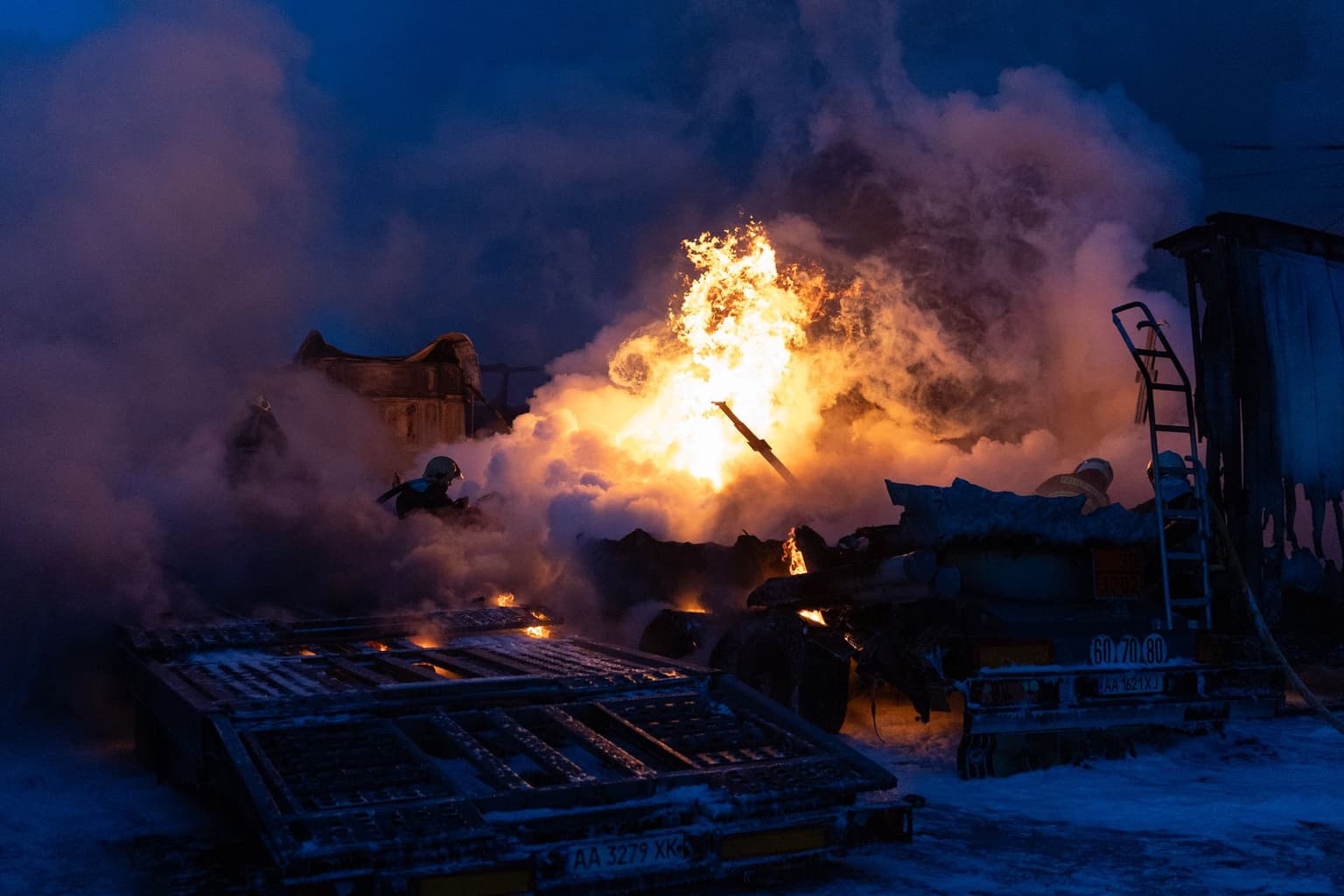
Ukrainian emergency personnel work to extinguish a fire at the site of an air attack in Kyiv, Ukraine, on Jan. 24, 2026, amid Russia’s invasion of Ukraine. (Oleksandr Magula / AFP via Getty Images)
 on Google
As Kyiv's repair crews scramble to keep the lights and heat on after repeated Russian strikes, the work has become punishing — and, in recent weeks, deadly.
Oleksandr Pitaichuk, a 31-year-old high-angle rescuer, died during emergency repair work at one of Kyiv's power facilities on Jan. 25, Interior Minister Ihor Klymenko said. Pitaichuk fell from a height of 20 meters, and his injuries proved fatal, according to Klymenko.

"He stood between chaos and normal life — so homes could have light and heat, and people could have hope," Olena Halushka, co-founder of the International Center for Ukrainian Victory, wrote in her tribute to Pitaichuk.
His death marks the fourth fatality among essential workers in Kyiv in about a month. On Jan. 21, Oleksii Brekht, a high-ranking Ukrainian energy worker, died after being electrocuted at a substation.
Brekht chaired the management board of Ukrenergo, Ukraine's state-grid operator, since September 2025. He spent 24 years working at the company, which manages Ukraine's embattled electrical grid.

On Jan. 19, a 60-year-old mechanic died while working on a call in an apartment building in Kyiv, according to Mayor Vitali Klitschko. The cause of death is currently being investigated by forensic experts.
On Jan. 14, an employee of the Kyivteploenergo municipal utility died while unloading generator equipment for heating individual residential buildings in Kyiv's Obolonskyi, the city's military administration reported.
The Kyiv Independent submitted a request to Kyivteploenergo for more details and the identity of an employee, but did not hear back by publication time.
Heavy workload, severe frosts, constant strikes
All of the deceased workers were dealing with the aftermath of a series of Russian attacks on Ukraine's critical infrastructure. After strikes on Jan. 9, Jan. 20, and Jan. 24, Kyiv has been struggling to restore power, heating, and water for many residents.
"Working in difficult weather conditions, with a tremendous workload, municipal workers are sparing no effort to restore services to Kyiv residents. Unfortunately, this is taking its toll," Kyiv's Military Administration said in a Telegram post on Jan. 14.
Ukraine's Prime Minister Yuliia Svyrydenko said on Jan. 25 that the recent week was one of the most difficult for the Ukrainian energy sector since the 2022 blackout.
She added that more than 180 teams of power engineers, utility workers, and railway workers are working around the clock to restore power. Klitschko said on Jan. 28 that more than 1,000 utility workers were working to resolve heating supply issues in Kyiv.
Valerii Osadchuk, head of communications and international cooperation at Ukrenergo, told the Kyiv Independent that emergency repairs at energy facilities hit by Russian strikes have become more difficult since autumn 2025, when Russia resumed regular, large-scale missile and drone attacks on energy infrastructure.
"The intervals between previous and subsequent strikes do not allow for the complete restoration of most facilities, forcing energy workers to work around the clock in all weather conditions," Osadchuk said.
He also said that during air alerts, energy workers are unable to work because Russia is "deliberately targeting skilled repair personnel." So the workers are obliged to go to shelters or leave the energy facility's premises.

In recent weeks, Russian forces have repeatedly attacked Kyiv with drones during the day, while repair work was ongoing.
Osadchuk said the work has long come with significant risks: Since the start of the full-scale invasion, Russia has attacked numerous Ukrenergo facilities, and 13 Ukrenergo workers have been killed at their workplaces due to Russian strikes.
Since late December 2025, the situation has become even more complicated, he added, as freezing weather set in across Ukraine, with temperatures falling below minus 20 degrees Celsius (minus 4 degrees Fahrenheit) on some days, slowing restoration work and worsening shortages across the power system.
A spokesperson for Ukraine's biggest private energy firm, DTEK, told the Kyiv Independent that it is "exhausting and physically difficult" for energy workers to repair substations, cable lines, and underground cable networks while being outside for 12–15 hours, sometimes during bitterly cold nights.
To deal with the extreme cold, energy workers carry thermoses to the workplace, and many local residents bring them tea, sweets, and sometimes even offer borsch, the spokesperson said.
"They take a break every 30–40 minutes to warm their hands and legs, which are freezing. But they can't stop for long because of the heavy workload and the awareness that in the nearby apartment building, a thousand people are waiting for electricity and light," the spokesperson added.


Both Ukrenergo and DTEK said that energy workers in Kyiv are facing an extremely heavy workload, so teams from other regions and cities are coming to help. For instance, DTEK has 60 brigades in Kyiv, and recently 12 brigades from other oblasts arrived to help with managing the winter crisis.
Klitschko said on Jan. 28 that specialists from Lviv, Poltava, Chernihiv, Vinnytsia, Zhytomyr, Mykolaiv, Odesa, Rivne, Kropyvnytskyi, and other cities were assisting their colleagues in Kyiv.
"Energy workers don't consider their work heroic. 'It's my job, I do everything for the Kyiv residents, because it's my responsibility. It's how I can help my country during the war,' they think, but everything depends on them," the DTEK spokesperson added.
"I want these people to be healthy. I don't want their hands to hurt. Everyone is waiting for warmer weather," the spokesperson said.
But for some, the toll of this winter has already been fatal, and, as Halushka argued, that human cost can be too easy to overlook.
"Abroad, I feel that many people think that yes, Ukraine is having a hard time, but they coped with previous winters, so they will get through this somehow. Every day of delay in providing assistance on their part costs us blood."
Note from the author:
Hi, this is Yuliia. Thank you for reading this article. Right now, Ukraine and Kyiv in particular live through the most brutal winter during the full-scale war, and it's important for us to make Ukrainian voices heard in these times. If you want more articles like this, consider joining our community today.