Peter Magyar’s Ukraine problem
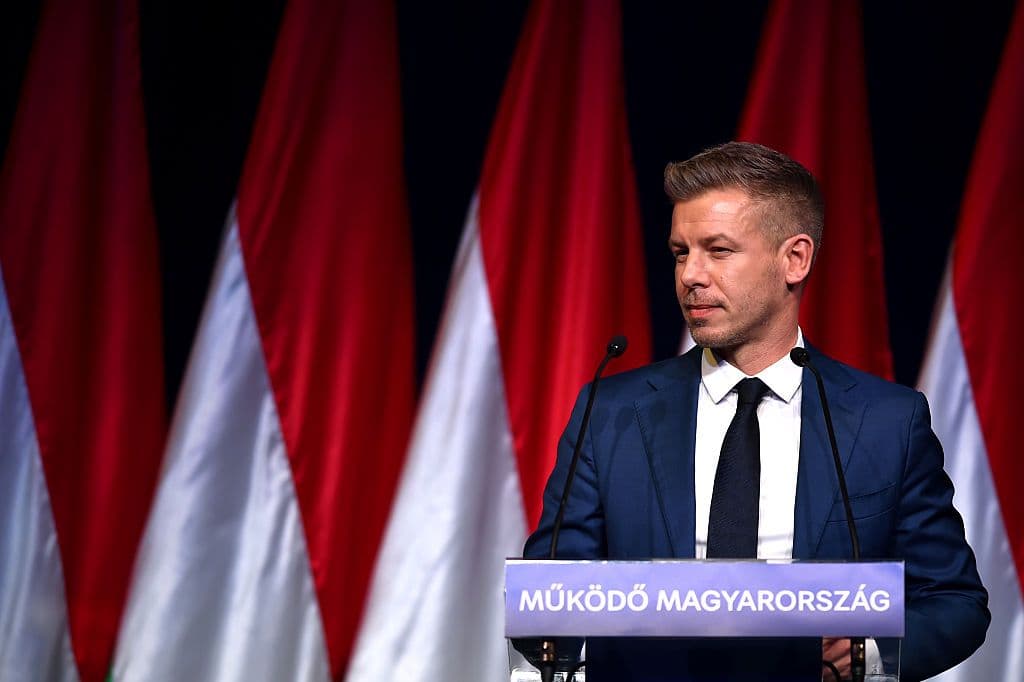
Peter Magyar, leader of the Tisza party, holds a speech to mark the beginning of the general election campaign in Budapest, Hungary, as the campaign for the 2026 Hungarian general election kicks off. (Balint Szentgallay/NurPhoto via Getty Images)
 on Google
As Hungarian Prime Minister Viktor Orban has effectively drawn Ukraine into his domestic fight for reelection, his main competitor has found himself in a tricky situation.
Peter Magyar, a 44-year-old former insider in Orban's Fidesz party, has pledged to mend ties with European partners, ending an era of obstructionism that has often hampered assistance to Ukraine.
His Tisza party has also taken aim at the Hungarian government's tilt toward Moscow and vowed to undo the growing dependence on Russian energy.
When it comes to Ukraine, however, Magyar has been walking a fine line, promising constructive relations, yet criticizing President Volodymyr Zelensky's jabs directed at Orban and the country's desire for a fast-track EU accession.
Magyar is a "sovereignist politician," says Zsuzsanna Vegh, an expert in Central European politics at the German Marshall Fund of the United States.
"He does not want to continue the sort of servile engagement (with Russia) that Orban and (Foreign Minister Peter) Szijjarto are pursuing," Vegh told the Kyiv Independent.
But "sovereignism" cuts both ways. As Orban's propaganda seeks to paint Magyar as a puppet of Kyiv, the opposition leader is careful not to fuel this narrative.
No U-turn
Anybody expecting a full reversal in Hungary's Ukraine policy will likely be disappointed, experts say. While Magyar's positions are closer to the European mainstream than Orban's, he stops short of endorsing more decisive forms of support.
"We need to be clear-eyed about the fact that Tisza is not a pro-Ukrainian party," says Daniel Hegedüs, deputy director at the Institute for European Politics (IEP).
Tisza, which holds a slight lead over Fidesz among decided voters, opposes fast-tracking Ukraine's EU accession and would put the country's membership to a binding referendum.
Unlike Orban, Magyar has not said he opposes Ukraine's accession altogether.

Despite belonging to the staunchly pro-Kyiv European People's Party (EPP), Tisza's European Parliament members abstained from key votes on Ukraine.
Tisza has ruled out sending Hungarian arms or soldiers to Ukraine — yet Magyar has openly identified Russia as the aggressor, in contrast to the current prime minister's Kremlin-friendly rhetoric.
Notably, Magyar visited Kyiv in July 2024 to bring humanitarian aid in the wake of a deadly Russian strike against the Okhmatdyt children's hospital.
The opposition "does not promise a U-turn" in their Ukraine policy, says Peter Kreko, the director of the Political Capital think tank in Budapest.
For example, the issue of the Hungarian minority in Ukraine's Zakarpattia Oblast — often politicized by Orban — will remain relevant even if Tisza wins, he adds.
Both Orban and Magyar stress sovereignty and national interests in their campaign.
The difference is that in Magyar's vision, sovereign Hungary is firmly anchored in the EU and NATO structures.
Where Kyiv stands to benefit is if Tisza ends Hungary's repeated disruption of EU consensus, which has often obstructed sanctions against Russia and support for Ukraine, Hegedüs says.
"I expect that (Tisza's) approach will be more constructive, less confrontational," Vegh says. "And I think that would be something that can shift the tone with Ukraine."
Navigating the Orban-Zelensky clash
Orban's propaganda has gone into overdrive in accusing the opposition of colluding with Ukraine to drag Hungary into war.
Hungarian streets have been filled with anti-Ukrainian posters of Zelensky, sometimes begging for money, sometimes flanked by Magyar or EU officials.

"Orban is putting this whole topic (of Ukraine) in the center of his campaign," Kreko says.
Magyar has sought to avoid getting caught in Orban's trap, instead focusing on domestic issues where he holds the upper hand, such as the cost of living and corruption.
But in recent weeks, Orban has pushed disputes with Kyiv to unprecedented levels.
He has blamed Ukraine for rising energy prices following the suspension of the Druzhba pipeline and threatened to use political force to break the "oil blockade." Hungary later seized over $80 million in Ukrainian cash and gold transiting through the country.
When Zelensky hit back at Orban's rhetoric by hinting he would give the prime minister's "address" to Ukrainian soldiers — a comment many perceived as a personal threat — Magyar was forced to respond.
"No foreign state leader can threaten anyone, not a single Hungarian," the opposition leader said, urging the EU to cut contact with Ukraine until Zelensky apologizes.
According to experts, Magyar did not have much of a choice.
"He cannot endorse a threat against the Hungarian prime minister," Vegh says. "And remaining silent would have been interpreted as endorsement."
Any other reaction would be "catastrophic" for Magyar's campaign, Hegedüs notes. "Peter Magyar and Tisza need to be very cautious in their communication, and even in their relationships with Ukraine, so that it's not exploited against them."

The expert believes that even if Tisza comes to power, Fidesz's recent surge in fear-mongering against Ukraine is likely to delay the normalization of bilateral relations.
The Kyiv Independent has repeatedly reached out to Tisza representatives to discuss the party's policy vision on Russia and Ukraine, but has not received a response.
Getting rid of Russia dependence
While Orban accuses Tisza of colluding with Ukraine, Magyar called out Russia for reportedly helping to prop up the Fidesz campaign.
The opposition leader — as well as several media outlets — said the Kremlin dispatched its agents to Budapest to help sway the elections in Orban's favor through disinformation tactics tested in Moldova.
"Hungary is the homeland of people who cherish freedom. We Hungarians are the heirs of the freedom fighters of 1956," Magyar said in a letter to a Russian ambassador in Budapest, alluding to Hungary's revolution against the communist government 70 years ago.
While Orban deepened energy ties with Russia throughout the full-scale war, particularly through pipeline gas and oil, Magyar pledged to reverse course.
In its program, Tisza named energy diversification as one of its chief goals, aiming to eliminate dependence on Russian energy by 2035.
The party also pledged to launch a full review of Hungary's nuclear power plant project led by Russia's Rosatom.
Tapping energy expert Anita Orban (no relation) as Tisza's foreign affairs chief and likely next foreign minister illustrates just how crucial the energy issue is for the opposition's platform.
According to Hegedüs, Orban's relationship with Moscow made anti-Russian positions an important "mobilizing factor for opposition voters."
A more assertive stance toward Russia also fits into Magyar's profiling as a "sovereignist" but pro-Western politician, in contrast to Orban's "servility" to Moscow.
But just like with Ukraine, Magyar treads carefully. The opposition leader has said his government would "seek balanced relations with the Russian Federation," suggesting there are limits to how far he would shift Hungary's policy.
read also
 Martin Fornusek
 Martin Fornusek
 Tim Zadorozhnyy
 Oleksiy Sorokin