Iran is building shadow state inside Georgia. I was interrogated for saying so
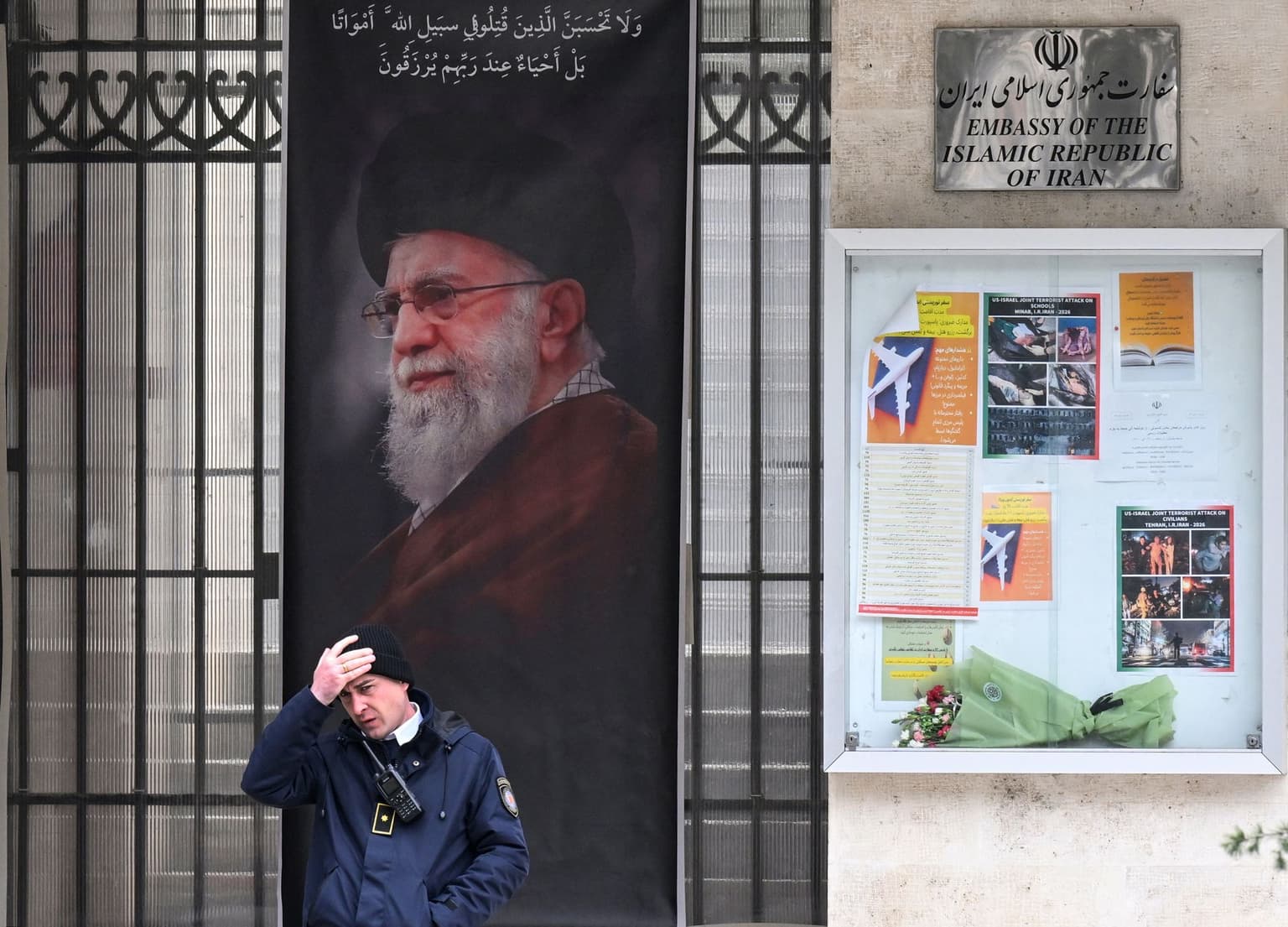
A portrait of late Iran's supreme leader Ayatollah Ali Khamenei sits at the entrance to the Iranian embassy in Tbilisi on March 6, 2026. (Vano Shlamov / AFP via Getty Images)
 on Google
Givi Targamadze
Georgian politician
On March 7, 2026, a crowd of Georgian citizens gathered outside Iran's embassy in Tbilisi. They held aloft portraits of recently killed Ayatollah Ali Khamenei and chanted a pledge of obedience to the supreme leader of a foreign theocracy.
A few blocks away, thousands of other Georgians continued the pro-European protests that have filled Rustaveli Avenue since the disputed November 2024 elections, demanding a new vote and a return to the Western path we fought for — and nearly died building.
Two Georgias, standing side by side in the same capital, facing in opposite directions.
The response of Prime Minister Irakli Kobakhidze was telling — and for those of us who remember what Georgia once was, infuriating. Rather than expressing alarm at citizens pledging fealty to a foreign autocrat, he equated the embassy rally with the pro-European demonstrations, saying both gatherings "need to be managed."
When a journalist pressed him on whether the State Security Service should be investigating Iran's influence operations, Kobakhidze deflected — and instead attacked former officials who had raised the alarm as "foreign agents."
I know something about being targeted by this government. After several of us raised concerns about Iran's expanding influence in Georgia — including the operation of an unaccredited Iranian university on Georgian soil — the security services summoned Giorgi Kandelaki, Gubaz Sanikidze, and General Vakhtang Kapanadze for questioning. And they summoned me.
The message is unmistakable: in today's Georgia, exposing a foreign adversary's influence network is treated as a crime, while the network itself is left to flourish.
I spent seven months in prison last year for refusing to appear before Georgian Dream's sham parliamentary commission — a body that Amnesty International called a tool of political repression.
I have survived a car bombing in central Tbilisi that I believe was jointly orchestrated by Georgian and Russian security services. I have testified at The Hague, where my evidence helped convict Russian soldiers. None of this gives me pause. What gives me pause is watching the country that my generation built being handed over, piece by piece.
We must be clear about what has happened. After the 2003 Rose Revolution, Georgia became one of the most remarkable democratic success stories in the post-Soviet space. For over a decade, we built institutions. We built an army that served with distinction in Iraq and Afghanistan. We built partnerships with the United States and Europe. We fought a war with Russia and refused to surrender our sovereignty.
We were imperfect, but we were moving forward, and we were free.

Georgian Dream has spent the last thirteen years dismantling all of it. And into the vacuum they created, Iran has moved — deliberately, systematically, and with the full cooperation of Tbilisi.
The Hudson Institute, in a landmark March 2026 report by Giorgi Kandelaki and Luke Coffey, documents what they call “Georgia's Iranian Turn." The findings are staggering. The Ahl al-Bayt World Assembly, a body founded under Khamenei's personal supervision, operates openly in Georgia, running four Shia madrasas and cooperating directly with the Georgian State Agency for Religious Issues.
Its head, Ayatollah Reza Ramezani, visited Georgia in 2023, met with state officials, and later hosted Georgian Shia imams at his headquarters in Qom. A branch of Al-Mustafa International University — sanctioned by both the United States and Canada for espionage and the promotion of extremism — runs three campuses on Georgian soil without any formal accreditation.
Youth organizations recruit young Georgian citizens into Tehran's ideological orbit. Annual processions now openly display anti-American banners and portraits of terrorist commanders.
The operational dimension is even more alarming. Iran has used Georgian nationals for assassination plots abroad. A U.S. federal court convicted Georgian citizen Polad Omarov and sentenced him to twenty-five years in prison for his role in an IRGC-directed plot to murder Iranian-American journalist Masih Alinejad in New York.
Another Georgian, Agil Aslanov, was arrested in Azerbaijan after being recruited by the Quds Force for an attempted assassination of a Jewish leader. Since at least September 2022, sanctioned Iranian aircraft have transited Georgian airspace to deliver cargo to Russia — flights the US Department of Commerce identified as carrying prohibited goods.
Seventy-two Georgian-registered companies imported Iranian oil and petroleum products between 2022 and 2025. Nearly 13,000 Iranian companies are now registered in Georgia. Tehran's officials openly describe my country as a convenient route for evading Western sanctions.
And the government? The government is complicit. Kobakhidze traveled twice to Iran in 2024 — first to President Raisi's funeral, where he stood alongside Hamas and Hezbollah leaders as crowds chanted "Death to America, Death to Israel" — and the prime minister of a nation that calls itself a friend of the West was there, a participant in that spectacle, not a bystander. He returned again for President Pezeshkian's inauguration.
In 2025, Georgia's deputy prime minister signed a condolence book at the Iranian embassy honoring those killed in U.S.-Israeli strikes. In February 2026, the Tbilisi TV Tower was illuminated in the colors of the Iranian flag to celebrate the anniversary of the Islamic Revolution.
All this while ordinary Georgians — including many Iranians who have made Tbilisi their home — have been protesting against both their own government and the Iranian regime.
The war now consuming the Middle East has made the stakes impossible to ignore. Azerbaijan announced on March 6 that it had foiled an Iranian network planning to attack the Baku-Tbilisi-Ceyhan oil pipeline — infrastructure that runs through Georgian territory and is a lifeline for European energy security.
I want to address the West. My country sits on a strategic corridor linking Europe, Turkey, and the Caspian Basin. What happens here affects NATO’s position in the Black Sea, the security of critical energy infrastructure, and the ability of the democratic world to counter adversaries who are openly converging against it.
Every madrasa operating without accreditation on Georgian soil, every sanctioned aircraft crossing our skies, every young Georgian recruited into Tehran's ideological network — these are threats not only to Georgia but to the entire architecture of Western security.
The West must exercise swift and effective control over this security risk before it metastasizes beyond Georgia's borders.
Editor's note: The opinions expressed in the op-ed section are those of the authors and do not purport to reflect the views of the Kyiv Independent.
read also
 Tim Zadorozhnyy
 Tim Zadorozhnyy
 Martin Fornusek