Beyond emergency aid — How Austrian ERSTE Foundation became Ukraine's cultural partner
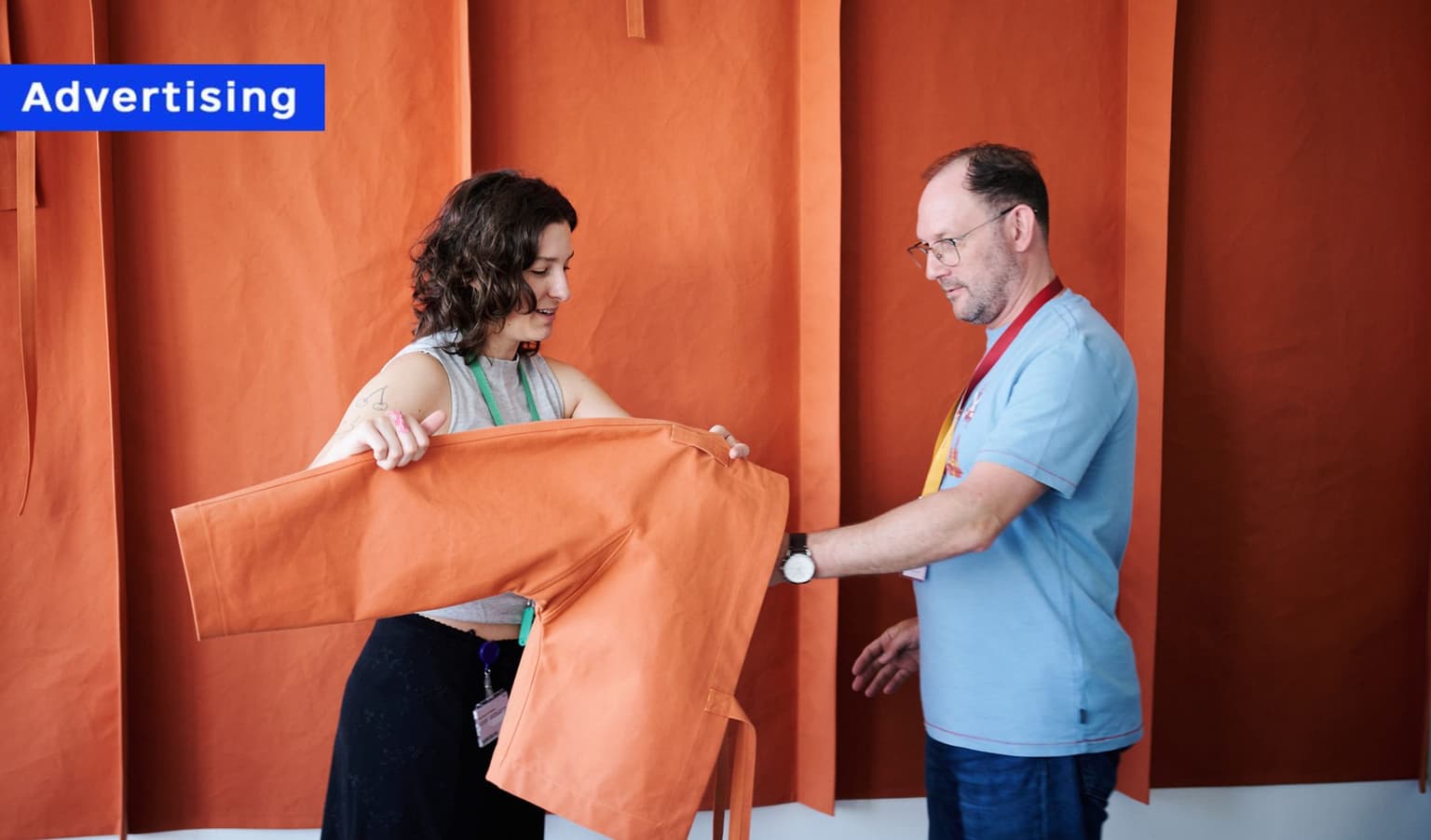
People examine materials during a workshop held as part of a public program linked to the KONTAKT Collection at the ERSTE Foundation in an undated photo. (Valerie Maltseva)
 on Google
From the grand halls of Kyiv's cultural institutions to small regional initiatives shaping public dialogue, Ukraine's cultural life has faced unprecedented pressures.
Amid daily attacks, occupation, and displacement, many of the country's most remarkable cultural projects continue — thanks to steadfast support from ERSTE Foundation, one of the most consistent international partners in Central and Eastern Europe.
For more than two decades, the Vienna-based institution has been deeply engaged in promoting art and culture across the region.
One prominent example is the international KONTAKT Collection, established in 2006, which preserves conceptual and neo-avant-garde works from Central, Eastern, and Southeastern Europe — including pieces by Ukrainian artists created well before the full-scale invasion.
But since Russia launched its all-out war, the foundation's role in Ukraine has evolved.
Today, its support for Ukrainian culture is no longer a gesture of wartime charity but a deliberate investment in the country's identity, resilience, and European trajectory.
Culture often sits at the edge of donor priorities, especially during war. Every day, Ukraine faces urgent humanitarian, military, and social crises — and culture rarely makes the list.
Deciding where to channel limited resources is a constant challenge.
In an interview with the Kyiv Independent, Yana Barinova, program director of Ukraine at ERSTE Foundation, said the approach is deliberate and far-reaching.
"What distinguishes us is the way we connect culture with democracy and European integration. We don't limit ourselves to cultural projects — our horizon is much broader."

Beyond emergency aid
As Russia's all-out war continues into its fourth year, the foundation has shifted from offering emergency assistance to acting as a committed partner in rebuilding Ukraine's cultural and civic systems.
This approach rests on the idea that culture is a cornerstone of national resilience.
Barinova explained that ERSTE Foundation Ukraine was built from scratch after funding became available at the start of 2022.
"We invest in sustainability — in building structures that will keep working long after individual projects end."
"My task was to integrate this new line of work into ERSTE Foundation's overall master plan," she said.
"We designed the support framework from a clean slate — from defining strategic goals and partnerships to creating programs with a long-term horizon."
"Today, this program is a full-fledged part of our European strategy."
Barinova said the foundation avoids short, crisis-driven funding cycles in favor of planning that looks beyond the immediate emergency.
"In a world where grants often have a short lifespan, we think institutionally," she said. "We invest in sustainability — in building structures that will keep working long after individual projects end."
Choosing which initiatives to prioritize is never simple. The flood of applications and limited resources mean that each decision can define the cultural landscape for years.
For ERSTE Foundation, this choice often comes down to a difficult balance between supporting Ukrainian projects at home and sustaining Ukrainian cultural presence abroad.
On the one hand, international visibility is essential to ensure that Ukraine's voice remains part of the European conversation and is not reduced to headlines about war alone.
On the other, culture inside Ukraine — created under Russian attacks, power outages, and instability — often functions as the last remaining social fabric holding communities together.
Supporting one project inevitably means postponing or declining another, turning each grant into a decision without a perfect answer.
In these constant trade-offs — between rapid response and sustained commitment, between Europe and Ukraine — the real, often invisible labor of cultural support takes shape.
Barinova noted that the foundation's work encompasses culture, civil society, social integration, and European policy work, all tied together to reflect Ukraine's wartime needs.
Those include relocating artists, strengthening expert communities uprooted by the war, supporting independent media, and ensuring Ukrainian voices remain part of key European debates.
By anchoring its work in both national and regional institutions, the donor aims to ensure that culture remains central to Ukraine's recovery.
From regional memory to international platforms
ERSTE Foundation backs some of the most ambitious cultural projects in Ukraine and abroad.
A prominent example of this support is the exhibition "Kherson. The Steppe Holds," showcased at Kyiv's Mystetskyi Arsenal — one of Ukraine's leading contemporary art institutions.
The project invited visitors into a region many had come to know only through grim wartime headlines.
Using films by Roman Bondarchuk and Daria Averchenko, the exhibition reconstructed Kherson and the surrounding steppe — Russian-occupied for eight months in 2022 — as a landscape shaped by memory, community, and identity rather than destruction alone.


The journey led audiences from the Dnipro delta village of Stara Zburyivka, through Kherson, and further to the city of Beryslav near the former Kakhovka Dam.
This exhibition shows that these landscapes were vibrant with meaning long before the war transformed them into symbols of resistance and loss.
Mystetskyi Arsenal Director Olesya Ostrovska-Lyuta told the Kyiv Independent that it was the foundation that made the project possible.
"They have been the main donor for the exhibition, providing the majority of its budget," she said. "As we know, funding is the lifeblood of any project. Without it, nothing would have been possible."

The work culminated in a major conference bringing together experts, community leaders, and cultural practitioners focused on Ukraine's south — an exchange Ostrovska-Lyuta described as an important point of cohesion.
From there, the philanthropic institution moves the story to Austria's capital, exploring resilience through a different lens.
The donor backed the multimedia installation "Mavky. Camouflage" by photographer Olena Hrom, showcased at its Vienna headquarters.
It documented the "Horenka Mavky," a group of women from Horenka, just 30 kilometers (18 miles) outside Kyiv, who survived occupation and artillery assault, then began weaving camouflage suits for Ukrainian snipers and reconnaissance units.
Their work continued through blackouts, freezing nights, and constant missile threats.

By backing and hosting the exhibition in Vienna, the foundation amplified a story of quiet survival that might otherwise remain unknown outside Ukraine.
The foundation's support goes beyond individual stories, fueling platforms that showcase Ukraine's wider cultural heartbeat — just like the Kyiv Biennial.
Now forced into an itinerant format due to the war, the Biennial continues to document civilian experiences, displacement, and the societal transformations triggered by Russia's invasion.
The cultural platform has built an outstanding international reputation for presenting contemporary Ukrainian art while confronting urgent realities.
Its 2025 edition marks its 10th anniversary, spanning multiple European cities with a central exhibition at Warsaw's newly opened Museum of Modern Art.
ERSTE Foundation also ensures that Ukrainian artists displaced by the war can keep creating.
Office Ukraine, launched just days after the all-out war, operates in Vienna, Bratislava, and Budapest, helping artists access studios, residencies, exhibitions, scholarships, and professional networks — keeping the country's artistic practice alive even in exile.
It provides information on university applications, open calls, and relevant cultural events, sometimes offering free tickets to strengthen access to the local arts scene.
Preserving memory is another key strand of the foundation's work.
For instance, the exhibition Everything for Everybody at the Dnipro Center for Contemporary Culture used two photographic archives — the Franki Raffles Collection from Scotland and Mykola Bilokon's work from Ukraine.


It explored how everyday lives, especially those of workers and women, can be preserved, remembered, or erased through archival records.
While Raffles captured the labor and struggles of working women across Scotland and the Soviet Union in 1989, Bilokon chronicled everyday life and "hero workers" in Ukrainian factories and collective farms.
Supported by the foundation, Everything for Everybody benefits from institutional backing that enables this nuanced exploration of memory and history.
At the same time, the foundation is amplifying voices beyond the capital and major urban centers.
Asortment Room in the western city of Ivano-Frankivsk challenges the dominance of big cities by showcasing contemporary art from Ukraine's periphery, helping smaller communities maintain a vibrant cultural presence.
With its support, ERSTE Foundation ensures that initiatives beyond major cities like Kyiv and Lviv can thrive, providing resources, visibility, and institutional recognition for artists.
Looking ahead, the Austrian donor invests in projects that shape Ukraine's cultural future.
In 2025, a series of expert workshops in Florence laid the groundwork for the Ukrainian Cultural Heritage Fund (UCHF), a future national institution for cultural reconstruction.
"The support for this initiative is not about providing ready-made solutions, but about creating a space for expert discussion and facilitating processes that may later form the basis for responsible decisions at the state level," the foundation said.
The sessions brought together over 40 cultural leaders and policy experts from all over the world.
Participants emphasized strategic phasing, local involvement, and international accountability, recommending a feasibility study as the immediate next step, with pilot programming by 2026 and full operations by 2028.
"Our focus is on sustainable results."
"As an independent private foundation, we see ourselves more as a neutral support and a 'room' where important discussions can take place — both under Chatham House Rules and publicly — without political pressure and with a focus on quality."
Bold and thought-provoking, projects continue to push these efforts further.
Later in 2026, Ukrainian artist Kateryna Lysovenko will transform a Salzburg wall into a large-scale mural, confronting viewers with questions of power, suffering, and what it truly means to be human.
Known for examining power, violence, propaganda, and human vulnerability, Lysovenko's work confronts the viewer with questions about survival and responsibility.
Lysovenko described the mural as an open-ended process.
"I don't even know yet exactly how the work will look in the end," she told the Kyiv Independent. "There is a huge gallery that spans almost the entire building."
The core question behind her work, she said, is "What does it mean to be human?"
She reflected that whether someone is recognized as human or not directly affects their life, noting that "when you are not perceived as human, it is dehumanization."
"This is a necessary step before genocide or war," she added.
The project engages with this concept of dehumanization, though she stressed that it does not have a fixed purpose.
"I already have some key elements in my sketches," she said. "But a lot will also emerge directly on the wall."
More than a donor
The foundation operates as far more than a financial donor, Barinova emphasized.
It functions as an institutional partner offering expertise, networks, and the structural conditions for projects to scale and endure.
"Our focus is on sustainable results," she added.
For culture, this means increased visibility, new networks, and deeper integration into Europe's intellectual and artistic landscape.
Barinova said the foundation plans to expand work on expert platforms, leadership programs, migration integration initiatives, and the strengthening of Ukrainian institutions committed to social change.

She highlighted the upcoming Europe's Future Initiative — expected to launch in 2026 — as a new space for thinking beyond wartime crisis management.
"Advocacy is not a separate activity but a mindset. We create formats where Ukrainian experts and artists can directly influence European decisions," Barinova said.
She described the foundation as a platform that amplifies Ukraine's voice during the war.
ERSTE Foundation, she said, works culturally by expanding Ukraine's visibility; socially, by supporting integration programs across Europe; politically, by strengthening civil society and independent media; and intellectually, by ensuring Ukrainian experts shape European debates rather than simply participate in them.
"For Ukrainian society, this is much more than wartime aid," she said.
"It is an investment in the future — shaping what Ukraine will look like within the European architecture after victory."
Artists and cultural leaders echoed this view.
Lysovenko said ERSTE Foundation plays a crucial role not only in Austria but across the region.
"They are simply excellent," she said. "Even small Austrian art projects would struggle without ERSTE Foundation. It is a fantastic and very powerful initiative."
Ostrovska-Lyuta described ERSTE Foundation as an exemplary donor.
She highlighted that the foundation understands the realities of working in Ukraine and ensures that procedures serve the purpose of the project rather than being applied formally.
"I can only express my gratitude for their work," she said.
"I think this is a very, very valuable work. We’ll definitely propose them more (cooperation) in the future."
Why it all matter
By backing artists, cultural hubs, and regional initiatives, ERSTE Foundation proves that culture is not decoration. It's stamina. It's identity. It's a way for society to stay whole.
Across Kyiv, in smaller cities, and on European stages, the foundation helps rebuild Ukraine's cultural backbone.
These efforts keep creativity alive not just despite the war, but in defiance of it.
Foundation's approach is simple: think long-term. Connect Ukrainian voices with Europe. Support those who had to flee. Strengthen institutions that can survive the crisis.
Culture becomes not a side project, but part of the country's recovery plan.
And even under bombardment, the message is unmistakable: Ukraine’s cultural life is not going anywhere. It will keep growing. It will shape Europe's understanding of the war.
In the end, the foundation is doing more than funding projects.
It's helping build the country that will emerge from this war — confident, creative, and impossible to ignore.