Under fire, Ukraine becomes Europe's energy defense instructor
 on Google
As Russian drones test Europe's skies, European governments are turning to the one nation that knows this battle best.
Ukraine’s state power company, Ukrenergo — which as the chief transporter of the country's electricity has borne the brunt of Russia’s drone and missile attack campaign on the energy system — has been advising and training counterparts in Germany, Poland, and Lithuania since the spring.
If Russia’s drone incursions into Europe escalate, "there could be sabotage or hybrid attacks on our energy facilities — we have to be properly prepared," Lithuania’s Energy Minister Zygimantas Vaiciunas told the Kyiv Independent.
Ukrenergo held mostly online workshops for its European counterparts in the spring and summer during a lull in Russian attacks, Ukrenergo's CEO Vitaliy Zaichenko told the Kyiv Independent.
A Lithuanian team also visited a site to witness Ukraine’s protective measures firsthand, Vaiciunas said.
"Ukraine is really in the worst feasible situation. But the experience that Ukraine’s distribution system operator is gathering is really valuable for Lithuania and for our region," he said.
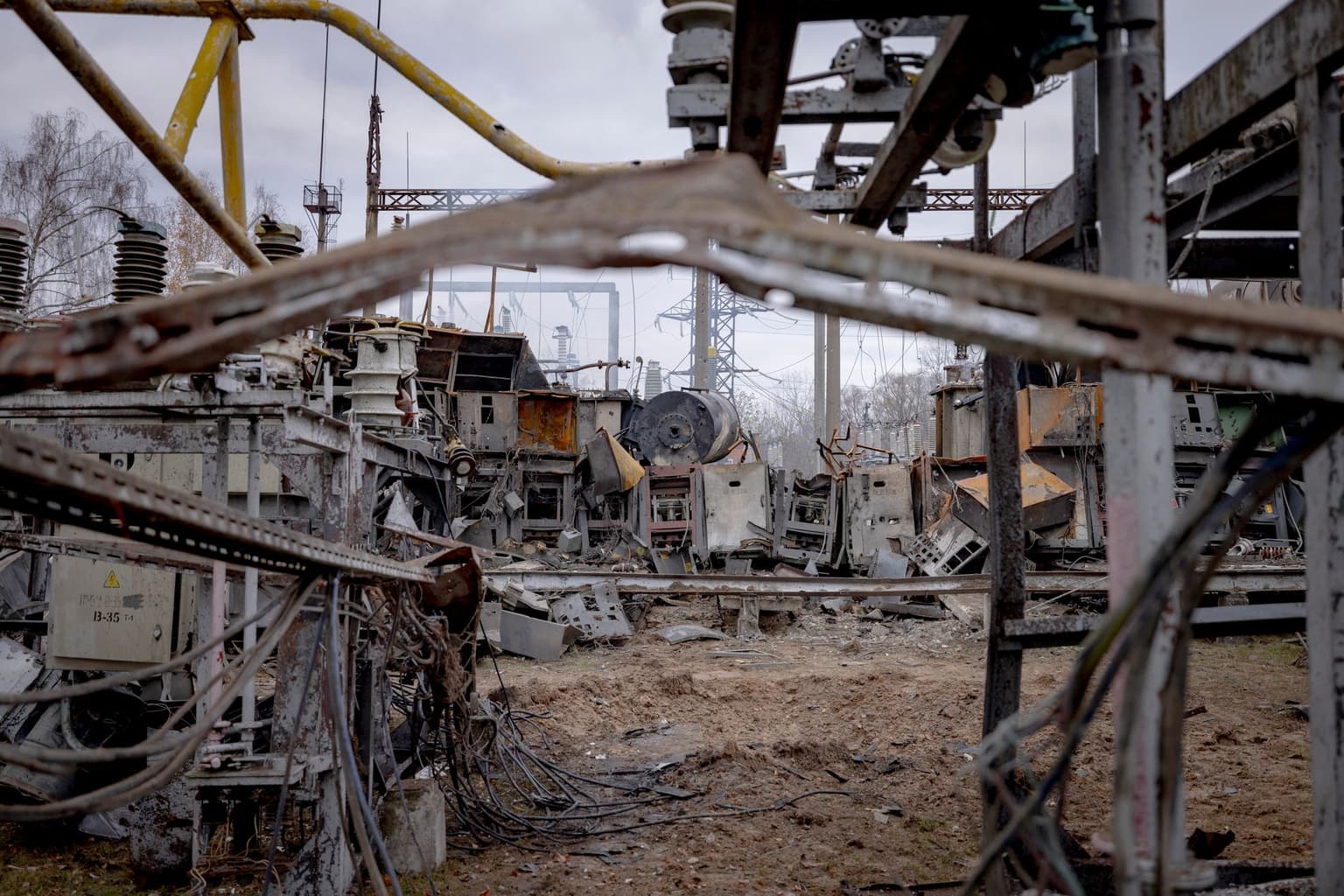
Ukrenergo’s repair teams — numbering in the thousands — work around the clock, often under fire, to keep the lights on. It’s this hard-won knowledge that European governments want to tap as Russia increasingly tests NATO’s nerves with drone incursions.
The company was forced to pause the program after Russia resumed mass attacks in the autumn. Since then, Ukrenergo has focused on sourcing replacement equipment and repairing damaged infrastructure as strikes on the energy system have intensified this year, bringing near-daily destruction.
For more than three years, Ukraine has endured Russia’s relentless campaign against its energy infrastructure. While Europe has supported Ukraine with equipment and financing, Kyiv is now returning the favor by advising European states on how to protect their grids.
Amid Russia’s hybrid warfare campaign, Europe’s unprotected energy equipment is a huge vulnerability, the European Union Institute for Security Studies, an EU-funded think tank, wrote in an August report.
Since 2023, Russia is suspected of sabotaging cables and pipelines in the Baltic Sea, while this year at least 100 drones have violated European airspace, including over Sweden, Lithuania, and Denmark.
Ukrenergo has already shared its battle-tested lessons on how to build fortifications against drones, work with financial institutions to procure equipment, and repair war-damaged facilities, according to Zaichenko.
Next year, Zaichenko says Ukrenergo is ready to host more workshops and even expand to other countries’ grid operators, which are usually fully or partially state-owned in Europe. "They need this knowledge," he said.
The Kyiv Independent reached out to the Polish and German grid operators, as well as the Polish Energy Ministry, but did not hear back by the time of publication.
With fears that Lithuania could be next in Moscow’s crosshairs, Vilnius has already launched a 140-million-euro program to cover over 150 energy facilities, namely substations, against potential drone strikes. Concrete fortifications are already underway, with all constructions expected to be finished by 2029.
It’s cheaper to invest in protection now than to face the expensive and destabilizing consequences of attacks, Vaiciunas said. Even in peacetime, Europe needs to be prepared for acts of sabotage and hybrid warfare against its energy facilities, he stressed.
Lithuania, which borders Belarus, declared a state of emergency on Dec. 9 after what Prime Minister Inga Ruginiene called a "hybrid attack" from Minsk following a swarm of weather balloons that disrupted air traffic and shut down the country’s largest airport.
But it’s not just Lithuania that is at risk. Vilnius, alongside its Baltic neighbors and Poland, will urge Brussels at a European Commission meeting on Dec. 15 to enshrine the protection of critical infrastructure into EU policy and carve out financing for fortifications.
Negotiations are expected to be finalized by the end of 2026, outlining a framework for funding that will span 2028-2034 under the Connecting Europe Facility, Vaiciunas said.
"It's very important and strategic that the EU has a separate budget line for the protection of critical energy infrastructure. Now is the time. It is not an option," Vaiciunas said at the Energy Security Dialogue conference hosted by think tank Dixi Group in Kyiv on Dec. 9.