Fact-check: Debunking Russian propaganda about 'persecution of Christians' in Ukraine
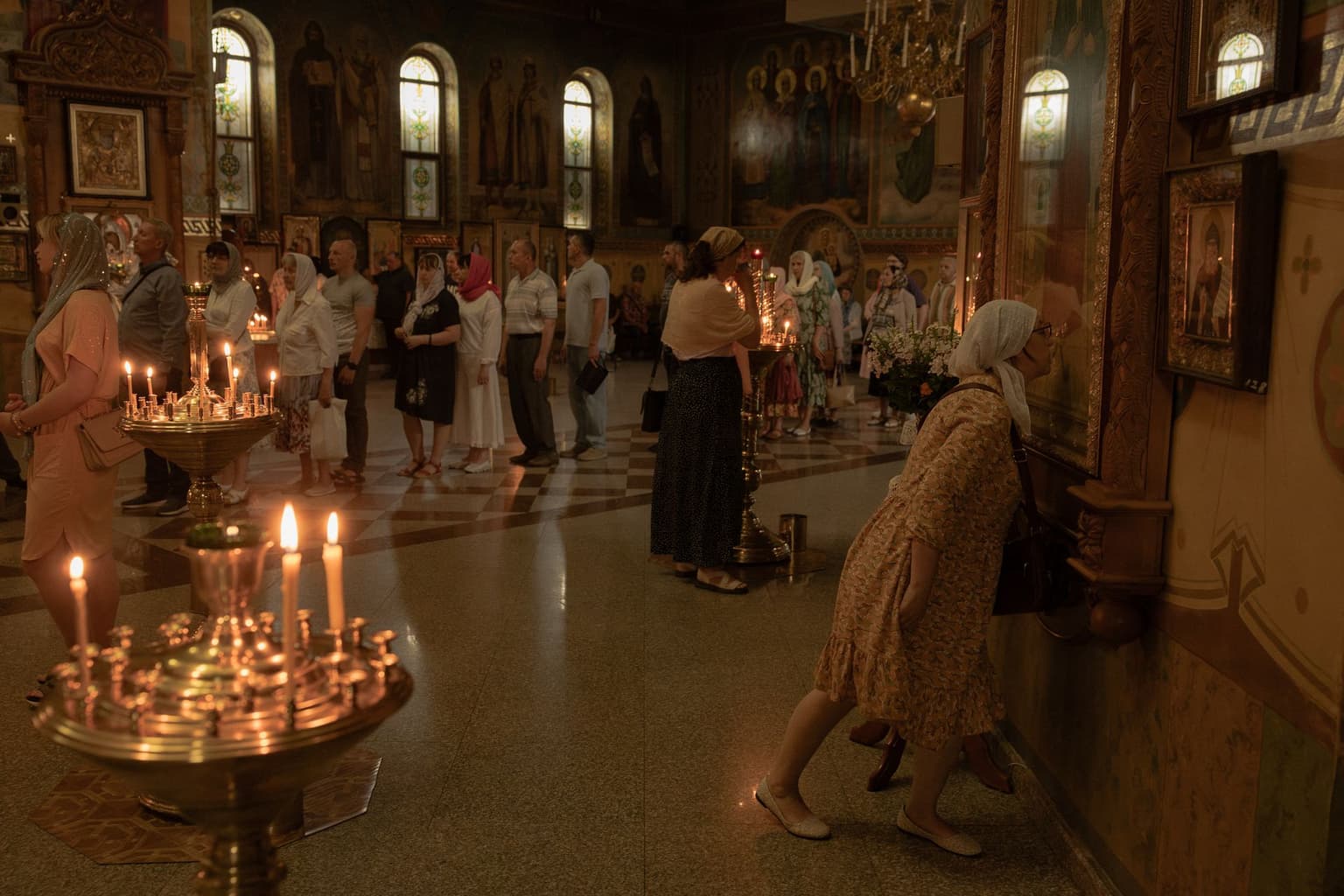
A woman kisses an icon during a prayer service at the Holy Trinity Cathedral in Kramatorsk, Donetsk Oblast, Ukraine, on July 20, 2025, amid the Russian invasion. (Roman Pilipey / AFP / Getty Images)
 on Google
The supposed "persecution of Christians" in Ukraine ranks among the most popular tropes of Russian disinformation.
Kremlin propaganda has sought to cast the state's push to limit the influence of the Kremlin-linked Ukrainian Orthodox Church of the Moscow Patriarchate (UOC-MP) — whose clergymen have aided Russia during the war — as an assault on Christians.
Though Ukraine is religiously diverse, Orthodox Christianity remains the dominant faith, with the independent Orthodox Church of Ukraine (OCU) being the country's most popular denomination.
In August 2024, Ukraine passed a law that banned activities of the Russian Orthodox Church and gave affiliated religious organizations — a move clearly aimed at the Kremlin-linked Ukrainian church (UOC-MP) — nine months to sever ties or face dissolution.
No decision to ban the church followed, while the issue remains stuck in court.
Yet, the narrative of supposed persecution has gained new impetus across the Atlantic after a visit of Russian Orthodox clergymen and laypeople to Capitol Hill, preaching Russian propaganda.
Visit to Washington
Anna Paulina Luna, a Republican lawmaker, met the Russian Orthodox delegation in Washington earlier this week. In a post on X, the representative from Florida declared that the "persecution of Christians under (President Volodymyr) Zelensky cannot be ignored."
The delegates reportedly held meetings with U.S. legislators and their staff to discuss what they called the suppression of religious freedom in Ukraine. The event followed a similar visit on Nov. 18.
On social media, Luna stressed that the U.S. "should not be giving funding to any countries" engaged in religious persecution.
Her statements were promptly amplified by Russian and pro-Russian actors, including Russia's chief economic negotiator, Kirill Dmitriev, who thanked Luna "for standing up for Christians."

News of the event was shared by controversial Ukrainian lawmakers Artem Dmytruk and Oleksandr Dubinskyi, both known for peddling pro-Russian narratives and being active in English-language social media platforms.
Dubinskyi, a jailed lawmaker facing charges of treason and other offenses, shared the news on his X account. Dmytruk, who illegally fled Ukraine in 2024, was more proactive, adding his own claims that "Christians in Ukraine are being killed right now."
"The goal of this campaign is to draw the attention of the U.S. legislative branch to the persecution of the Ukrainian Orthodox Church," the fugitive lawmaker posted.
Dmytruk, a subdeacon of the UOC-MP, has long decried alleged religious persecution in Ukraine.
Just in recent days, he spread claims on his Russian-language Telegram channel that Christians are being "tortured in the basements" by the authorities or that the criminal prosecution of Bishop Arsenii — who was charged with deliberately revealing coordinates of Ukrainian forces — is an "undeniable evidence of persecution of Christianity."
The disinformation monitoring team at the LetsData company reports that malignant actors have spread related narratives in Russian and Ukrainian languages, primarily on Facebook and Telegram. LetsData identified Dmytruk as one of the disseminators.
Disinformation actors also pushed claims that Ukraine is controlled by "satanists" or that the Ukrainian government suppresses "Orthodox values" in favor of other religions, the analysts said.
'Pan-Orthodox' delegation?
After the Washington visit was met with public backlash, its supporters and organizers sought to present it as a "pan-Orthodox" event, involving nearly 200 believers of various denominations — the Orthodox Church in America (OCA), the Russian Orthodox Church Outside of Russia (ROCOR), the local branch of the Serbian Orthodox Church, or the Antiochian Orthodox Christian Archdiocese.

The above-mentioned churches have links or displayed sympathies toward the Russian Orthodox Church (ROC), which, in turn, is closely aligned with Russian President Vladimir Putin and supports the invasion of Ukraine.
The ROCOR restored its canonical unity with the ROC in 2007 and came under scrutiny from U.S. lawmakers, who called for an inquiry over suspected espionage and influence activities on American soil.
The Orthodox Church in America, in turn, branched out from the ROC, despite the Ecumenical Patriarchate of Constantinople saying that Moscow had no authority in creating such a church. The Orthodox Church in America is not recognized by most of the Orthodox world.
Both the Antiochian and the Serbian Orthodox Church openly praise their close ties with the Russian Orthodox Church, and Patriarch Porfirije of the Serbian church met Putin and Patriarch Kirill in Moscow in April.
Pushback against Russian influence
During the full-scale invasion, the Russian-linked Ukrainian church (UOC-MP) has come under heavy scrutiny over suspected sympathies and ties to Moscow, a suspicion validated by evidence of the clergy's justification of the aggression or collaboration with Russian forces.
Facing the pressure, the church declared in 2022 that it had severed its ties to Moscow, a move critics say had no legal or practical effect.
This September, Ukraine's State Service for Ethnopolitics and Freedom of Conscience filed a lawsuit to terminate the activities of the Kyiv Metropolis of the UOC-MP, concluding that its ties to Moscow persist.
If the lawsuit is accepted by the court, individual UOC-MP parishes do not need to be dissolved; they can continue to operate independently or join the independent Orthodox Church of Ukraine (OCU) or another church, the State Service said.
Surveys show that the independent Ukrainian church is dominant among the believers.
Around 54% of Ukrainians declared themselves followers of the OCU, according to a September 2024 poll by the Kyiv International Institute of Sociology (KIIS).
Only about 6% identified themselves as members of the UOC-MP, while 7% identified themselves as Orthodox Christians without further specification.
Ukraine is also home to Greek Catholics, Protestants, Jews, Muslims, and others.


In spite of this, the claim about persecution of Christians has gained traction among some conservative figures in the U.S., a country where both the White House and Congress are now led by the Republican Party.
According to Keir Giles, an expert on Russian disinformation at Chatham House, the narrative taps into Russia's self-portrait as "a centre of traditional civilizational values, and in fact a bastion of Christianity — despite its public actions both at home and abroad being so clearly unchristian in nature."
Russia has systematically persecuted the clergy of the independent Orthodox Church of Ukraine, Catholics, and Protestants in occupied parts of Ukraine, while promoting the Russian Orthodox Church.
Priests who refused to submit to the Russian church have been driven out, kidnapped, or killed.
Giles says the contradiction "shows how there is no limit to how divorced from reality Russia's narratives can be."
"They will still find fertile ground among the naive or the unscrupulous in target countries that can be convinced by Russia's propaganda."
Editor's note: This article was published as part of the Fighting Against Conspiracy and Trolls (FACT) project, an independent, non-partisan hub launched in mid-2025 under the umbrella of the EU Digital Media Observatory (EDMO). Click here to follow the latest stories from our hub on disinformation.

Note from the author:
Hi, this is Martin, the author of this article.
Our team is committed to countering disinformation with accurate, fact-based reporting. We believe that access to truth should be available to all — that's why we don't use a paywall.
If you want to support our work, please consider joining our community.