EU indefinitely freezes Russian assets, moving closer to financial lifeline for Ukraine
 on Google
The European Union has agreed to indefinitely freeze Russian central bank reserves, moving the bloc a step closer to securing a financial lifeline to Kyiv as the war heads into its fourth year.
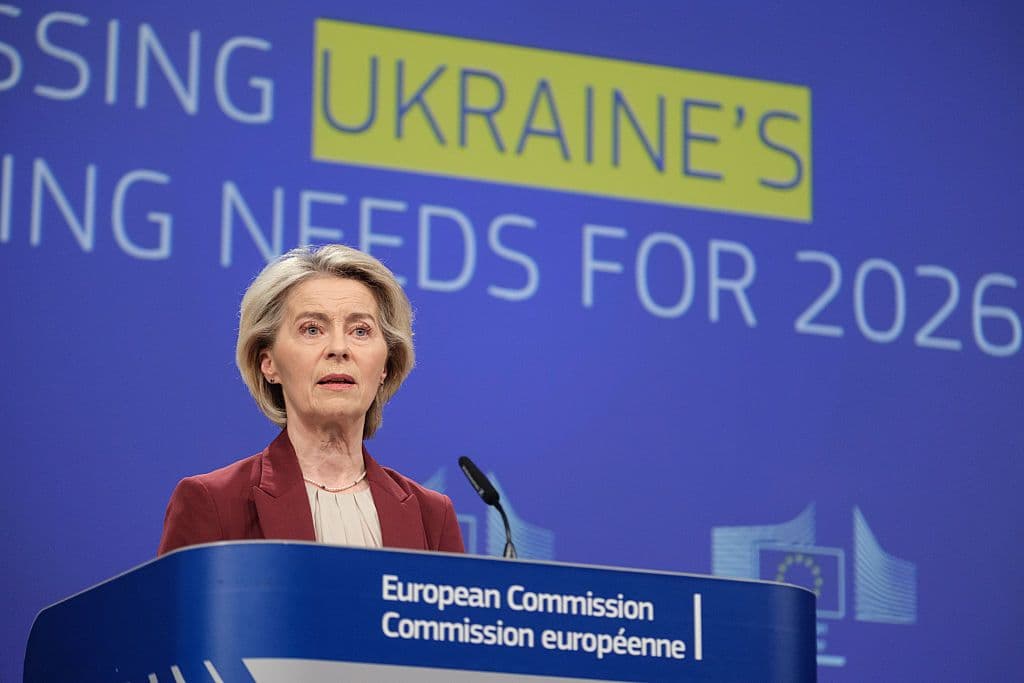
"I welcome the decision of the council on our proposal to continue the immobilization of Russian Sovereign Assets," President of the European Commission Ursula von der Leyen wrote on Twitter on Dec. 12.
The move means that roughly 210 billion euros ($245 billion) in Russian assets will now remain blocked in the EU until at least 15 countries representing over 55% of the EU's population vote to lift the freeze.
Previously, the continued immobilization of the assets had to be agreed upon by all 27 member states every six months — leaving them vulnerable to a veto by Hungary or Slovakia, who had repeatedly threatened to vote against renewing the sanctions.
With that risk gone, the decision marks a step towards a so-called "reparations loan," which would lend 90 billion euros ($105 billion) to Ukraine over the next two years, backed by the frozen assets.
The announcement comes just ahead of a European Council summit on Dec. 18–19 where EU leaders could unlock billions of euros in Russian assets to get critical financing to Kyiv for its war effort.
Von der Leyen proposed the plan on Dec. 3, which would cover two-thirds of Ukraine's needs over the next two years. Without extra financing, Kyiv will run out of cash by mid-2026.
In what appeared as a response to reports of indefinite immobilization, the Russian Central Bank said in a press release that it had sued Euroclear, the Belgian financial institution holding the vast majority of Europe's frozen assets, in a Moscow court on Dec. 12.
It also called the EU's reparations loan "illegal" and "contrary to international law" in a different press release, also published on Dec. 12.
Most scholars agree that the reparations loan is a well-crafted policy response to Ukraine's financing needs and Russia's continued aggression in Ukraine.
The Bank of Russia also said that it will proceed with "all available legal and other mechanisms" to challenge the reparations loan.
A legal memo from the prominent multinational law firm Covington & Burling, seen by the Kyiv Independent, states that litigation risk from the reparations loan is "minimal."
"In reality, it would be well-nigh impossible for Russia to persuade an international court or tribunal to find and exercise jurisdiction over such a claim," the document stated in reference to the proposed reparations loan.
The European Council's decision addresses one of Belgium's key concerns, which has expressed staunch opposition to the reparations loan initiative.
Belgian Prime Minister Bart de Wever has worried that, should the EU go forward with the reparations loan initiative and the sanctions not be extended due to a veto, then Belgium would be on the hook to repay the Russian central bank for a third of its GDP.
De Wever has repeatedly called for other countries to share the risk of any fallout from the proposal. The official proposal for a reparations loan, presented by Ursula von der Leyen on Dec. 3, included assurances that countries would provide guarantees for the loan proportional to their gross national income.
Italy, Malta, and Bulgaria on Dec. 12 also reportedly joined Belgium in opposing the reparations loan, drafting a document that called on the European Commission to explore other options to getting Ukraine financing.
The vote to indefinitely immobilize sanctions with a majority of countries — rather than unanimity — was done using an emergency clause in the EU lawbooks, known as article 122, a move reportedly seen as controversial.