Chart of the week: Every month, tens of thousands of Ukrainians flee danger
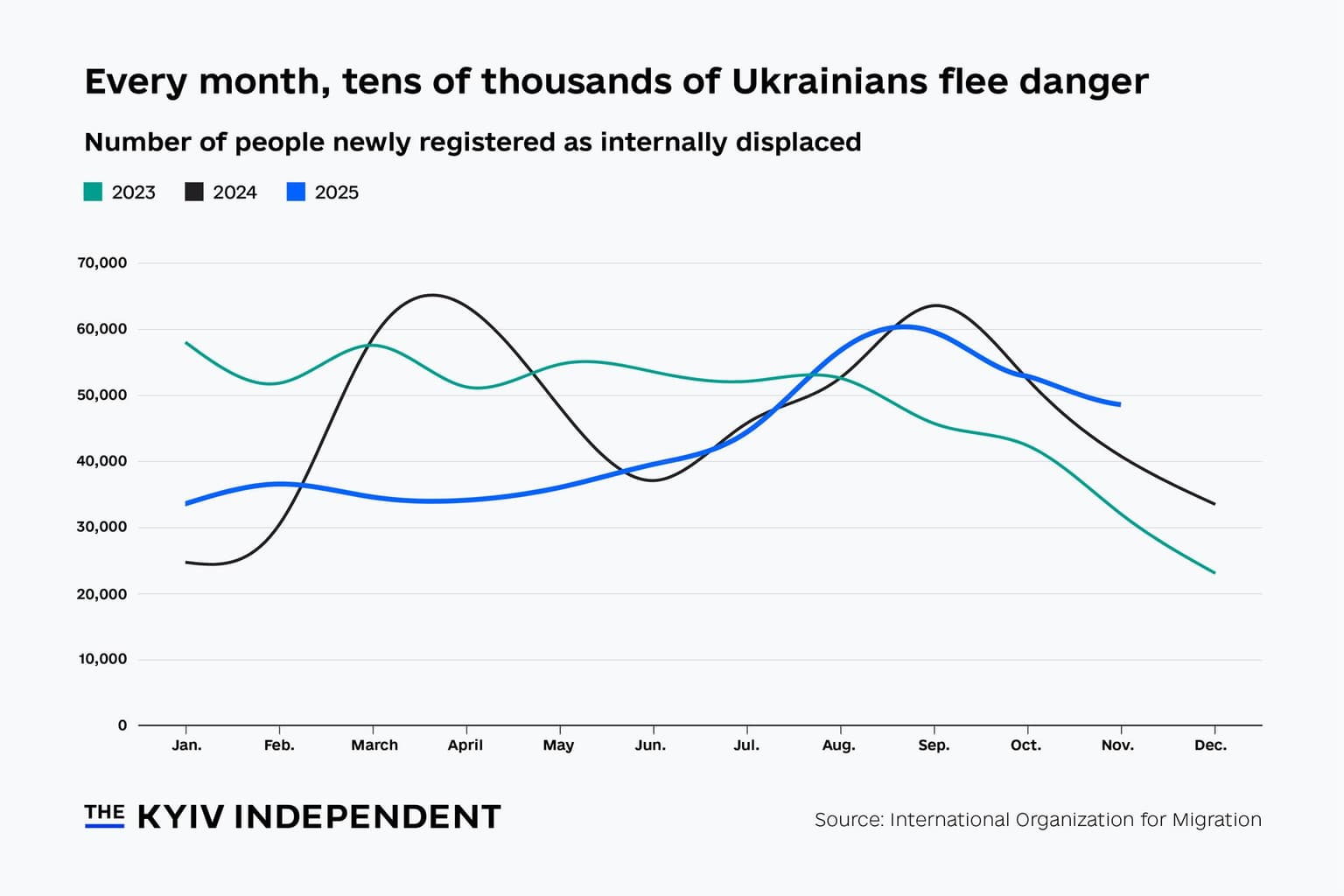
Every month, tens of thousands of Ukrainians flee danger. (Nizar al-Rifai/The Kyiv Independent)
 on Google
"Warning! Mandatory Evacuation." Those words were posted just two weeks ago on the website of Mezhivska hromada in Ukraine's central-eastern Dnipropetrovsk Oblast.
By June, the small region of 15,000 found itself around 20 kilometers away from the front line, but in recent months, the fighting has edged closer. Back in the summer, the hromada's council communicated with residents about the risks and offered guidance on the various support pathways available.
Now, the council says, everyone is under instruction to evacuate.
As peace talks intensify, European leaders rush to iron out the minutiae of a new funding package for Ukraine, and BlackRock's Larry Fink dips his toe back in reconstruction talks, tens of thousands of people continue to evacuate their homes every single month due to Russia's full-scale invasion.
According to the United Nations' International Organization for Migration, 48,000 people were forced to leave their homes in November 2025 — adding to their estimate of roughly 3.7 million people who are internally displaced in Ukraine today.

Internal displacement means leaving your home, while staying in the country. Even before Russia’s full-scale invasion, an estimated 1.8 million people had already been displaced within Ukraine due to Moscow's 2014 annexation of Crimea and invasion of the eastern Donbas region.
After the start of the invasion, almost 1 million people were newly registered as internally displaced in April 2022. Since then, the number of newly displaced people has fluctuated, but not stopped. Each and every month of the invasion, tens of thousands are newly registered as internally displaced.
Among those monthly figures, some people are leaving their homes for the very first time. Others will have moved not once, but multiple times.
From May to November 2025, Russia took on average 470 square kilometers of territory per month, according to BlackBird Group, a Finland-based analysis group. The front-line oblasts of Dnipropetrovsk and Kharkiv — where the front line has slowly moved one village westwards at a time — are home to the largest number of registered internally displaced people (IDPs).
Those oblasts' regional capitals have become major hubs for displaced people and humanitarian organizations. But even as the infrastructure for displaced people has become more established, many still perceive their new homes as temporary. "Ultimately," says Dejan Keserovic, deputy chief of mission at the U.N.'s migration agency in Ukraine, "the central need that emerges is stability.”


But stability is hard to find. According to a U.N. migration agency survey conducted between July and October 2025, just over a third of internally displaced Ukrainians said they planned to integrate into their current locations. Almost a quarter were unsure of their next steps. One-fifth said they would stay, but "not integrate." The remaining 16% affirmed they plan to return to their "places of origin."
Deciding whether to stay or go is one of the most difficult decisions anyone can make. But, as the Mezhivska authorities remind in their announcement, "the health and well-being of you and your loved ones is the highest priority."