Ukraine’s bid to build weapons in the EU gains ground, but slowly
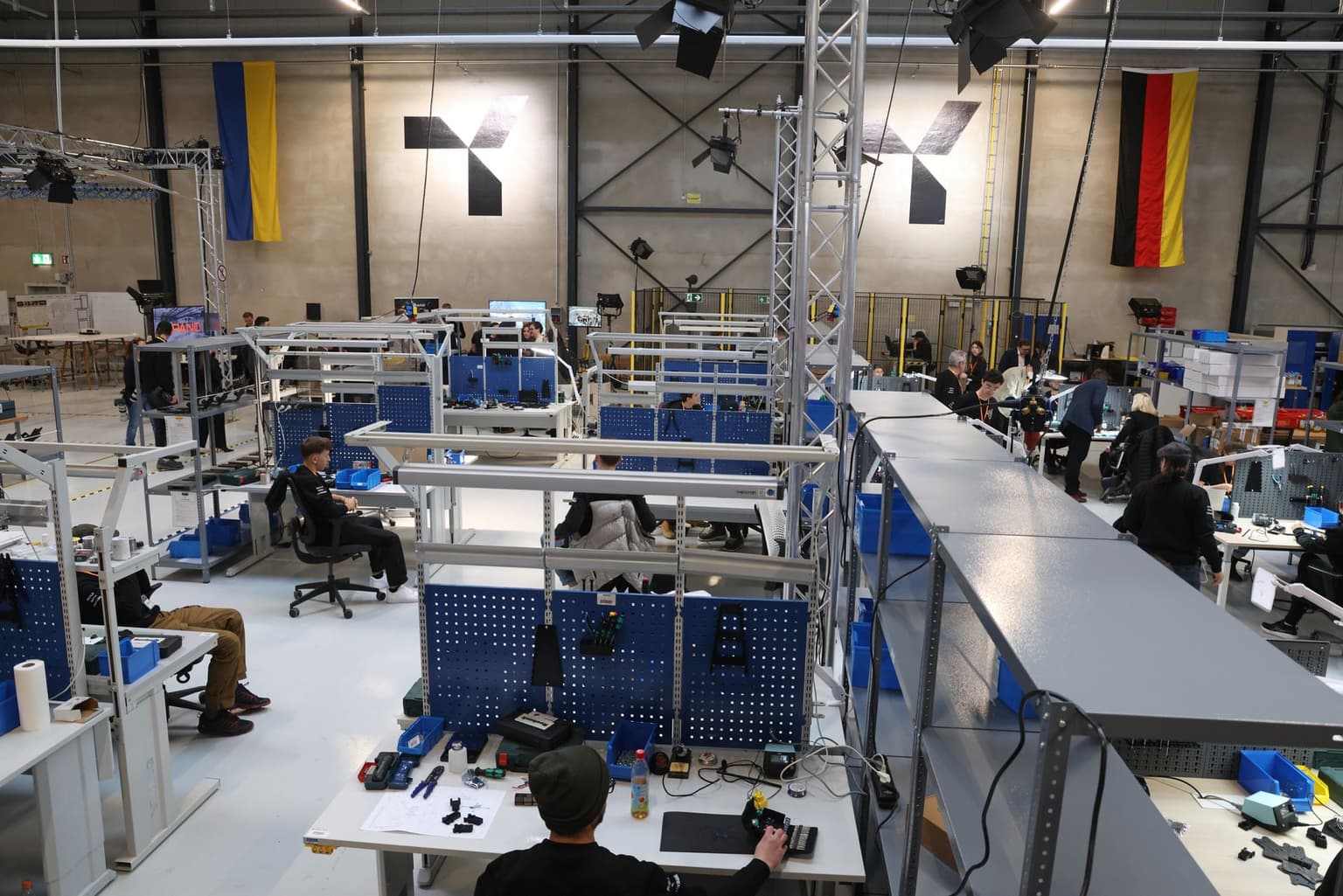
Ukrainian and German flags hang over workers at the Quantum Frontline Industries (QFI) production facility near Munich, Germany, on Feb. 13, 2026. (Sean Gallup / Getty Images)
 on Google
Ukraine last week welcomed the first fruits of a much-touted deal to build Ukrainian weapons in the safety of factories on European Union soil.
Ukrainian Frontline Robotics and Germany's Quantum Systems delivered to the Ukrainian Defense Ministry the first batch of a planned 10,000 small copter-bomber drones built in Germany through a joint venture on April 1.
It’s the first public shipment of weaponry to reach Ukraine from a series of deals under a Build with Ukraine initiative, a Ukrainian government program to launch joint production lines for Ukrainian weapons in European partner states announced last summer.
That initiative promised to create a streamlined process to interlink Ukrainian and European drone industries, which Ukraine is looking to as a pillar of its postwar security and economy.
Dogged by shake-ups in the Ukrainian government over the past year, Build with Ukraine has yet to manifest into a proper cohesive program. But demand is surging for Ukrainian drones, as the war on Iran highlighted both the importance of unmanned vehicles and the U.S.'s unreliability as a guarantor of Europe's security. Ukrainian companies, their European counterparts, and EU nations intent on building local drone industries with Ukrainian engineers are pushing to finalize a broad range of deals.
"We’re trying to work this out but right now there’s no clear roadmap," said one Ukrainian interceptor maker who asked not to be named for fear of undoing negotiations to build in the EU. The main obstacle, they said, was securing Ukrainian government clearance to move production to the EU.
The Frontline-Quantum joint venture offers the clearest guidance to date on how to cut through what remains a jumble of regulations for drone makers looking to go international.
Westward migration
The partnership worked in part because Quantum was already deeply embedded in Ukraine. It was among the first Western drone companies to set up full-time operations in Ukraine at the outset of Russia’s full-scale invasion in 2022. The firm went on to build the first factory of any Western drone company on the ground in Ukraine, starting with an R&D center announced in December 2023 and expanding to production in April 2024.
"You need to have a reliable partner who you’ve spent a decent amount of time with," Mykyta Rozhkov, head of business development for Frontline Robotics, told the Kyiv Independent.
The financial relationship between the two formally started with an $800,000 investment from Quantum into Frontline last July. The two subsequently created a joint venture, with the blessing and financial backing of the German Defense Ministry. The current production in Germany depends on buying key components from within Ukraine, Rozhkov said, financing not just Frontline Robotics, but also Ukraine-based drone component producers.
“The liberalization of exports is a big chance for Ukraine’s defense industry to take its place in the global defense-industrial complex.”
President Volodymyr Zelensky and then-Strategic Industries Minister Herman Smetanin initially announced the legal frameworks for Build with Ukraine in early July.

While light on details, the intention was to expand European financing for Ukrainian weapons makers and Ukraine’s footprint on European defense. Critically, the framework offered Ukrainian producers sanctuary at a time when Russia was hunting for them.
"The situation escalated in the spring and summer of 2025," said Rozhkov. "There was an active strike campaign against industry and industrial buildings and production. There was a strike next to one of our facilities."
Frontline approached Quantum Systems with its idea to build in Germany that August, Rozhkov explained.
The Build with Ukraine deals initiative also promised eventual access to foreign markets outside of strict — though officially unacknowledged — export restrictions on weapons leaving Ukraine.
"The liberalization of exports is a big chance for Ukraine’s defense industry to take its place in the global defense-industrial complex," Rozhkov said. "We’re trying to make the process more transparent so other companies can understand how to act."
That matters beyond Frontline. Many Ukrainian defense companies still depend on a single market, a single procurement customer, and one wartime budget cycle, Dariia Yariieva, president of the Ukrainian miltech start-up incubator Defense Builder, said in a statement to the Kyiv Independent. Firms want European money to build more drones, initially to send to Ukraine, but ultimately to build long-term international businesses.
More than 10 Ukrainian companies have announced agreements or memoranda of understanding with firms in the EU or UK. Several of these deals, including Frontline and Quantum’s, became public at the Munich Security Conference in early February.
A high-level Ukrainian official with knowledge of the matter told the Kyiv Independent to expect another round of such announcements by the end of April.
"The first one is already working. The others are still on the way," they said.
Still, the first shipment is arriving nine months after officials signed the first Build with Ukraine deals. Rozhkov declined to specify the number of drones, but said it is "a triple-digit number."
Ukrainian drone producers are famously quick to set up in workshops within Ukraine and relocate to new ones whenever Russia discovers their location. Building in Europe, by contrast, has proven far slower.
David Aloyan, deputy secretary of the National Security and Defense Council (NSDC), told the Kyiv Independent that in addition to Frontline and Quantum, Octopus interceptor drones are already in production in the United Kingdom, though they have yet to send a shipment back to Ukraine.
When it comes to private deals, it's typically the European entity that has to make the first move. Industry figures say many are willing.
"In joint ventures, the European companies usually find the Ukrainian companies," one Ukrainian working on such joint ventures told the Kyiv Independent, asking not to be named to avoid damaging their own ongoing negotiations.
"(German defense giant) Rheinmetall doesn’t really need a joint venture with Ukraine because they already have some of the technologies.
"For example, some Dutch companies have a lot of money but don’t have the weapons they need for the market right now. For them it’s much easier to make a joint venture with Ukrainian companies than to make their own R&D, because you get your engineers for free."

Political turmoil
Ukrainian producers of drones say there is still no clear process to build with Ukraine, in part because of months of upheaval across the government bodies involved.
Over the past nine months, Ukraine has repeatedly reshuffled the institutions overseeing defense production and exports. Shortly after Smetanin signed the first Build with Ukraine deal, the Strategic Industries Ministry was dissolved.
A new interagency commission was supposed to streamline approvals, but industry players say the process remains unclear.

Several Ukrainians working in the local defense industry told the Kyiv Independent that the real decisions or at least political will still come from the President’s Office itself, despite that office not having formal legal power over the "Build with Ukraine" process.
But still, some see an opportunity. On April 7, General Cherry, one of Ukraine’s largest drone producers, announced a new memorandum of understanding with Croatian component maker Orqa, another European company early to Ukraine, for a pending joint venture to produce Ukrainian interceptor drones without Chinese components.
Per the plan, Orqa will first send staff to help General Cherry build an underground component factory inside Ukraine which will then supply Orqa's operations in Croatia, where the final drones would be assembled.