Analysis: Why effective use of manpower will define who is winning the war in Ukraine in 2026
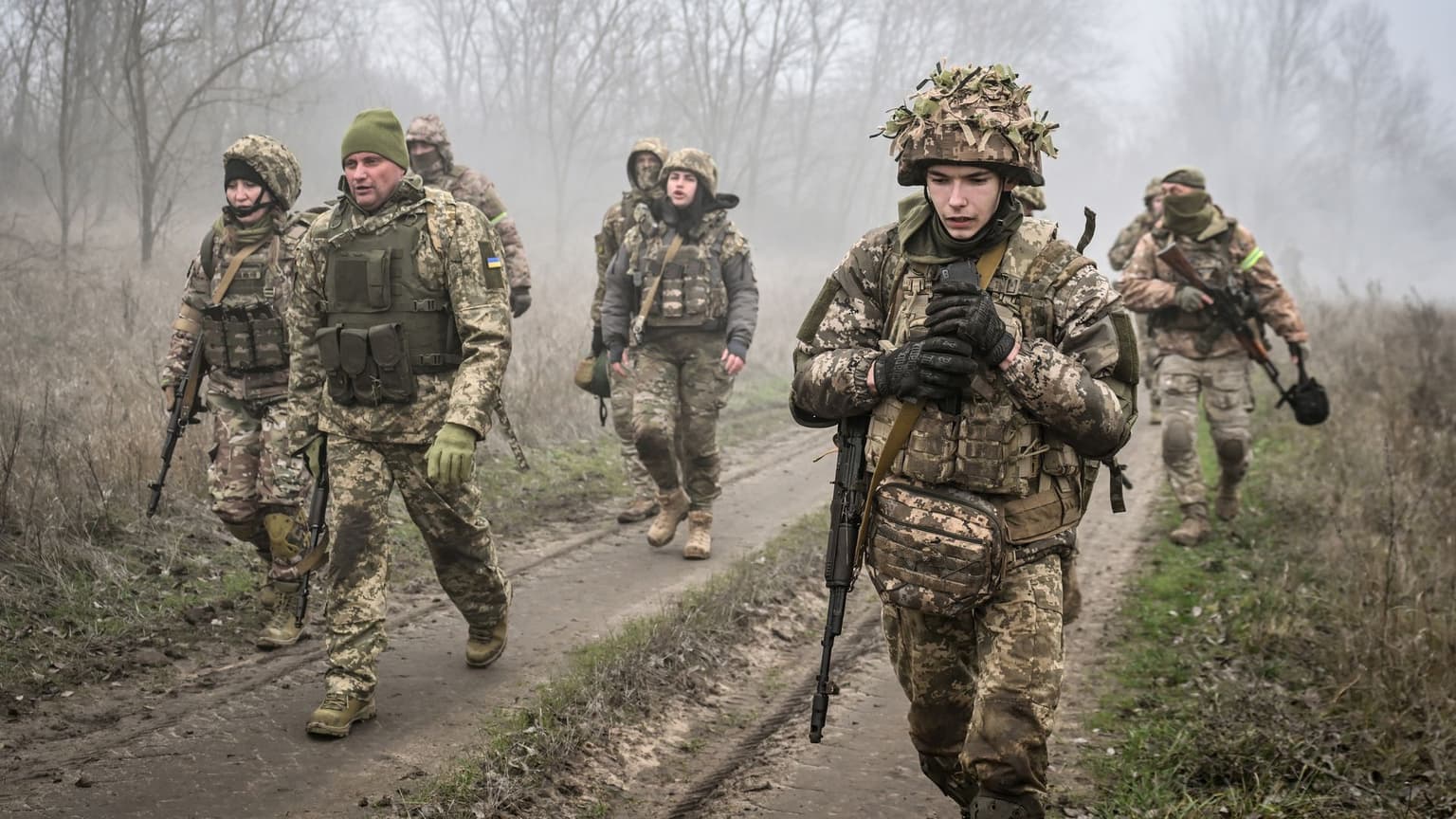
Recruits march under instructor supervision during the first day of basic military training with the 118th Separate Mechanized Brigade in Zaporizhzhia Oblast, Ukraine, on Nov. 30, 2025. (Dmytro Smolienko / Ukrinform / NurPhoto via Getty Images)
 on Google
In a dimly-lit wooden bunker, a tall, formidably-built Ukrainian officer is filmed from behind, wishing his men good fortune one by one with firm handshakes before a mission.
The soldiers in question — a few dozen mobilized Ukrainian men mostly in their forties, each dressed in issued pixel fatigues and with a basic rifle by their sides — respond mostly without enthusiasm, looking forward with blank stares as they accept their commander's greetings.
With context, this seemingly innocuous bit of military social media content, Ukraine's 425th Assault Regiment, better known as Skelia, takes on a darker tone, illustrative of the country's grim manpower situation as the fifth year of Russia's full-scale war approaches.
Skelia is the poster child of Ukraine's Assault Forces, a new branch of the military created in fall 2025 out of a handful of separate assault units known for their penchant for attacking at high intensity and their commanders' loyalty to Commander-in-Chief Oleksandr Syrskyi.
Over 2025, the regiment has gained attention as one of the military's top "firefighter" units, responding rapidly across the front line to quickly localize and liquidate Russian breakthroughs.
But with that attention has also come notoriety for its reckless use of mobilized soldiers in costly assault operations, leading to consistently high losses, while standard mechanized brigades are starved of reinforcements.
Rules of the game
With temperatures plummeting well below freezing in early January, the traditional slow-down of Russian advances is setting in on the battlefield.
But, as has been the case for as long as wars have been fought, offensives will pick up speed in the spring and summer, and the Ukrainian army remains afflicted by a chronic manpower crisis, felt even in the most elite units.
With the systemic lack of soldiers come greater tensions — between the assaulters and the defenders, between an exhausted nation and the existential threat it still faces, between the faceless commander and the dour-faced mobilized infantryman — that could define the war of 2026 for Ukraine.

With no peace deal in sight, 2026 will see the ongoing war of attrition continue along the same formula it has done since the failure of Ukraine's summer 2023 counteroffensive.
In a protracted attritional struggle, both sides aim to degrade both the ability and the will of the other to stay in the fight.
Moscow’s grander aim remains the breaking of a free and independent Ukraine through the destruction of the Ukrainian military.
Huge, heavily armed, and for the most part still motivated, it is nevertheless physically overstretched by the task of defending more than a thousand kilometers of front line year in, year out, against an enemy with an advantage in firepower, resources, and a seemingly endless supply of expendable assault infantry.
Even if military and financial aid continues to come in from Ukraine’s partners as it has done since the full-scale invasion, even if Ukraine’s domestic military production continues to grow, develop, and innovate, and even if the population in the rear is not compelled to capitulate through strikes on energy infrastructure, the war effort remains dependent on people.
If the hundreds of thousands of human beings forming the long chain of more than a hundred brigades covering this front line are no longer numerous, capable, or motivated enough to continue, even the most maximalist of Russia’s war aims will be within reach.

Trade-offs and weak spots
For most of the attritional, positional phase of the full-scale war, wherever Russia has intensified offensive operations, Ukraine has been able to respond in turn, reallocating forces to stabilize and snuff out offensives before they take too much territory.
Moscow’s acute focus on conquering the rest of Donetsk Oblast has been beneficial for Ukraine.
Here, Kyiv can concentrate some of its strongest brigades and drone units and use densely built-up areas like Pokrovsk and Kostiantynivka to stage long attritional fights that grind through immense amounts of Russian manpower and equipment.


In areas well covered by crack Ukrainian drone teams, and with a well-manned, competent brigade holding the sector, Russia remains unable to achieve anything close to a true operational breakthrough.
If this could remain the case across the entire front line going forward, Kyiv would be well placed to resist outside pressure to accept a capitulatory peace deal for years to come, as Russian costs incurred for each kilometer, treeline, and village would simply be too high to sustain.
In some front-line hotpots, this continues to be the norm, especially in areas where the defense is led by top brigades and drone units under the umbrella of a respected corps command.
But elsewhere, the trend over 2025 has been in the other direction, in worrying signs for the future direction of the war.
The strain on the army is being felt in the form of larger and larger weak points opening along the front line, while sectors that for years had been locked down with a stable defense are now becoming the sites of fresh Russian advances.
This is most evident on the southern front line, near the town of Huliaipole in Zaporizhzhia Oblast, which was overrun by Russian forces over the Christmas period.
Here, despite the area’s strategic importance, chaotic Ukrainian withdrawals over the past month put the entire defense of Zaporizhzhia Oblast in jeopardy, and the defense of Huliaipole was still being led by the undermanned, poorly equipped, and poorly commanded 102nd Territorial Defense Brigade.
In late December, the unit made headlines for all the wrong reasons after one of its battalion-level command posts was captured by Russian forces, hastily abandoned with computers, maps, and other sensitive communications equipment still intact.
Around the same time, the city of Siversk, which had served as a key bastion for Ukraine’s defense of northern Donetsk Oblast for years, was taken by Russian forces in the space of weeks.
The brigades defending this area were battle-hardened and combat-effective.

But after the ranks of their infantry were degraded for too long without proper replenishment, and as their drone teams were increasingly targeted by Russian fire, these veteran units simply could not hold the line in the way they once did.
Meanwhile, along the state border in Sumy Oblast, Russia's entry into the village of Hrabovske — in an area that until now had not seen any movement but was also defended by a thinly-spread Territorial Defense unit — exposed the growing threat of new front lines being opened, creating further strategic dilemmas for Kyiv.
Beyond mobilization
In wider discourse, the problem of the lack of manpower on the battlefield is often reduced to a mobilization problem; the need to make the unpopular decision to pull a lot more — and younger — men out of civilian life into the country's ranks.
But while Ukrainian society as a whole still flat-out rejects the idea of a capitulatory peace deal, the internal stress and strife brought by forced mobilization is simmering and could reach boiling point over 2026.
Attacks, sometimes fatal, against draft officers in the streets of Ukrainian cities, are more and more frequent, and — shockingly — are often praised on social media not by Russian bots, but by real Ukrainians, for whom the threat of losing one's country can sometimes take a back seat to the immediate distress of forced mobilization.
Much can be done to improve the mobilization process, and many of the necessary changes will be unpopular.
But the much clearer need is to improve how the Ukrainian military uses the manpower it already has.
The portrait of the average mobilized soldier at the dawn of 2026 is often a grim one — above 40, with increased likelihood of health issues, and unlikely to be driven by fierce patriotic ideals.
The challenge that is turning these men into a capable, enduring fighting force is only becoming more acute.
Much more attention and resources is needed for the country's training system, plagued with poor facilities, Soviet-era practices and a dire lack of capable, qualified instructors.
Beyond training, the most glaring issue — and that which could be most quickly rectified — is the distribution of mobilized men between combat units.
Speaking in an interview to Ukrainian television on Dec. 29, Syrskyi acknowledged not only the military's uneven distribution of new mobilized troops, but also — perhaps unwittingly — the twisted reason for the practice.

"The prioritization (of the Assault Forces for personnel replenishment) came about because of the shortage of the manpower resource attained by mobilization," Ukraine's top general said.
"Because the current intensity of fighting is such that we cannot replenish every unit at the same time, we have had to prioritize those units that are fighting in the hottest parts of the front line, and of course, those that suffer the highest losses."
This deadly trio — an inflow of unfit and unmotivated mobilized men, sent to poor-quality training, and then into units where their lives aren't protected — is what has led to soaring AWOL and desertion figures over the last year.
In the first 10 months of 2025 — before the Prosecutor General's Office stopped publishing the figures — 165,200 criminal cases for AWOL in the military were registered, as many as all those registered during the entire full-scale war before 2025.
Coming on top of battlefield casualties themselves and given the difficulties with mobilization, these numbers are not sustainable, and spending too long on this trajectory could be what makes a larger Russian breakthrough possible down the line.
On top of the obvious threat of mass desertion and front-line collapse, if not addressed, these issues also work to further reduce public trust in mobilization.
Make or break
Going into 2026, the battlefield balance of power remains by far the most important factor for any end of war scenario.
A consolidated Ukrainian military waging a stable, rock-solid defensive campaign would be Kyiv's strongest possible card, giving Moscow the choice of either stopping its war or announcing forced mobilization and overextending its economy.
But vice versa, a chaotic Ukrainian defense — withdrawing across the front line in a state of increasing chaos — puts Russia in pole position to force Kyiv to either capitulate at the negotiation table or face defeat in the field.

Since the hectic first hours of the full-scale war, Ukraine's key advantage over Russia has always been its people.
Now, the manpower question will likely make or break this fight.
To roll back the crisis, Kyiv must improve the conditions of its rank and file across the board, from dignified mobilization and training to smarter distribution between units and a human-centric command culture.
But before any of that, the Ukrainian military leadership must first realign its own strategic vision with the reality on the ground.
This entails not only the rational need to wage the most effective defensive attritional fight, but also to remember both how and why Ukraine fights on — first and foremost, it is all about protecting its people.
Note from the author:
Hi, this is Francis Farrell, cheers for reading this article, my first of 2026, in which I thought it important amid holiday festivities and sheer madness on the world stage to bring us all back to what the core fight will be about in Ukraine over the next year. From the point of view of our front-line reporting, 2026 will see more of the same: more drones in the air, more danger for journalists, and even less attention, let alone field reports, from international media on the battlefield. We, on the other hand, do not plan to shy away or slow down. Please consider supporting our reporting.