After 4 years of war, it's time to Ukrainize Europe
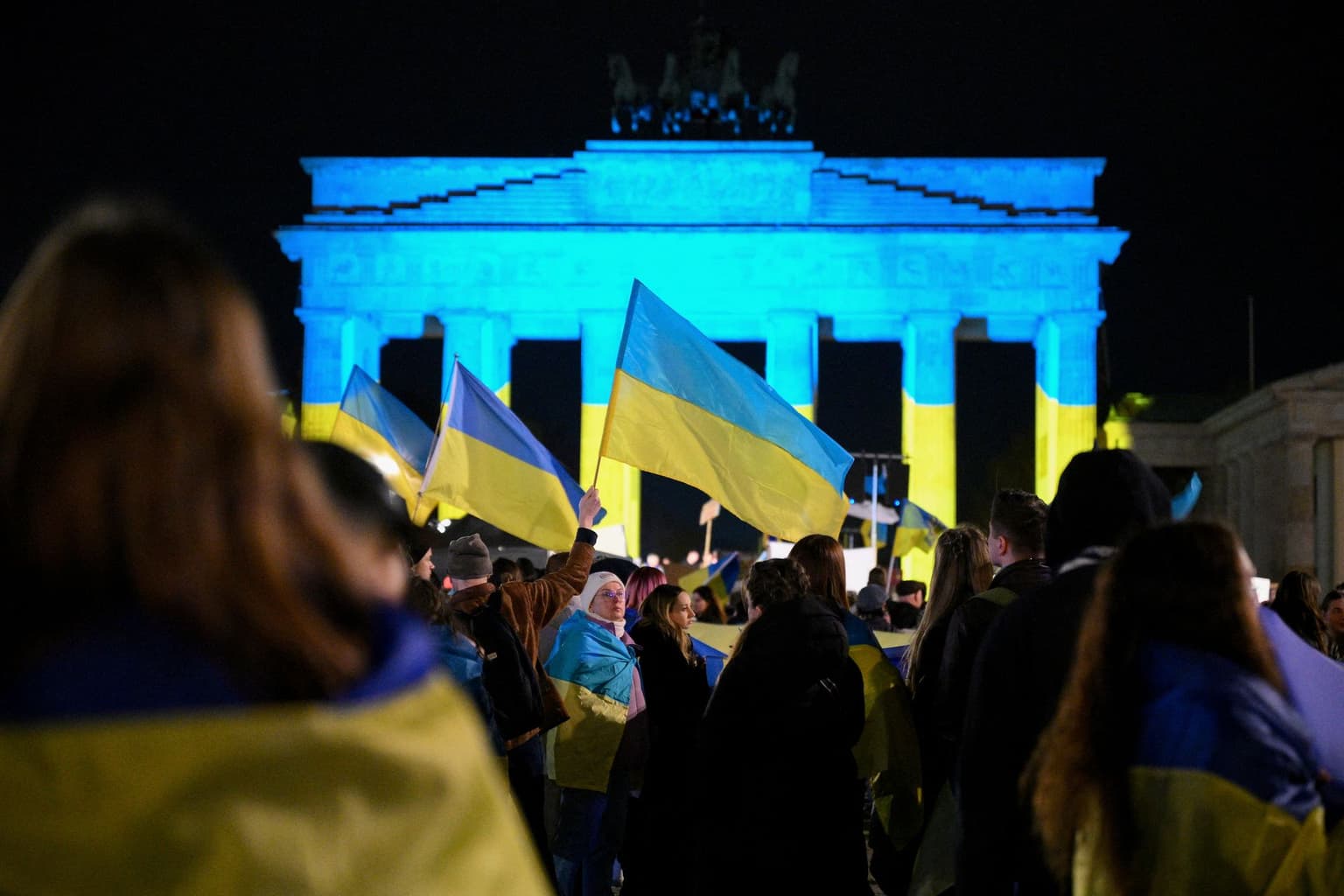
People take part in a pro-Ukraine demonstration in front of the Brandenburg Gate, illuminated in the colors of the Ukrainian flag, in Berlin, Germany, on Feb. 24, 2025. (Ralf Hirschberger / AFP via Getty Images)
 on Google
Andriy Lyubka
Ukrainian poet, essayist, and translator
A month ago, I put my work as a writer and volunteer on hold and enlisted in the Ukrainian army. As I left for service, some of my acquaintances said goodbye to me as though I were already dead.
Yet my reasoning was the exact opposite: if you want to survive, defend your family, your home, and your country, you must be fully trained and prepared to protect yourself. There is no better school for that than the Ukrainian Armed Forces on our continent.
So when I put on the military uniform, it felt as though I were putting on protective armor, increasing my chances of survival compared to the civilians around me. That realization filled me with confidence and optimism.
Reading this, you may well have tapped your temple in disbelief. But I am not alone. If God had a sense of humor, he would burst out laughing at the thought that, of all European nations today, Ukrainians are the greatest optimists. According to a pan-European survey conducted at the end of last year by the European Council on Foreign Relations, 41% of Ukrainians express optimism about the future of the world. By contrast, only 7% of Italians share that outlook, along with 8% of the French and 12% of the Danes.

It would be logical to assume that Ukrainians are naïve or foolish since there are not many reasons for optimism in today's world. Yet the real explanation is far more dramatic: entering the fifth year of full-scale war, people are so exhausted that it feels as though things simply cannot get any worse. And if they cannot get worse, then better days must lie ahead. In the end, optimism, faith, and hope may be the final sources of resilience that no dark soul can impose tariffs on.
There are mathematical optimists among us who believe things will improve simply because a long run of bad luck must eventually give way to a good one. There are analytical optimists who support their hope with hard reasoning: Russia is weakening and slipping into economic decline, and our partners have finally awakened and are ready to invest in defense.
And there are fatalistic optimists, waiting for a "black swan" in the form of some global cataclysm, the sudden death of a dictator, or another improbable miracle, like the resurrection of the United Nations.
I recall how, several years ago, I spent a month living in Slovenia — a paradise on the shores of the Adriatic Sea. Everyone I met complained bitterly about their country and apologized for everything. Only later did I learn that, in Balkan folklore, Slovenians are considered the most pessimistic and perpetually dissatisfied of nations.
Entering the fifth year of full-scale war, people are so exhausted that it feels as though things simply cannot get any worse. And if they cannot get worse, then better days must lie ahead.
That was when a joke occurred to me — a joke that, over time, has lost much of its humor. I proposed launching month-long patriotism courses in Ukraine for other nations: spend a few weeks living as we do, and your complaints about home will quickly fade. You would go back to Slovenia (or wherever the place you came from) as an ardent patriot of your own country.
And today, what once sounded almost like a joke is confirmed by sociological research: if Europeans need more faith in themselves and in tomorrow, they should look to Ukraine. Our country is not merely an open wound, but also a source of strength — a testament to the fact that even in a cynical and turbulent modern world, one does not have to abandon one's principles in order to survive.
Thus, Feb. 24, 2026, marks not only the fourth anniversary of the launch of Russia's massive war crime, but also eloquent proof that the Neanderthal law of brute force has failed to prevail. As the fifth year of full-scale aggression begins, the rabid bear has yet to fulfill even its initial goals — the total occupation of Donbas, let alone erasing Ukraine altogether.

In this dark hour for Europe — intimidated by Russia and betrayed by the U.S. — Ukraine has become a kind of beacon, a living example that even in the fiercest storm it is possible to stay the course and fight for survival. I repeat this because it really does matter: not to fight for survival by betraying one's course, but to fight for survival while firmly holding to one's values. If Ukraine has managed to do so, why should Europe not be able to?
Seen in this light, the words of Wolfgang Ischinger, chairman of the Munich Security Conference, no longer sound quite so scandalous. In an interview with Tagesspiegel, he stated that "as long as Ukraine is fighting, the danger to Europe remains limited." His remark can be read cynically as though Europe has no real interest in peace for Ukraine. But it is far more illuminating to see it through the lens of realpolitik: Ischinger was effectively acknowledging that Ukraine’s resistance is now the foundation of European security.
Let me repeat: not NATO, but Ukraine has become the cornerstone of EU security in 2026.
In this rather bizarre way, Ukraine's true European integration is already taking place. The documents have yet to be signed, but in practice, we are integrated into the European Union on many levels. And if the EU wishes to survive and strengthen itself as a geopolitical actor, it has to integrate Ukraine. To be more precise, it must mutually integrate with Ukraine.
The days when relations between the EU and Ukraine resembled those of teacher and student are long gone. Through years of trials and war, Ukraine has gained invaluable experience in resilience, learned real lessons of survival on the battlefield, and, at its most difficult moment, made a technological leap by creatively applying innovation in its defense industry. Today, we have much to share with our partners as well.
I could only dream of such a reality 22 years ago when I attended my first political rally during the Orange Revolution of 2004. Back then, as a naïve freshman, I believed that Ukraine's accession to the EU would instantly solve all our problems. To me, development meant quietly and unquestioningly adopting every Brussels norm and practice — what could we, the poor and backward relatives, possibly contribute, after all?

Two decades have passed since then: the Revolution of Dignity, the hybrid war of 2014, and later the full-scale invasion of 2022. They were years of persistent effort and determined movement toward Europe — a path we saw as a historic and cultural return home. Those 22 years encompass my entire conscious life, guided by a generational dream of making Ukraine European.
Today, we stand on the threshold of fulfilling that dream. Ukraine today stands at the center of European life; the fate of our country is shaping the future of the continent. I would note, somewhat ironically, that in this case the Ukrainian proverb "If you want to make God laugh, tell Him your plans" has proven entirely true.
We spent so long dreaming of the Europeanization of Ukraine that we now see the moment has come to Ukrainianize Europe — to teach resilience, fidelity to principle, and, as improbable as it may sound, optimism.
And so the fourth anniversary of Russia's criminal invasion is a fitting occasion to say that I am proud to be Ukrainian. And to add: Europe is profoundly fortunate to have Ukraine.
Editor's note: The opinions expressed in the op-ed section are those of the authors and do not purport to reflect the views of the Kyiv Independent.
read also
 Tim Zadorozhnyy
 Alisa Yurchenko
 Abbey Fenbert