What Russia’s internet blackouts reveal about Putin’s endgame
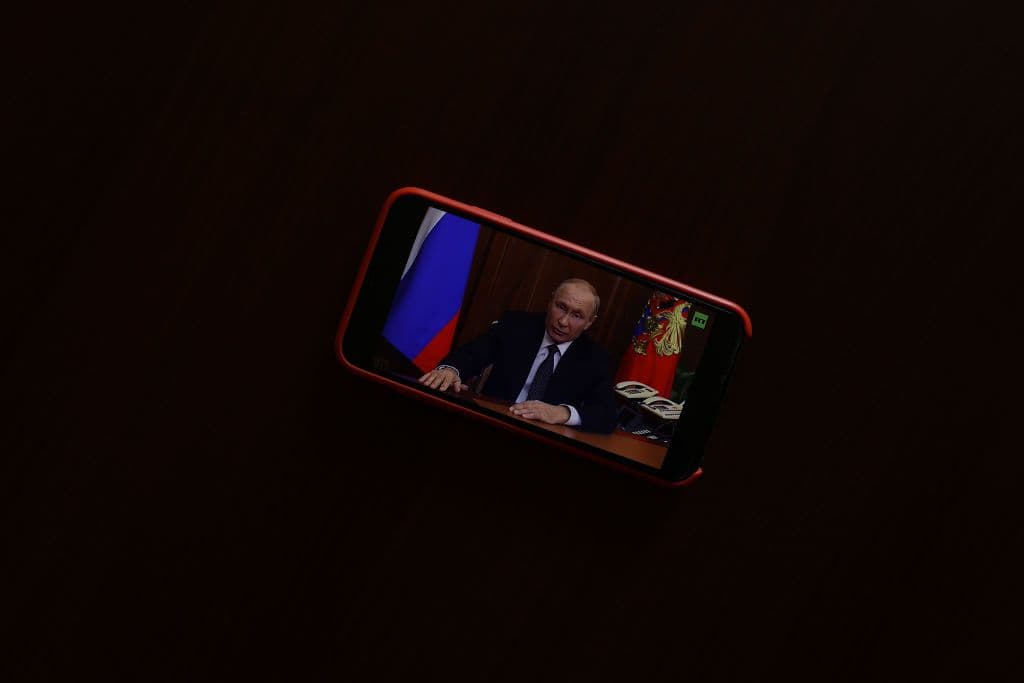
A photo shows a mobile phone screen while Russian President Vladimir Putin delivering a speech in televised address to the nation to announce partial military mobilization in Russia, in Moscow, Russia on Sept. 21, 2022. (Sefa Karacan/Anadolu Agency via Getty Images)
 on Google
Russia has intensified internet censorship in recent weeks as the U.S.-Israeli efforts to kill top Iranian officials prompted concerns that the security of its own leaders could also be compromised.
The official reason for the ongoing internet shutdowns is Ukrainian drone attacks on Russia.
Experts, however, believe that the intensifying internet censorship is part of the Kremlin's efforts to take full control of the online space, something the regime has been preparing for since the start of the all-out war.
Iran, a Kremlin ally, implemented a near-total internet blackout in January to crack down on street protests, killing thousands and suppressing the uprising.
"The (Russian) regime perfectly understands — learning from the experience of its allies as well — that the prevention of any mass protests and/or their suppression requires strict control," Ryhor Nizhnikau, a Russia expert at the Finnish Institute of International Affairs, told the Kyiv Independent.
"Currently, these developments in Moscow, as well as other regions, give us a glimpse of a new reality that (Vladimir) Putin builds for Russia: a new infrastructure that permits the regime to see 'everything' online, control what one can do and preventively identify threats, and most importantly, cut off internet access at any moment."
Internet outages intensify
Since May 2025, Russia has experienced frequent fixed-line and mobile internet shutdowns all over the country.
But on March 5, the Russian government took it further, cutting mobile internet and public wifi in the nation's capital. The outages have continued since then.
On March 15, the authorities began shutting down mobile internet in Moscow Oblast.
The Russian news agency RBC reported, citing its sources, that the blackouts were due to the testing of "white lists" — lists of government-approved sites that can be accessed during internet shutdowns.

"Since the beginning of March, authorities started to implement 'white lists' in Moscow for the first time, but in a very chaotic way," Leonid Iuldashev from eQualitie, a Canadian IT company that develops tools for circumventing censorship, told the Kyiv Independent.
"(They are checking if they) can turn them on for a particular house, for a particular district, for a particular street, and what the collateral damage would be."
Crackdown on messaging apps
The shutdowns followed Russia's efforts to crack down on Western messaging apps.
In August 2025, Russia's telecommunications regulator started blocking calls on Telegram and WhatsApp, although text messages remained available.
The blocks coincided with the Russian government's efforts to introduce a domestic alternative — the Max messaging app. It became mandatory to install Max on all new electronic devices.
The introduction of the app prompted concerns that it would be used for surveillance by Russian intelligence agencies.
The government-controlled app gathers and retains user metadata — such as IP addresses, contact lists, and activity logs — and its privacy policy permits sharing this information with third parties, including government agencies.
In February 2026, the Russian authorities started fully blocking Telegram. The Russian newspaper Kommersant reported on March 17 that roughly 80% of requests to Telegram domains failed on average in Russia, and in some regions the figure amounted to 90%.
On March 10, Kremlin spokesman Dmitry Peskov attributed the internet outages to Ukrainian attacks.
"All of this is probably linked to the primary need to ensure security," he said. "But the problems it poses for businesses are, of course, a matter for further analysis."
Wartime totalitarianism
Analysts dismissed the official reason that Ukrainian drone attacks were the primary reason for the shutdowns but linked them to a general atmosphere of wartime totalitarianism.
"It's a general drive to restrict all forms of communication and access to independent information, and to establish control over any communication," Russian columnist Sergei Parkhomenko told the Kyiv Independent. "Any communication is dangerous for a totalitarian regime during wartime."

Nizhnikau said that "these recent measures are not about drones or air defense: we see that drones are not really affected even if GPS and mobile internet are down."
"It is about the Putin regime's own security, which sees anything out of its control as an imminent threat," he told the Kyiv Independent. "In this respect, Putin is driven by his long-term fears of regime change through mass mobilization and protests."
Another Russian analyst told the Kyiv Independent that the censorship fits "the logic of the self-development of an authoritarian regime that, in its pursuit of complete Orwellian control, is degenerating into a semi-totalitarian one."
The analyst spoke on condition of anonymity due to the fear of reprisals.
Links to protests, war in Iran
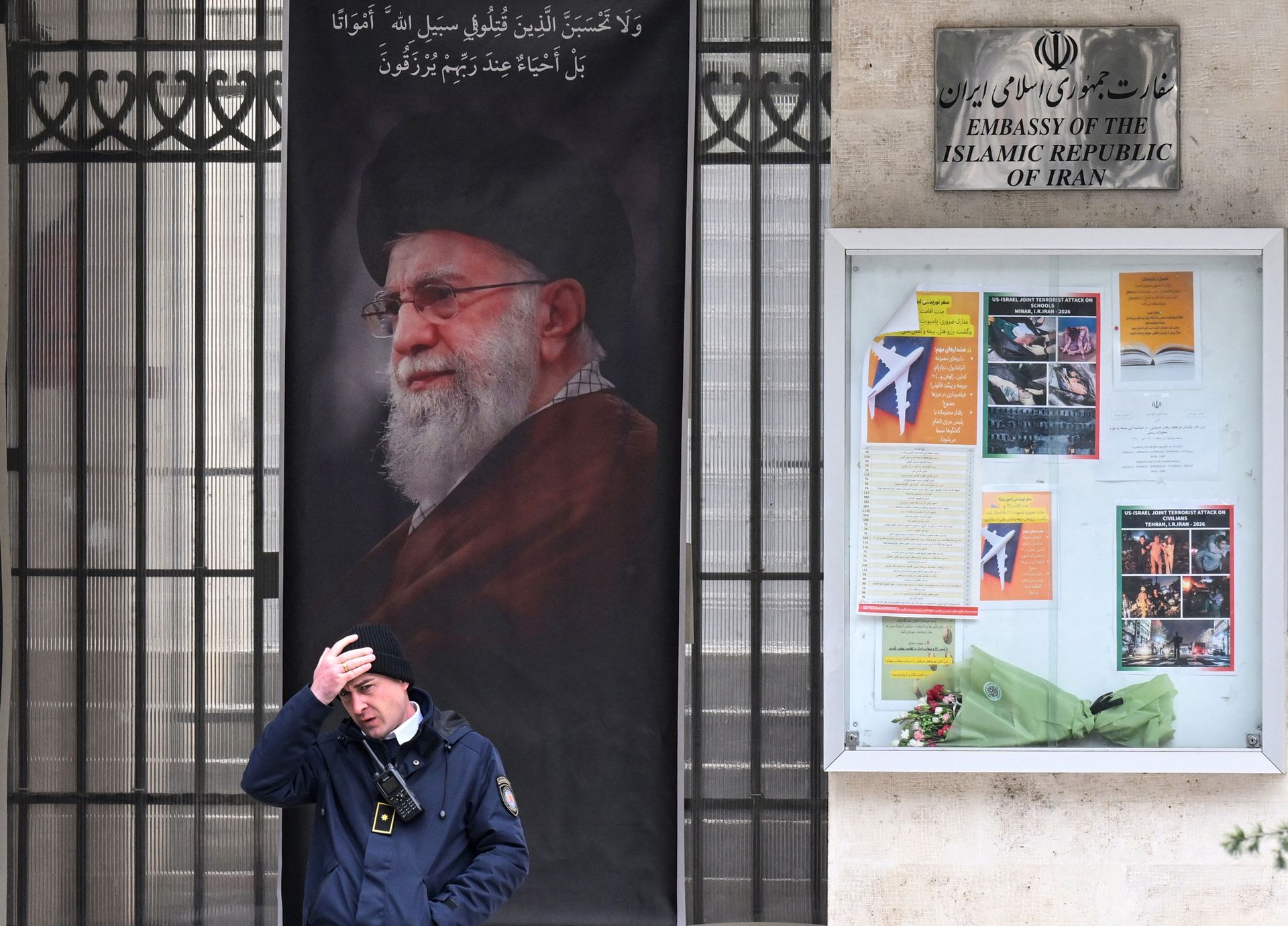
Analysts, including Parkhomenko and Iuldashev, also believe that the new wave of censorship is linked to efforts by Israel and the U.S. to track down and kill numerous top Iranian officials, which reportedly involved access to electronic devices, navigation apps, and cameras.
Most prominently, Supreme Leader Ali Khamenei was killed on Feb. 28, and Ali Larijani, secretary of Iran's security council and reportedly the country's de facto leader, was assassinated on March 17.
"(One theory is) that Putin personally was afraid because of the leveraging of the internet and surveillance infrastructure in Iran by Israeli intelligence agencies that were able to geolocate Ayatollah Khamenei and actually kill him," Iuldashev said.
Russia could also have been inspired by Iran's near-total nationwide internet blackouts during anti-government protests in January and during the ongoing war with the U.S. and Israel, Iuldashev said.
"They saw how successful Iran was with this 'white list' implementation, where only pro-governmental Telegram channels had actual access to the global internet," he added.
read also
 Martin Fornusek
 Oleg Sukhov
 Givi Targamadze