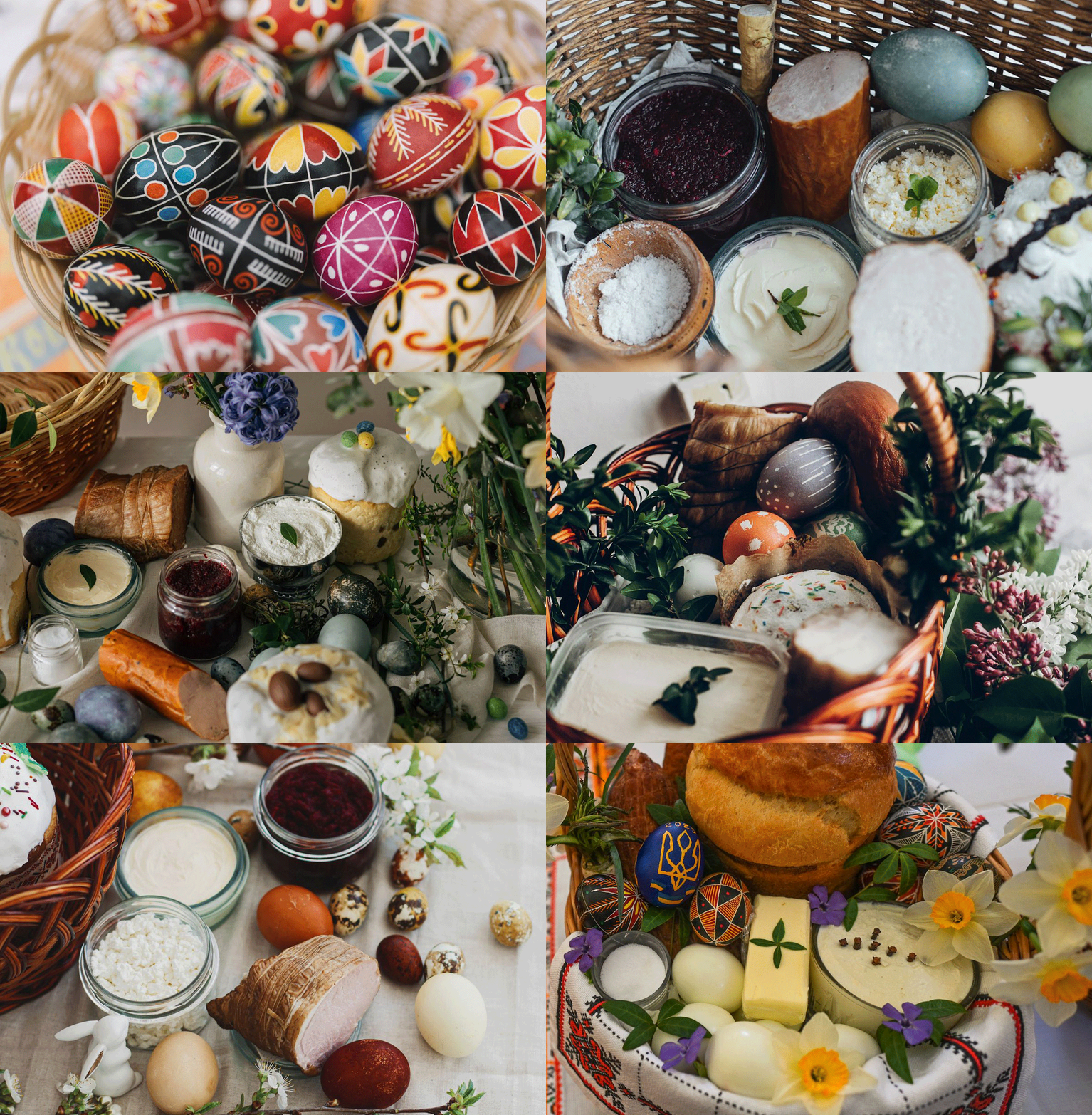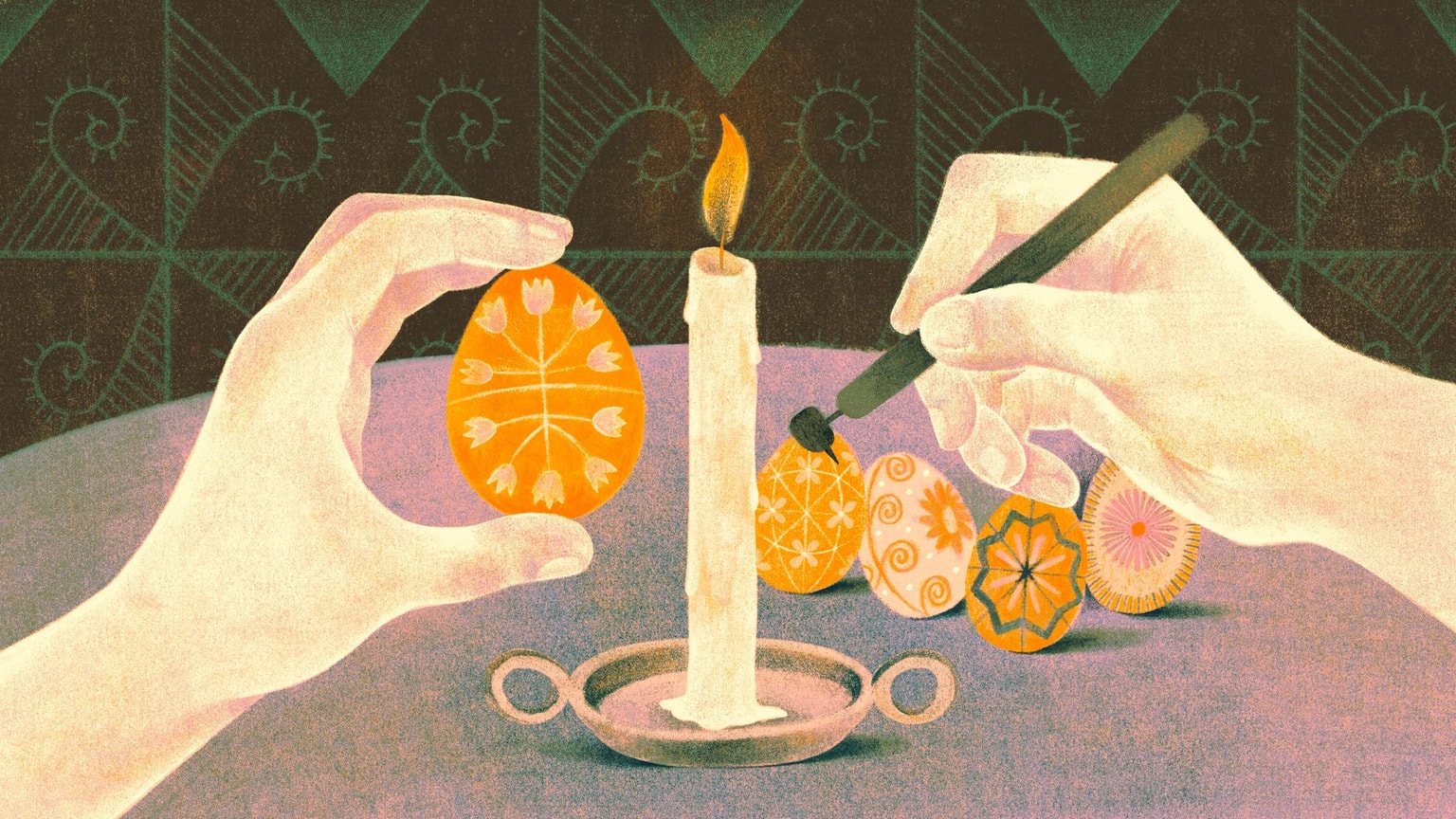
Pysanky, intricately adorned Easter eggs crafted through an ancient wax-resist method, endure as a living tradition among Ukrainians worldwide, carrying memory, belief, and cultural identity across generations. (Daria Filippova / The Kyiv Independent)

In the days before Orthodox Easter in Soviet times, one Ukrainian historical researcher recalls children being lined up, their hands inspected for signs of forbidden dye.
Teachers were searching for any sign that the children’s families had secretly celebrated the Christian holiday by decorating traditional Ukrainian Easter eggs, or pysanky as they're known in Ukrainian.
"Making pysanky was banned… Anyone caught with dye stains was punished," recalled Yaroslava Muzychenko, a researcher at the Ivan Honchar National Center of Folk Culture, in an interview with Ukrainian media outlet NV.
Despite a Soviet ban on religion, some families in Ukraine during that period came together in kitchens and back rooms, and through whispers and flickering candlelight, learned a language passed quietly through the generations.
Today, that language endures. For Ukrainians at home and abroad, the art of pysanky is a living practice that carries memory, belief, and cultural pride.
A cultural export for an important holiday
Even amid a renewed focus on national identity since 2014, Easter continues to rank as the most important holiday for Ukrainians. Easter in Ukraine is typically celebrated according to the Orthodox Christian calendar, which often falls on a different date than the Western Christian Easter.
Preparations include the Easter basket and hard-boiled eggs dyed a single color called krashanky from the verb "to beautify." But the more intricate pysanka has become Ukraine’s most recognizable Easter emblem abroad.
Pysanka — plural: pysanky — comes from the Ukrainian word pysaty, "to write." Eggs are decorated with complex designs using a wax-resist method. They have become so closely associated with Ukraine that in 2024, UNESCO added pysanky to the country’s list of Intangible Cultural Heritage.

Their origins, however, predate Christianity. Early ceramic versions were believed to hold protective, even cosmic power.
From pagan ritual to folk art
After Kyivan Rus adopted Christianity in 988 AD, many pagan rituals were incorporated into religious holidays. Over time, pysanky and their symbols evolved from a rite of spring to something layered with the resurrection of Christ.
Archaeological finds trace ceramic pysanky back to the 12th century, while the oldest surviving eggshell example is more than 500 years old. For much of that history, the practice passed from mother to daughter through oral tradition.
These were not originally objects of self-expression. They functioned as amulets akin to the Greek evil eye. Their messages carried wishes for the rebirth of spring and protection from evil.
That began to shift at the turn of the 20th century. In 1899, ethnographer Serhiy Kulzhynsky published a catalog of more than 2,000 designs from across Ukraine. Documentation transformed the practice. What had been primarily symbolic became, increasingly, aesthetic.
Craft layered with meaning
The process of making a pysanka starts by hollowing a raw egg through a pinhole. While chicken eggs are most common, goose and quail eggs are also used.
Designs are "written" in hot wax using a copper funnel tool called a kyska. Clear beeswax is charred into dark ink over a candle flame. Designs are applied in stages with the liquid wax. Each layer of wax seals the shell before the egg is dipped into progressively darker dyes.
The artist known as a pysankarka, or "writer," works in reverse. Lighter colors are preserved beneath layers of wax and pigment. Once the design is completed, the wax is melted away to reveal the final artwork. The effect is both technical and symbolic.
But long before pysanky were decorative, they formed a visual vocabulary tied to nature and spirituality.
Central to the tradition are recurring motifs: the eight-pointed star, ruzha, symbolizing the sun god, Dazhboh; the broken cross or windmill, svarha, representing the god of sun, sky, and thunder; and the triangle, first connected to raked fields and later associated with the Holy Trinity.
Beyond that, the decorations use a combination of geometric, animal, or floral symbols depending on the region and period they were made.


The symbols were also designed to reflect a person’s stage of life. Children received eggs with the most white space, suggesting their unwritten futures. Married couples often received the 40-triangle design with netting to invoke fertility and an orderly home. Older folks received the darkest eggs with an emphasis on eternity motifs to guide them to the afterlife.
Eggs as resistance
If pysanky once carried prayers to the sun, they now carry something closer to witness.
Across Ukraine and its diaspora, the widespread practice has taken on renewed urgency since the Russian invasion. What was once holiday preparation and cultural preservation has also become a form of resistance.
For some, the oral tradition is now passed through YouTube. Zlata Anatska, a teacher and internally displaced person from Donetsk, is learning to write traditional pysanky designs from YouTube tutorials by Tetyana Konoval.
Anatska told Radio Free Europe that she also hopes to pass the practice on: "If we were to return to normal life, I think I would be happy to teach children how to make pysanky…I really want to share my skills."
In the United States, Sophia Charron, 21, started teaching pysanky writing to her community in Pennsylvania, echoing the mindset of diaspora shaped by earlier waves of displacement. "(The diaspora) thought they might be the last Ukrainians," she said. "So they had to preserve the culture."


Elsewhere, the tradition has entered institutional spaces. Since 2016, the Canadian Royal Mint has issued commemorative gold and silver pysanky coins designed by Ukrainian-Canadian artists. Ukrainian-American artist and ethnographer, Sofika Zielyk, curates an ongoing exhibit at the Ukrainian Institute of America called "Pysanka: A Symbol of Hope." Her project collects eggs from around the world to be sent to the Ukrainian front line.
In Ukraine, Instagram channels and master classes in how to make pysanky have popped up in various cities amid a Ukrainian cultural renaissance brought on by Russia's invasion. Ukraine’s official postal service, Ukraposhta, has also been issuing annual commemorative stamps dedicated to pysanky for the last decade.
Oleg Kirashchuk, a master pysanky maker and serviceman of the Armed Forces of Ukraine, has been making pysanky for over 30 years. He learned from his mother and grandmother, and his works are in museums around the world.
Now he makes them for his fellow servicemen from behind the front. Kirashchuk is most pleased when "I’ve just painted a pysanky, removed the wax, and the guys carefully pack them in boxes, trying to find a way to get them home."
Home, like spring, is both a place and a promise.
More than a century ago, in a 1918 issue of the Ukrainian Sich Riflemen’s magazine Samokhotnyk, soldiers wrote: "God grant that we all celebrate the second (next) Easter at home, among our relatives, in a free Ukraine."
It is a wish that has been written and rewritten many times since.