As Russia takes Pokrovsk, sister city Myrnohrad stares down encirclement
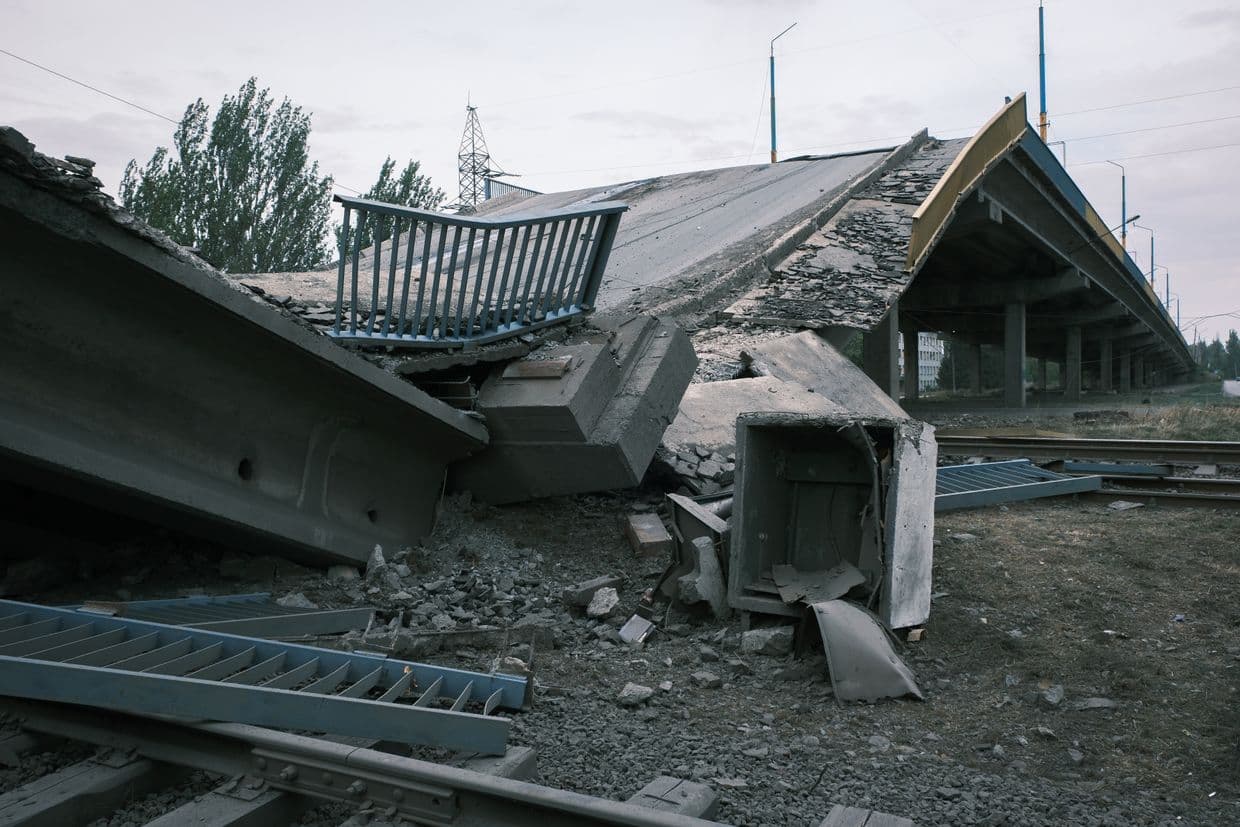
A bridge destroyed by Russian forces in Pokrovsk, Donetsk Oblast, on Sept. 9, 2024. (Francis Farrell/The Kyiv Independent)
 on Google
Ukraine's great fortress city of Pokrovsk has officially fallen — as far as Moscow is concerned.
More than five weeks after Russian troops first started to swarm into the southern outskirts of the Donetsk Oblast city, Pokrovsk has been decisively overrun, although Kyiv still claims a presence inside the urban area.
Though nearing its close, the final act of the Battle of Pokrovsk has come gradually, as Ukrainian forces are squeezed out of the city center by Russian infantry on the ground and drones in the air.
Meanwhile though, a much darker situation continues to unfold for the sister city of Myrnohrad to the east, where the entire city is under serious threat of encirclement.
In a nod to the political significance of taking Pokrovsk, the claim was first made by Russian President Vladimir Putin on Dec. 1, after receiving a report on the latest battlefield situation from his top general, Valery Gerasimov.
On the same day, Russia's Defense Ministry uploaded a video of Russian soldiers strolling leisurely through central Pokrovsk and unfurling the state flag on Shybankova Square.
Reposting the video on her personal X account, Russian propagandist presenter Margarita Simonyan proclaimed it as the "moment Pokrovsk became Krasnoarmeysk," referring to the Soviet-era name of the city, which was changed in 2016 as part of Ukraine's decommunization drive.

Kyiv quickly denied the claim.
"This is just another attempt by the Kremlin to use the videotaped "flag-raising" for propaganda purposes to influence participants in international negotiations," the General Staff wrote on Dec. 2.
With the front line under increasing international scrutiny amid the latest flurry of U.S.-led attempts to strike a Russia-Ukraine peace deal, the official status of control of Pokrovsk has taken on extra political meaning.
But compared to the fierce war of narratives that has surrounded the Battle of Pokrovsk, the reality — as it has been since late summer — continues to be hostage to the fog of war.
Almost all of the center of the city, together with the rest of the built-up area south of the main railway line, is now assessed as being under Russian control, according to most independent mapping projects, including Ukraine's DeepState map.

Strikes on both Russian and Ukrainian soldiers have been recorded in the northern low-density residential neighborhoods of Pokrovsk, but in the dynamic and hazy environment of the front-line contact zone, proper territorial control is difficult to establish.
Shybankova Square, where the Russian troops unfurled the flag in the Defense Ministry video, is in this area, far from any recent geolocation of Ukrainian soldiers.
But with Kyiv bringing in more reinforcement, and with elite drone teams of the Special Forces, Unmanned Systems Forces, and Assault Forces all adding to the firepower bearing down on northern Pokrovsk, the area above the railway line has proved difficult for Russian troops to properly dig into.
In a fashion not unlike the last phase of the Battle of Bakhmut, Ukraine's hold over Pokrovsk is dying a quiet death, as full Russian control over the city is denied de jure but close to being secured de facto.
According to one Ukrainian drone pilot, who spoke on the condition of anonymity to the Kyiv Independent, Ukrainian soldiers still hold some positions in the northern part of Pokrovsk.
But, in the environment of constantly advancing Russian infiltration groups — moving forward through the urban area and soon followed by reinforcements digging in — these Ukrainian positions are mostly cut off on the ground, resupplied only by drone.
"It's stupid to keep them surrounded there," the pilot said.
"The defense line near Pokrovsk needs to be strengthened now, and they're keeping them there."

Ukrainian units — in particular of the Assault Forces and Special Forces' Third Regiment, have continued raids and other clearing operations in northern Pokrovsk, but — as per the nation of their missions — do not hold permanent positions there.
"These clearing operations unfortunately don't carry much weight, as the enemy has every opportunity to continue gathering in the central and southern parts of the city," DeepState founder Roman Pohorilyi said in a livestream on the project's channel on Dec. 3.
In an embarrassing information stunt that drew scorn online from Ukrainian figures and ridicule from Russians, the 425th Assault Regiment posted an AI-generated image almost identical to the two Russian soldiers on Shybankova Square, but with a Ukrainian flag. The post, claiming to "debunk Russian propaganda" was soon deleted.

While Ukraine's retreat from Pokrovsk is slow but orderly, the situation in Myrnohrad has only become more critical over the last weeks.
Worsening an already dire logistical situation, Russian advances northeast of Pokrovsk look to be closing the noose on the city, threatening the first operational-level encirclement of Ukrainian troops since the Battle of Mariupol in 2022.
On the southern and eastern flanks of Myrnohrad, hardened Ukrainian brigades have largely managed to hold the line, although Russian infiltration groups have broken into the city.
Since the first weeks after Russian troops entered Pokrovsk in October, no Ukrainian vehicles have been able to pass through the remaining land corridor to Myrnohrad, with Ukrainian commanders telling the Kyiv Independent at the time that all supply runs were conducted by drones and unmanned ground vehicles.
Since then, the two Russian pincers to the west of Myrnohrad have practically met, and although maps like DeepState continue to mark the thinnest of corridors remaining, any attempt to move troops in and out, even by foot, are facing climbing threats of being caught in firefights on the ground with Russian troops.
In a social media post on the evening of Dec. 3, the 7th Corps of Ukraine's Air Assault Forces, responsible for the defense of the Pokrovsk area, denied a full encirclement of Myrnohrad claiming that in the week up to Dec. 3, several successful rotations of personnel were carried out in and out of the city.
In comments to Ukrainian media outlet Hromadske however, one unnamed commander in the 38th Marine Brigade said that Myrnohrad had been encircled on the ground for the last five days, while another source told the outlet that the last successful rotation was back on Nov. 12.
"We continue to defend every piece of our land, the battles for Myrnohrad are hellish," said a senior officer of one of the brigades fighting in the city to the Kyiv Independent.
The officer, who also asked his name and unit not to be disclosed, declined to comment on whether or not he assessed his troops to be encircled.