In Ukraine, a paralyzed parliament raises alarms over wartime governance
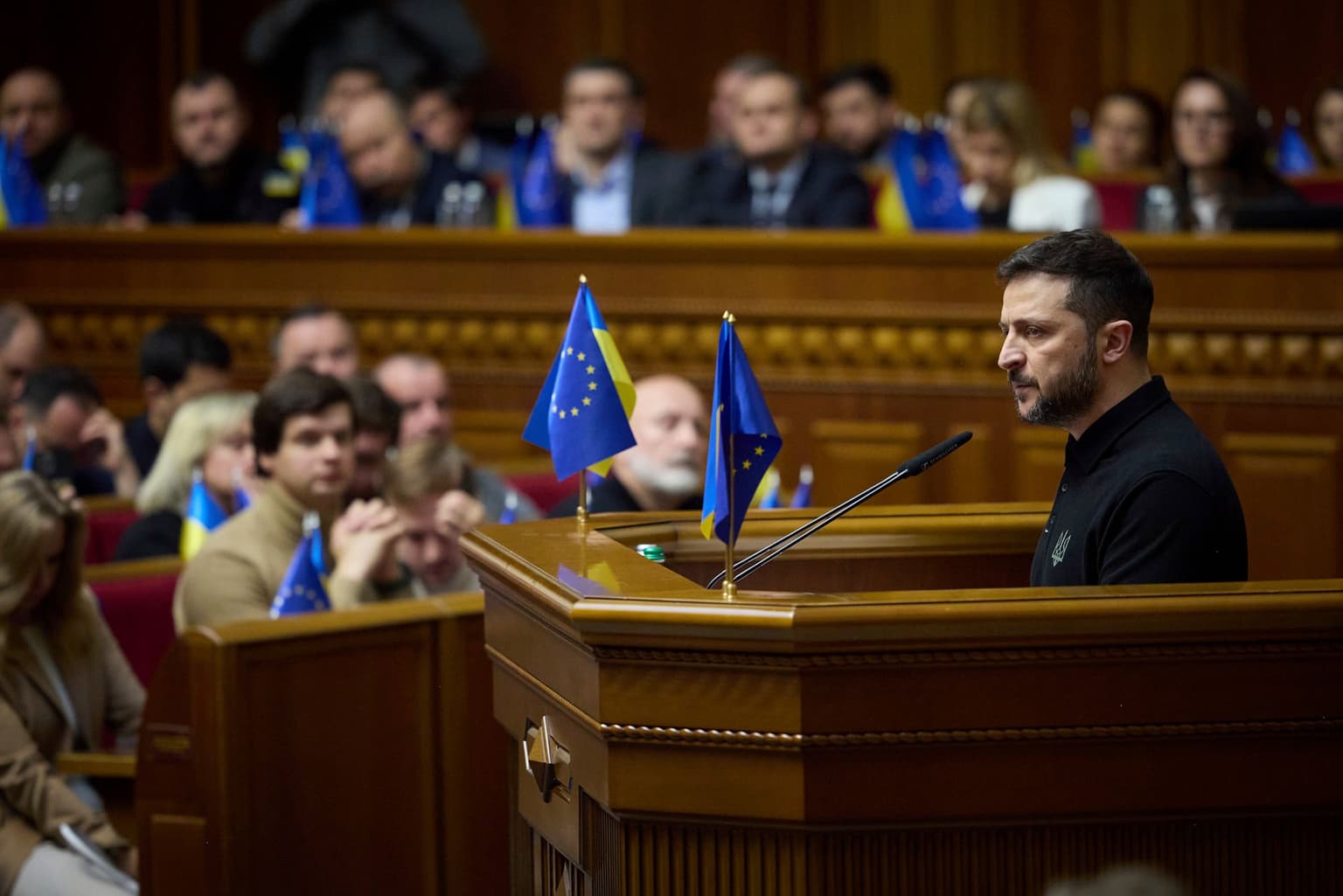
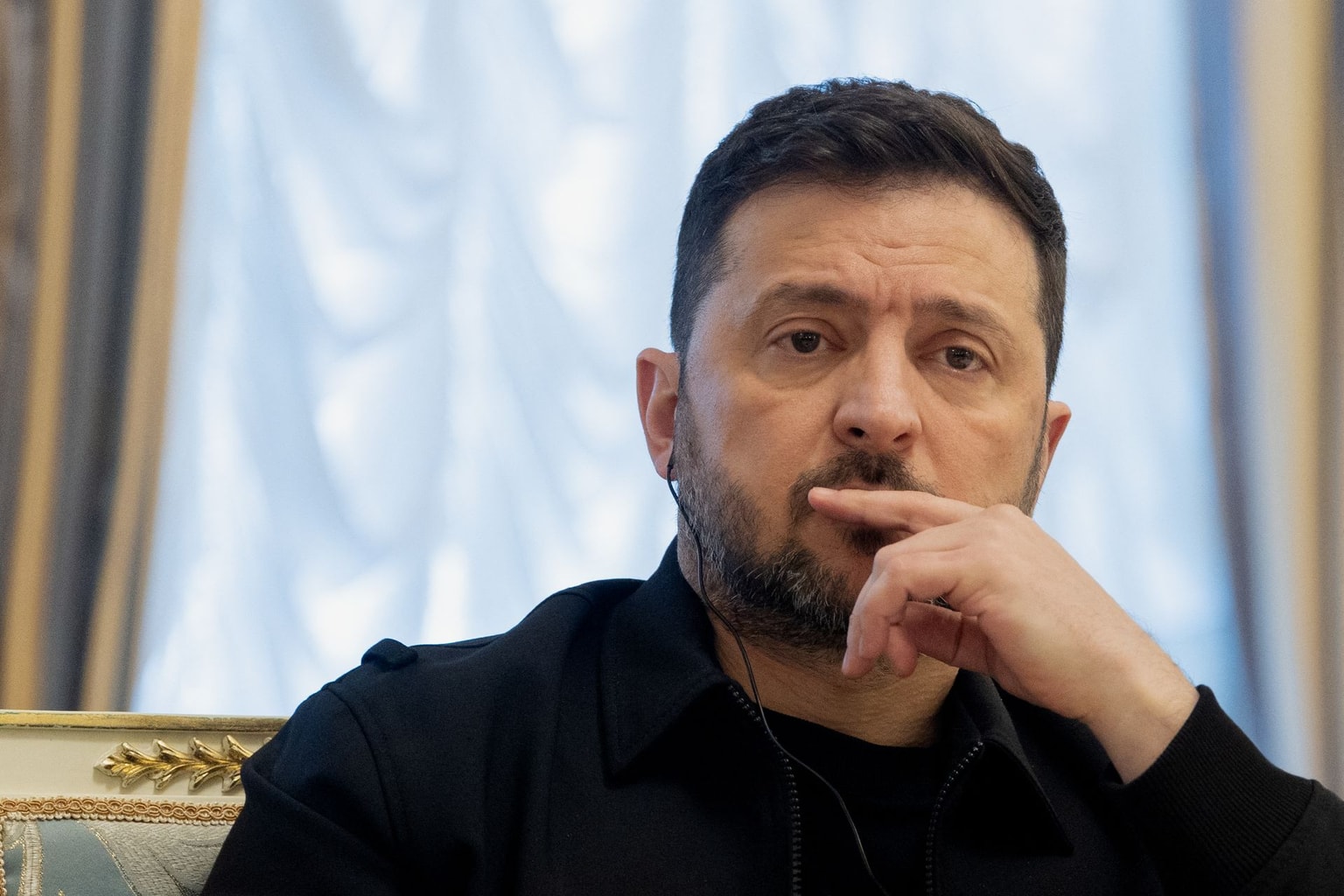
President Volodymyr Zelensky addresses parliamentarians at the Verkhovna Rada in Kyiv, Ukraine, on Oct. 16, 2024. (Press Service of the President of Ukraine / AP)
 on Google
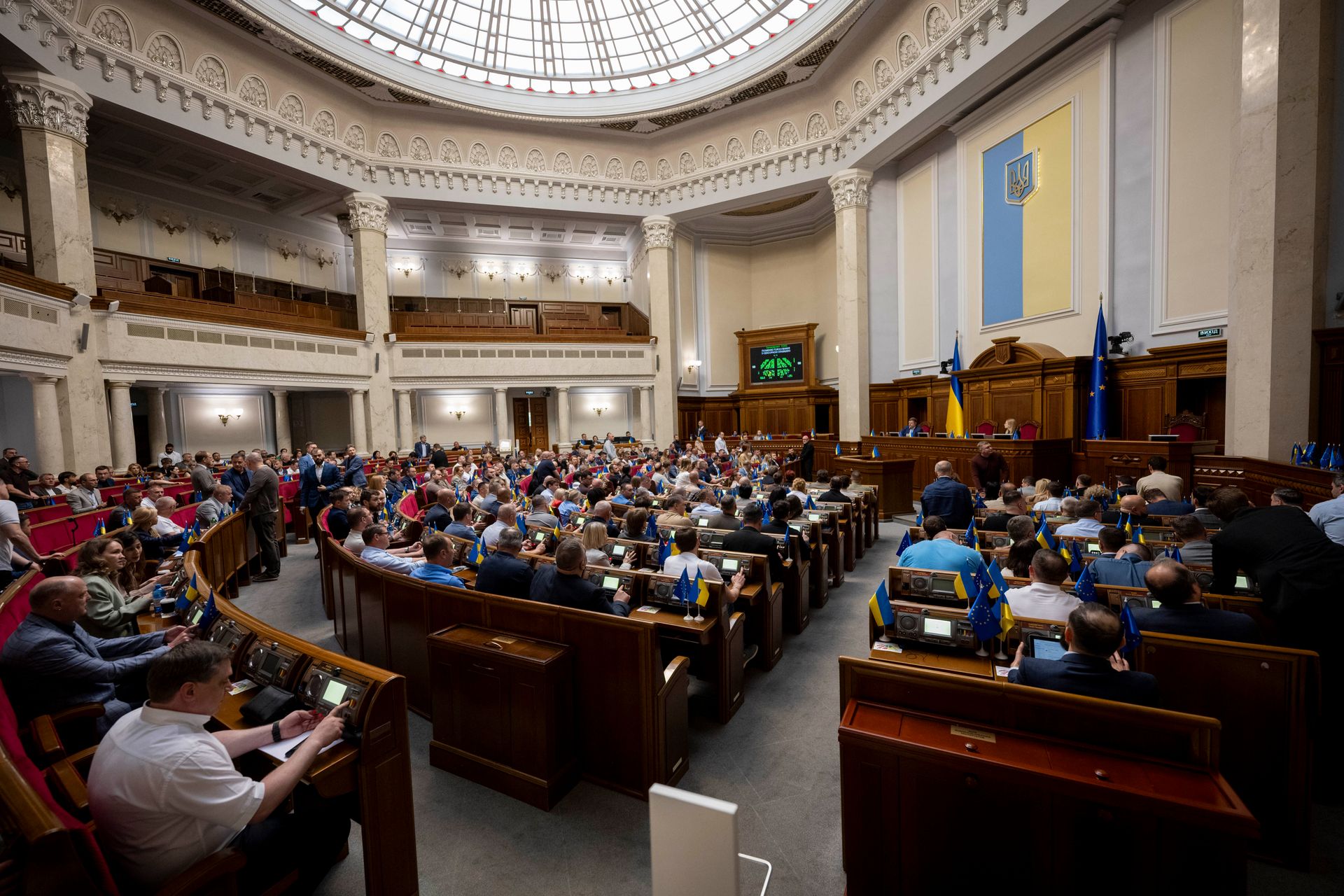
Ukraine's parliament is in gridlock as relations have broken down between the legislative and executive branches of government.
The parliamentary crisis, as some have rushed to describe it, has been ignited by the President's Office's weakening influence over the legislature and a lack of communication between parliament and the Cabinet of Prime Minister Yulia Svyrydenko, lawmakers and analysts have told the Kyiv Independent.
"(Svyrydenko) works only with the President's Office and does not work with parliament," political analyst Volodymyr Fesenko told the Kyiv Independent. "This is one of the main causes of the parliamentary crisis. There are also many complaints that the Cabinet of Ministers has lost contact and a normal, working, constructive line of communication with the Verkhovna Rada."
During a plenary session on March 25, the parliament successfully passed several pieces of legislation proposed by lawmakers — but failed to do the same for a single piece of legislation backed by President Volodymyr Zelensky's office and the Cabinet of Ministers, highlighting the growing wedge.
The crisis has crystallized in recent weeks as Kyiv approaches a series of deadlines to pass legislation required to unlock billions of dollars from international partners, including the IMF, the European Union, and the World Bank.
That funding is all the more precious, as Hungarian Prime Minister Viktor Orban blocks a critical 90 billion euro ($107 billion) loan from the European Union to Ukraine, without which Kyiv could run out of cash by mid-year.
Several factors are at play for the parliament's lack of votes — including a fragile parliamentary majority, disillusionment with Zelensky from both his own party and opposition members, corruption, and the war's wear and tear on the parliament's fundamentals.
A source in the President's Office told the Kyiv Independent that the office maintains proper communication with lawmakers and that, when needed, the lawmakers do show up.
The same source said that Orban's decision to block EU funding for Ukraine is political, and no legislation passed by parliament will fix the fact that Budapest is effectively blackmailing Kyiv as part of Hungary's ongoing election campaign.
"When they talk about problems with securing the votes, they primarily mean things that the IMF needs, but it is objectively difficult to explain that we actually need (to vote for) it," they added.

President's control weakens
Andriy Motovylovets, deputy head of Zelensky's Servant of the People's parliamentary faction, said in a March 13 interview with Forbes that the faction had "lost its core" — a majority of lawmakers who can be relied upon when the authorities want to pass a bill.
The ruling party formally has 228 seats, but Motovylovets said that the "core" had fallen to a mere 111 members. Fesenko told the Kyiv Independent that Motovylovets might have exaggerated the problem since 150 to 175 Servant of the People lawmakers still vote for the government's initiatives.
To pass, a draft law must obtain 226 votes in favor.
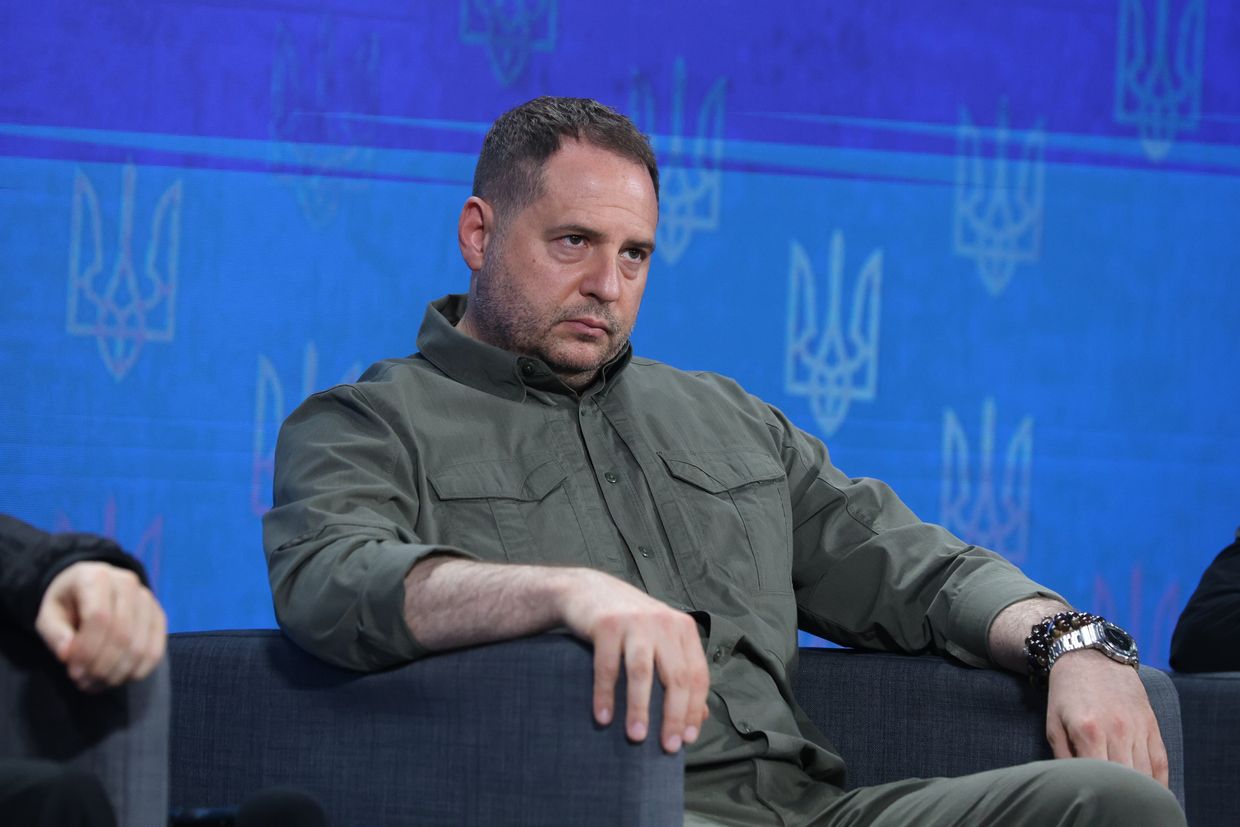
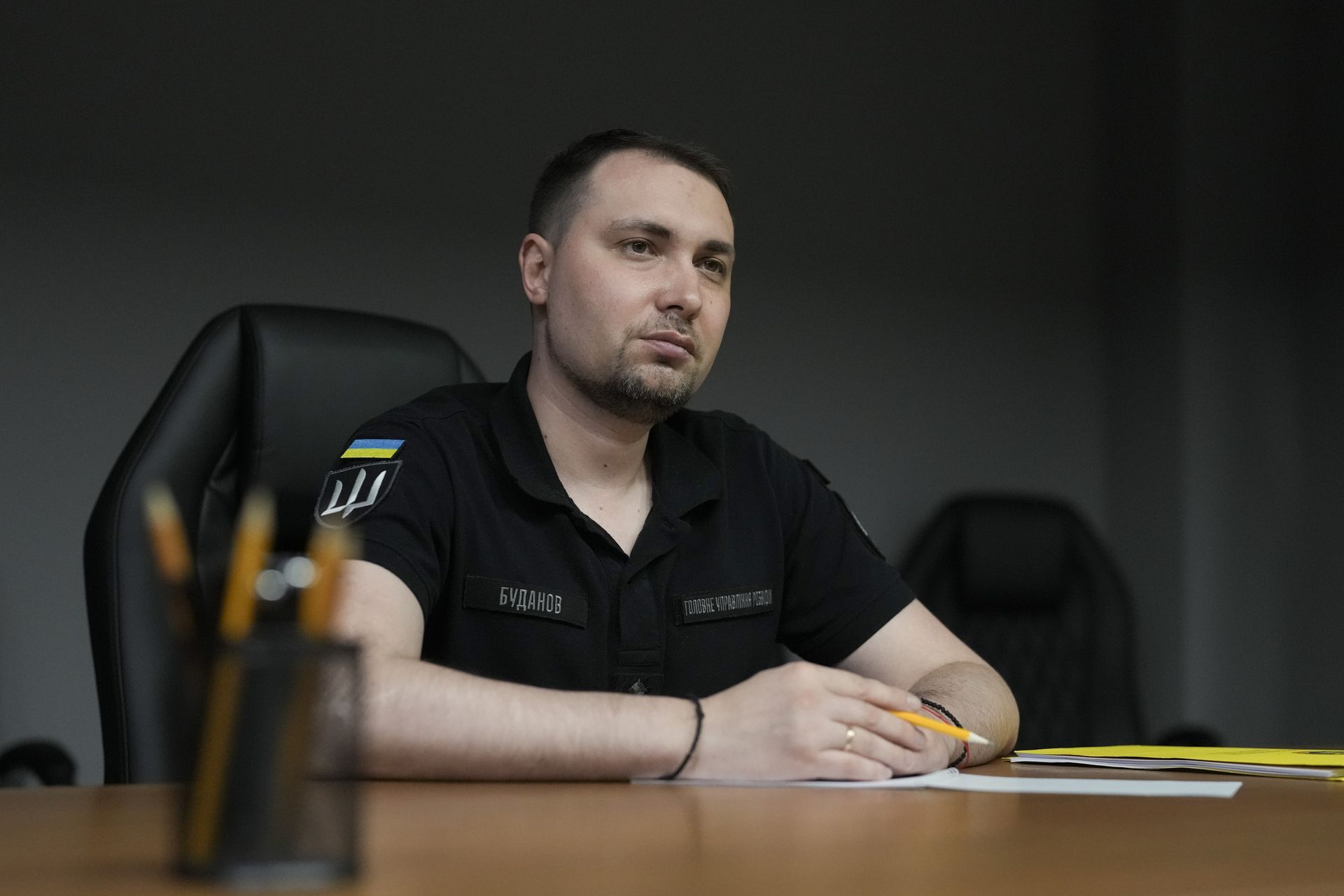
One reason for the failure to collect votes is the resignation of Zelensky's former Chief of Staff, Andriy Yermak, in November, followed by the appointment of Kyrylo Budanov to replace him in January.
"So the situation has changed, and discipline has indeed worsened," Oleksandr Merezhko, head of parliament's foreign affairs committee and a lawmaker from Zelensky's Servant of the People party, told the Kyiv Independent. "Back then, during Yermak's time, there was this sense of intimidation — people were told that the President's Office was closely watching how everyone voted."

He said that "Yermak was a kind of boogeyman, and that actually disciplined people."
The source in the President's Office told the Kyiv Independent that while Budanov does take part in some domestic affairs, it was Yermak who handled communication with lawmakers.
The source also mentioned David Arakhamia, head of the Servant of the People's faction, who has long been seen as a bridge between the President's Office and parliament.
Volodymyr Ariev, a lawmaker for the European Solidarity party, also said that "it has become harder for the President's Office to control parliament."
"Yermak handled all issues through pressure," he told the Kyiv Independent. "Absolutely everything was done through pressure, threats, and blackmail."
A lawmaker from Zelensky's party said that, unlike Yermak, Budanov is not communicating with parliament, and that is why "the balance itself has been disrupted."

"The influence of the President's Office has diminished — that kind of totalitarianism has decreased," the lawmaker said.
The lawmaker spoke on condition of anonymity due to the sensitive nature of the topic.
Both Budanov and Arakhamia are now focused on peace talks and cannot devote much time and resources to the Verkhovna Rada, several lawmakers said.
"The President's Office has now shifted more toward foreign policy — the negotiation process," Merezhko said. "(And Arakhamia is also) more focused on this negotiation track. Because of that, it has also become harder to gather votes."
Bad communications with Cabinet
But there is another problem as well: a lack of adequate communication between parliament and government.
Ukraine's executive branch has committed to a large array of legislation as part of EU accession and international funding arrangements, including a recently agreed $8.1 billion program under the International Monetary Fund.
The list of reforms is long and complex — and in some cases radical. They include new taxes intended to "de-shadow" Ukraine's economy, changes to the country's court system, and the privatization of large state-owned companies.
While necessary to more closely align with European and international standards, several reforms the government has agreed to pursue are unpopular with the broader public.
For example, Ukraine must adopt a series of new taxes on digital services, self-employed entrepreneurs, and small parcels from abroad to unlock the next tranche of the IMF program, scheduled for June this year. Those taxes look unlikely to pass before the deadline.
Some lawmakers say the government is trying to distance itself from the unpopular policies it agreed to pursue and frame parliamentarians as responsible.
"The government takes credit for popular measures, such as distributing social welfare, while parliament is left to bear responsibility for politically sensitive issues, including those on tax increases."
Others say that some pieces of legislation have been put forward just before deadlines, leaving little time for the second reading — yet still experiencing pressure from the government to pass the bill.
"These initiatives have created tension in relations with the government across the entire parliament," Mykyta Poturayev, a lawmaker from the Servant of the People party, told the Kyiv Independent. "The government is not communicating these initiatives the way it should. As a result, a situation has emerged in which neither our faction nor the parliament has ever given this government a mandate for such initiatives."

Merezhko argued that lawmakers "fundamentally do not want to vote for unpopular laws because they are guided by their voters and want to be re-elected in their districts."
"I can see that colleagues are frustrated that the government takes credit for popular measures, such as distributing social welfare, while parliament is left to bear responsibility for politically sensitive issues, including those on tax increases," Anastasia Radina, a lawmaker from Zelensky's party and head of the anti-corruption committee, told the Kyiv Independent. "Lawmakers expect the Cabinet of Ministers to engage in better communication."
The source in the President's Office said the IMF didn't weigh in, noting that the draft laws it requires of Ukraine are "bad for public sentiment and don't really provide that much money."
Meanwhile, the Ukrainian government is planning to hand out Hr 1,500 ($34) per person to pensioners and other groups eligible for social assistance, Zelensky said on March 12.
Ariev also argued that Zelensky is trying to make parliament vote for tax increases while he himself hands out cash subsidies.
"He is handing things out — he has funds for all kinds of cashback schemes, for giving money to retirees, to anyone possible, to the railways — he has money for everything," Ariev said. "And they look great together with Zelensky, who comes out with these initiatives, while in the Verkhovna Rada, it's lawmakers who end up taking the heat for voting on unpopular measures."
Ariev also said that negotiations with the IMF "should simply have been conducted better and more professionally."
Members of parliament across several parties are frustrated at a perceived lack of agency, lawmakers say, as the executive branch patronizes what is supposed to be the most important branch of government.
"The government's approach to parliament is one of 'stop asking questions and vote'," Volodymyr Tsabal, a lawmaker from the opposition Holos party, told the Kyiv Independent.
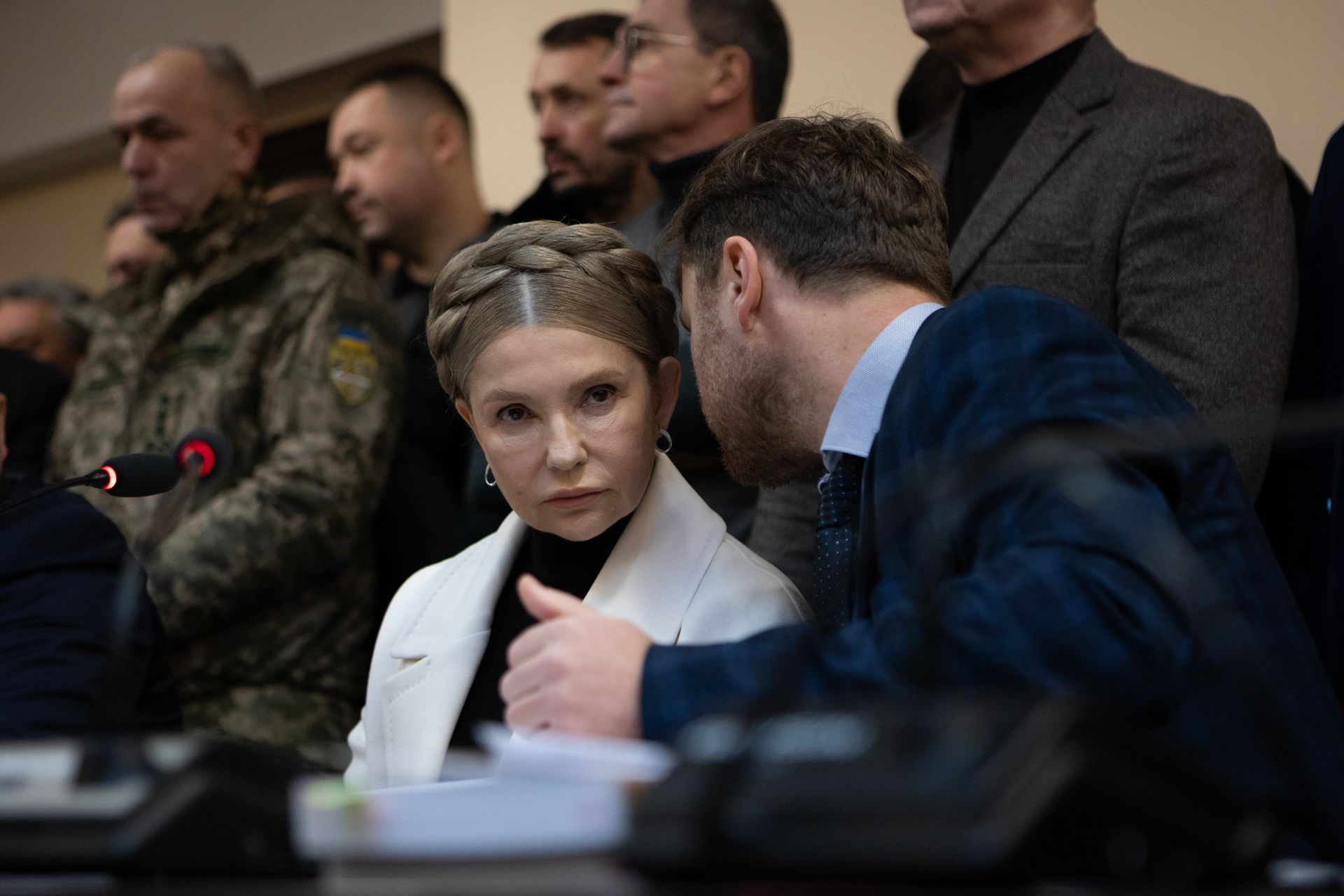
NABU controversy
As the Ukrainian parliament is becoming more dysfunctional, some lawmakers are also accusing anti-corruption agencies of destabilizing their work, several sources familiar with the matter told the Kyiv Independent.
The complaints follow charges brought by the National Anti-Corruption Bureau (NABU) against several Servant of the People lawmakers in December for allegedly taking cash in exchange for votes.
Chief Anti-Corruption Prosecutor Oleksandr Klymenko said in January that 41 members of the current parliament had been charged with various corruption-related offenses.
"Now they're saying 'if you're not going to step in and protect me,' then I won't vote."
Among those currently under investigation are lawmakers from the governing party who allegedly received "cash bonuses" for attendance and votes, and another group of lawmakers who, in turn, were allegedly receiving bribes for voting against government initiatives.
The latter ones were allegedly paid by Yulia Tymoshenko, former prime minister and head of the opposition Batkivshchyna party. Tymoshenko has been charged with illicit enrichment by the NABU as a result.

Now, some lawmakers claim they are hesitant to vote due to the fear of being charged. Earlier in March, members of parliament complained about the NABU's activities at a meeting of faction leaders, a source in parliament told the Kyiv Independent.
Lawmaker Motovylovets also said in a March 13 interview that members of the Servant of the People faction don't want to vote after the NABU charged some of them.
The source in the President's Office confirmed that such a problem exists.
Merezhko argued that some lawmakers might feel that the President's Office has failed to protect them from the anti-corruption agencies.
"If you play as part of the team, you have a higher chance that you'll be protected in some way," he said. "So now they're saying 'if you're not going to step in and protect me,' then I won't vote."
NABU Director Semen Kryvonos told the Kyiv Independent that his agency is "in favor of the parliament voting for European integration laws, for the development of anti-corruption infrastructure, as well as for what the International Monetary Fund requires."
"(But) you can't refuse to investigate someone if this person committed corruption. This should be completely out of the question," he added.
Experts argue that lawmakers' arguments make little sense.
"To me, this looks either absurd or like a confession," Daria Kaleniuk, executive director of the Anti-Corruption Action Center, told the Kyiv Independent. "If lawmakers are afraid of the NABU, it probably means they have committed some corruption-related offenses, and that is why they fear investigations into those offenses. If they haven't done anything, then they have nothing to fear."
Kaleniuk said that the anti-NABU rhetoric is "an attempt to find some kind of logical justification for not wanting to do their job as members of parliament."
Fesenko also believes that "it is a kind of political scare tactic designed to discredit the NABU, to explain the nature of the problems in parliament — but the explanation is wrong, and the diagnosis is completely fake."
The President's Office, meanwhile, doesn't see a problem with the current state of affairs.
"It's an exaggeration that parliament is falling apart," they added.